
How to Calculate College ROI :
Choosing a college after Class 12 is one of the biggest financial and career decisions a student makes. Students often compare colleges based on college fees, campus facilities, rankings, highest packages or brand name. But there is one factor that can give you a much clearer picture of whether a college is actually worth the investment:
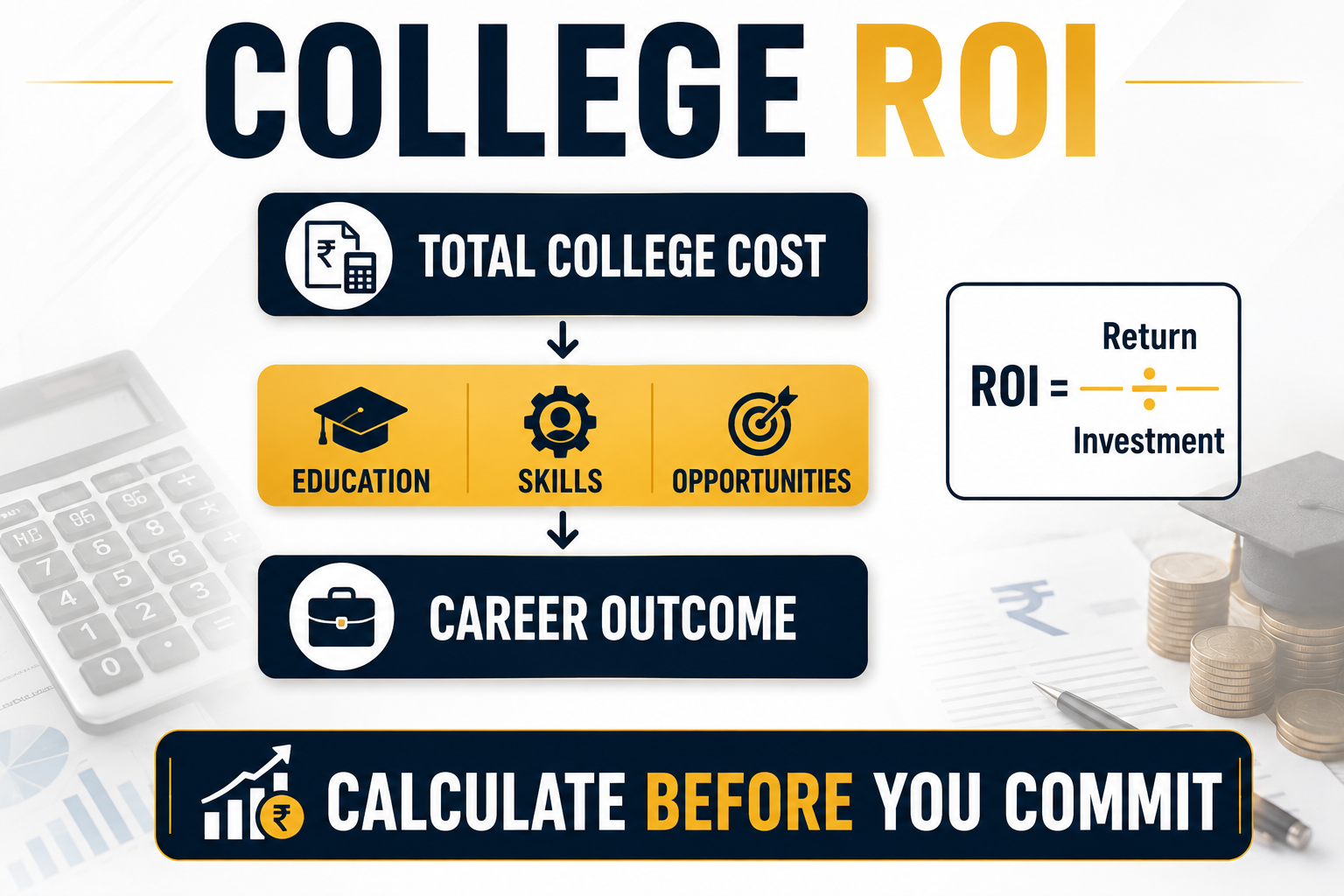
College ROI — Return on Investment
Suppose one college costs ₹4 lakh for the entire degree, while another costs ₹12 lakh. The second college may have better infrastructure, but does that automatically make it a better investment?
Not necessarily.
Similarly, a college advertising a ₹50 LPA highest package may look impressive. But if only one student received that package and most graduates earn significantly less, the headline doesn’t tell you much about the actual value of the degree.
This is why students should learn how to calculate college ROI before taking admission.
College ROI is not simply about comparing fees with salary. You also need to consider the average package, median salary, placement rate, course quality, internships, career opportunities, location, additional costs and long-term career growth.
In this guide, we’ll understand exactly how to calculate college ROI, what numbers you should check before admission, and how to compare two colleges objectively.
What Is College ROI?
ROI stands for Return on Investment.
In simple terms, it answers one important question:
“What am I getting in return for the money I am investing in my education?”
When you pay college fees, hostel expenses and other costs, you are making an investment in your education.
In return, you expect to gain:
- Knowledge
- Skills
- Internships
- Industry exposure
- A degree
- Career opportunities
- Placement opportunities
- Professional network
- Long-term earning potential
Therefore, college ROI should be viewed from both financial and career perspectives.
A simple financial formula is:
ROI = (Financial Return − Total Investment) ÷ Total Investment × 100
However, for college decisions, this formula needs to be interpreted carefully because your salary is not your immediate profit.
Your first job salary is only the beginning of your career.
Why College ROI Matters Before Admission
Imagine you have two options.
College A
Total four-year cost: ₹5 lakh
Average placement package: ₹7 lakh
College B
Total four-year cost: ₹14 lakh
Average placement package: ₹8 lakh
At first glance, College B may not seem attractive financially.
You are spending ₹9 lakh more but the reported average package is only ₹1 lakh higher.
This doesn’t automatically mean College A is better.
You still need to check:
- Placement percentage
- Median salary
- Course quality
- Recruiters
- Internship opportunities
- Career growth
- Scholarship
- Location
- Student outcomes
But the example shows why simply asking “Which college has the highest package?” is not enough.
You need to ask:
“What am I paying, and what realistic outcomes am I getting?”
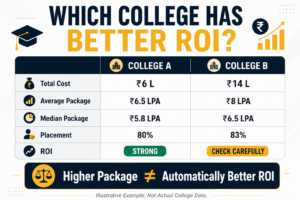
College ROI Is More Than Salary
One of the biggest misconceptions among students is that college ROI means:
Fees ÷ Package
That’s too simplistic.
A good college ROI calculation should consider at least seven major factors:
- Total education cost
- Placement outcomes
- Average and median salary
- Placement percentage
- Internship opportunities
- Career growth
- Non-financial benefits
Let’s understand each one.
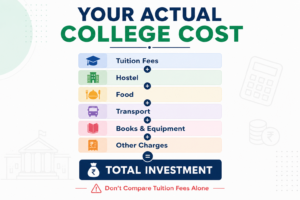
Step 1: Calculate the Total Cost of College
Before calculating ROI, you need to know your actual investment.
Don’t look only at tuition fees.
Your total college cost may include:
Tuition Fees
The basic academic fee charged by the institution.
Hostel Fees
If you’re staying on campus or in college accommodation.
Mess and Food
Food expenses over several years can become significant.
Transportation
This may include local travel, college transport or commuting costs.
Books and Study Material
Depending on the course, you may need textbooks, software, equipment or other resources.
Laptop and Technology
For programmes such as BTech, BCA, Data Science or Design, a laptop may be an essential expense.
Examination and Other Charges
There may be registration, examination, laboratory or activity charges.
Personal Expenses
These can include travel, communication, clothing and other living expenses.
So your basic calculation should be:
Tuition
- Hostel
- Food
- Transportation
- Books & Equipment
- Laptop / Technology
- Other Academic Charges
=
Total Education Cost
This is the number you should use while comparing colleges.
Step 2: Don’t Forget the Opportunity Cost
There is another concept that many students ignore:
Opportunity Cost
Suppose you spend four years completing a degree.
During those four years, you could have been gaining work experience, building skills or pursuing another career path.
The value of the alternative you give up is part of your opportunity cost.
You don’t necessarily need to put an exact rupee value on it, but you should understand that your college decision involves more than tuition fees.
For example, an expensive programme with limited career opportunities may have a higher opportunity cost than a reasonably priced programme that provides strong internships and employment opportunities.
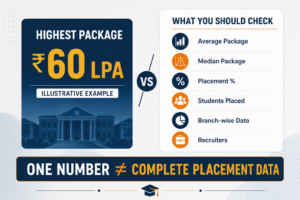
Step 3: Look at Average Package, Not Just Highest Package
This is one of the most important rules of college placement analysis.
Suppose College A advertises:
Highest Package: ₹60 LPA
Sounds impressive.
But suppose:
- Highest package = ₹60 LPA
- Average package = ₹6.5 LPA
- Median package = ₹5.5 LPA
Now compare another college:
College B
- Highest package = ₹25 LPA
- Average package = ₹8 LPA
- Median package = ₹7 LPA
Which college looks better for the average student?
The answer isn’t automatically College B, but the data tells you something important.
College A has a flashy headline, while College B may have more consistent outcomes.
This is why students should learn highest package vs average package before making a college decision.
ALSO READ : Courses After 12th: Best Career Options for Science, Commerce & Arts Students (2026 Complete Guide)
Step 4: Check the Median Salary
The median salary can sometimes be more informative than the average salary.
Why?
Because averages can be influenced by extremely high salaries.
Imagine five students earn:
₹4 lakh
₹5 lakh
₹6 lakh
₹7 lakh
₹40 lakh
The average becomes much higher because of the ₹40 lakh package.
The median is the middle value.
So when researching college placement data, check:
Average Salary
and
Median Salary
together.
If the average is significantly higher than the median, investigate why.
This doesn’t necessarily indicate a problem, but it tells you to look deeper.
Step 5: Check the Placement Percentage
Salary isn’t the only important number.
You also need to know:
How many students actually got placed?
For example:
College A
Students eligible for placement: 1,000
Students placed: 850
Placement rate: 85%
College B
Students eligible: 1,000
Students placed: 450
Placement rate: 45%
Even if College B has a higher highest package, College A may provide more consistent placement opportunities.
This is why placement percentage should be part of your ROI calculation.
Also check whether the published percentage refers to:
- Entire graduating batch
- Students who registered for placements
- Students eligible for placements
- A specific department
- A specific programme
The definition matters.
Step 6: Analyse Branch-Wise Placement Data
This is particularly important for engineering students.
A college may advertise strong overall placement statistics.
But the outcomes can vary significantly between:
- Computer Science
- Information Technology
- Electronics
- Mechanical
- Civil
- Electrical
- Other branches
Therefore, if you’re taking BTech admission, don’t rely only on overall placement data.
Look for:
Branch-Wise Placement Data
This gives you a more realistic picture of what students in your chosen programme may experience.
The same principle applies to BBA, BCA, Commerce, Law, Design and other programmes.
Step 7: Calculate Your Break-Even Period
One of the easiest ways to understand college ROI is to calculate your approximate break-even period.
Suppose:
Total College Investment
₹10 lakh
Expected First-Year Salary
₹6 lakh
A very basic calculation would suggest that the initial investment is approximately equal to around 20 months of gross salary.
But don’t interpret this as:
“I’ll recover my college fees in 20 months.”
Your salary isn’t entirely disposable income.
You will have:
- Taxes
- Rent
- Food
- Travel
- Personal expenses
- Loan repayments
- Other responsibilities
So this is only a rough financial indicator.
A better approach is to calculate how much of your annual income you could realistically save or use toward recovering your education investment.
Step 8: Consider Education Loans
If you’re financing college through an education loan, ROI becomes even more important.
Suppose your total education cost is ₹15 lakh and you’re borrowing a significant portion.
Your post-graduation income needs to be sufficient to manage:
- Loan principal
- Interest
- Monthly EMI
- Living expenses
This doesn’t mean you should avoid an expensive college.
It means you should understand the financial commitment before admission.
Ask:
What will my expected EMI be?
How much will I earn initially?
How much can I realistically save each month?
How long might repayment take?
A college that looks attractive academically may become financially difficult if the total cost is too high relative to realistic career outcomes.
Step 9: Include Scholarships in Your ROI Calculation
Never calculate ROI using the published fee alone if you qualify for a scholarship.
Suppose:
Original Course Fee
₹12 lakh
Scholarship
₹3 lakh
Effective Cost
₹9 lakh
Your ROI calculation should use the effective cost you actually expect to pay.
Check:
- Scholarship eligibility
- Scholarship amount
- Renewal conditions
- Academic requirements
- Whether the scholarship continues every year
This can significantly change the financial comparison between colleges.
Step 10: Compare Two Colleges Using a Scorecard
If you’re confused between two colleges, create a simple college comparison scorecard.
For example:
| Factor | College A | College B |
|---|---|---|
| Total Cost | ₹7 Lakh | ₹11 Lakh |
| Average Package | ₹7 LPA | ₹8 LPA |
| Median Package | ₹6 LPA | ₹6.8 LPA |
| Placement Rate | 82% | 85% |
| Internships | Strong | Strong |
| Industry Exposure | Good | Excellent |
| Scholarship | Available | Limited |
| ROI | Strong | Moderate |
| Location | Good | Excellent |
Now the decision becomes more objective.
You can also give each factor a score from 1 to 5.
For example:
Fees / ROI — 30%
Placements — 25%
Academic Quality — 15%
Internships — 10%
Industry Exposure — 10%
Infrastructure — 5%
Location — 5%
This weighted approach is much better than choosing based on emotions or advertisements.
Step 11: Don’t Ignore Course Quality
A college may have good overall placement statistics but a weak programme in the course you’re interested in.
That’s why you should calculate course-specific ROI wherever possible.
For example, if you’re considering BCA, research:
- BCA-specific placements
- BCA curriculum
- Programming opportunities
- Internships
- Technical clubs
- Industry exposure
If you’re considering BBA, examine:
- Management placements
- Internships
- Business projects
- Corporate exposure
- Higher-study opportunities
The ROI of a college isn’t necessarily the same across every programme.
Step 12: Consider Internships as Part of ROI
Internships may not immediately appear in a salary calculation, but they can have significant career value.
A strong internship can help you:
- Build practical skills
- Understand workplace expectations
- Build a professional network
- Strengthen your resume
- Explore career options
- Improve your chances of getting a job
Therefore, when comparing private vs government college or two private universities, look beyond placement packages.
Ask:
How many meaningful internship opportunities will students actually get?
Step 13: Evaluate Industry Exposure
A degree gives you academic knowledge.
Industry exposure helps you understand how that knowledge is applied.
Look for:
- Industry projects
- Guest lectures
- Workshops
- Live assignments
- Hackathons
- Corporate partnerships
- Industrial visits
- Incubation centres
- Entrepreneurship programmes
These opportunities can improve the value you get from your college investment.
Step 14: Consider Location
Location can influence ROI more than students realise.
Suppose two colleges have similar academic outcomes.
One is located near a major corporate hub.
The other is in a location with fewer companies and internship opportunities.
The first may provide more opportunities for:
- Internships
- Networking
- Industry events
- Part-time experiences
- Corporate exposure
However, a metropolitan location can also mean higher living costs.
So location has both benefits and costs.
Step 15: Consider Alumni Network
A strong college alumni network can create long-term value.
Alumni may help students with:
- Mentorship
- Internships
- Industry connections
- Career advice
- Job referrals
- Higher education guidance
This value may not appear in a placement report, but it can still influence career growth.
When comparing colleges, check where alumni are working and what industries they have entered.
A Practical College ROI Formula
For a basic comparison, you can use:
ROI Score = Career Outcome ÷ Total Education Cost
But because career outcomes aren’t represented by one number, a more practical student framework is:
College ROI =
Placement Outcomes
Career Opportunities
Skills & Industry Exposure
Long-Term Growth Potential
÷
Total Cost of Education
This isn’t a formal accounting formula.
It’s a decision-making framework.
The purpose is to stop students from evaluating colleges only through the lens of fees or highest salary.
Example: How to Compare Two Colleges
Let’s take a hypothetical example.
College A
Total cost: ₹6 lakh
Average package: ₹6.5 LPA
Median package: ₹5.8 LPA
Placement rate: 80%
Strong internships
College B
Total cost: ₹14 lakh
Average package: ₹8 LPA
Median package: ₹6.5 LPA
Placement rate: 83%
Excellent infrastructure
The question isn’t:
“Which college has the higher package?”
College B does.
The better question is:
“Is the additional ₹8 lakh investment justified by the additional opportunities and career outcomes?”
If College B provides significantly better opportunities, industry exposure and long-term career prospects, the additional investment may make sense for some students.
But if the outcomes are only marginally better, College A may provide stronger financial ROI.
This is exactly why college ROI calculation is useful.
What Numbers Should You Ask a College For?
Before taking admission, try to collect the following information:
Academic Information
- Course curriculum
- Faculty profile
- Accreditation
- Specialisations
Financial Information
- Total tuition fee
- Hostel fee
- Other charges
- Scholarship
- Refund policy
Placement Information
- Highest package
- Average package
- Median package
- Placement percentage
- Number of students placed
- Number of recruiters
- Branch-wise placement data
Career Information
- Internship opportunities
- Industry partnerships
- Career services
- Alumni network
The more complete your information, the more reliable your ROI calculation will be.
Red Flags While Calculating College ROI
Be careful if you see:
Only Highest Package Being Advertised
Without average or median salary.
No Placement Report
A serious college comparison requires actual outcomes.
Vague Placement Percentage
If you can’t understand how the percentage was calculated, investigate further.
Extremely High Package With No Context
Ask how many students received it and in which programme.
Very High Fees With Weak Outcomes
This can indicate poor financial ROI.
Placement Data Combining Multiple Programmes
Overall numbers may not represent your course.
Pressure to Pay Immediately
Don’t let an admission deadline prevent proper research.
Does a Higher Fee Mean Better ROI?
Absolutely not.
A higher fee can sometimes provide access to:
- Better infrastructure
- Better faculty
- Industry exposure
- Better internships
- Stronger placements
But higher fees alone do not guarantee better outcomes.
Likewise, a low-fee college can offer excellent ROI if it provides strong education and career opportunities.
That’s why:
Cheap does not automatically mean high ROI, and expensive does not automatically mean low ROI.
The outcome matters.
Government vs Private College: ROI Perspective
When comparing government vs private college, ROI can be particularly useful.
Government institutions often have lower fees, which can result in excellent financial ROI, especially when combined with strong placements.
Private colleges can have higher fees but may provide:
- Modern infrastructure
- Industry-oriented programmes
- More specialisations
- Internship opportunities
- Flexible admission routes
- Extensive campus facilities
The right comparison is not:
Government = Good
Private = Expensive
Instead compare:
Total Investment → Education Quality → Opportunities → Placement Outcomes → Long-Term Career Growth
College ROI Isn’t the Same as Your Personal ROI
This is an important point.
A college can have excellent placement statistics, but your personal outcome will depend on what you do during those four years.
Two students from the same college can graduate with completely different outcomes.
Why?
Because of differences in:
- Skills
- Internships
- Projects
- Communication
- Networking
- Certifications
- Academic performance
- Interview preparation
- Consistency
Therefore, college provides the platform.
You still have to use it.
How to Improve Your Personal ROI From College
Once you take admission, focus on increasing the value you get from your degree.
Build Practical Skills
Don’t depend only on classroom learning.
Complete Internships
Try to gain relevant work experience before graduation.
Build Projects
Projects demonstrate that you can apply what you’ve learned.
Develop Communication Skills
Good communication can influence interviews and workplace growth.
Build Your Network
Connect with professors, alumni and professionals.
Participate in Competitions
Hackathons, case competitions and technical events can strengthen your profile.
Use College Resources
Libraries, labs, clubs, career centres and mentorship programmes are part of what you’re paying for.
This is how you convert college investment into career value.
College ROI Checklist Before Admission
Before paying your admission fee, check:
Financial
☐ Total tuition fees
☐ Hostel expenses
☐ Food expenses
☐ Transportation
☐ Other charges
☐ Scholarship
☐ Loan requirement
Placement
☐ Average package
☐ Median package
☐ Highest package
☐ Placement percentage
☐ Number of students placed
☐ Branch-wise placement
☐ Recruiter information
Career
☐ Internship opportunities
☐ Industry exposure
☐ Projects
☐ Alumni network
☐ Career support
Academic
☐ Faculty
☐ Curriculum
☐ Labs
☐ Accreditation
☐ Course-specific reputation
Final Decision
☐ Total ROI analysed
☐ At least 2–3 colleges compared
☐ Official information verified
☐ Family budget considered
Frequently Asked Questions About College ROI
What does college ROI mean?
College ROI means evaluating the value you receive from your college investment compared with the total money you spend on your education and the career opportunities you receive.
How to Calculate College ROI ?
Start by calculating the total cost of your degree, including tuition, hostel, food and other expenses. Then compare that investment with realistic placement outcomes, average salary, median salary and long-term career opportunities.
Should I use the highest package to calculate ROI?
No. The highest package may represent only one or a few students. Use average package, median package and placement percentage for a more realistic comparison.
Is a private college worth the higher fees?
It depends on the specific college. Compare its total fees against placement outcomes, internships, infrastructure, industry exposure and career opportunities.
Is a government college always better for ROI?
Not automatically. Many government colleges provide excellent ROI because of lower fees, but the quality and outcomes of individual institutions vary.
Should I check branch-wise placement data?
Yes. Especially for engineering, placement outcomes can differ significantly between branches.
Does ROI matter for every course?
Yes. Whether you’re pursuing BTech, BCA, BBA, BCom, Law, Design or another programme, understanding the relationship between education cost and career outcomes can help you make a better decision.
Final Verdict: Calculate Before You Commit
Choosing a college is not simply about finding the lowest fee or the highest package.
It’s about finding the right balance between:
Education Quality
Total Cost
Career Opportunities
Placement Outcomes
Skills
Long-Term Growth
That is what makes college ROI important.
Before taking admission, don’t ask only:
“Which college has the highest package?”
Ask:
“How much will this degree actually cost me, what realistic opportunities will I get, and is the investment justified by the outcomes?”
Calculate the total cost.
Check the average and median salary.
Analyse placement percentage.
Look at branch-wise data.
Research internships.
Compare industry exposure.
Consider scholarships.
Think about education loans.
And most importantly, compare the specific college and course, not just the label of government or private.
Your college is a significant financial and career investment.
So don’t make the decision because a campus looks impressive, an advertisement promises a huge package, or everyone around you is choosing the same institution.
Calculate the cost. Check the outcomes. Compare the options. Then decide.
Because the best college isn’t necessarily the one with the biggest package or the lowest fees.
It’s the one that gives you the strongest combination of education, opportunities, career growth and value for the investment you make.