
Private vs Government College :-
Choosing a college after Class 12 can feel like a simple question:
“Government college better hai ya private college?”
Lekin reality mein iska answer itna simple nahi hai.
Government colleges are often associated with lower fees, strong reputation and competitive admissions, while private colleges are often known for modern infrastructure, multiple courses, flexible admission routes and industry-focused programmes.
But does that mean government college is always better?
Not necessarily.
And does choosing a private college mean you are compromising your career?
Absolutely not.
The right choice depends on several factors, including your course, budget, academic goals, entrance exam performance, placement expectations, location and the kind of learning environment you want.
For a Class 12 student, choosing between a private and government college is a major decision because you are not simply selecting a campus.
You are investing several years of your time and money.
So, instead of asking:
“Private vs Government College — which is better?”
A better question is:
“Which college gives me the best combination of education, opportunities, affordability and career outcomes?”
In this guide, we will compare private colleges vs government colleges on fees, admission, placements, infrastructure, faculty, courses, campus life, ROI, scholarships and career opportunities.
Private vs Government College: What Is the Difference?
Before comparing them, let’s understand what these two categories generally mean.
Government Colleges
Government colleges are institutions established, funded or significantly supported by government authorities.
Depending on the institution, they may be affiliated with:
- Central government
- State government
- Government universities
- Public institutions
- Autonomous public bodies
Many government institutions have relatively affordable tuition fees because a portion of their operational costs may be supported through public funding.
Some government institutions are also highly competitive and have strong academic reputations.
Examples of well-known public institutions include IITs, NITs, IIITs and various state government colleges.
However, not every government college has the same reputation or placement outcomes.
What Are Private Colleges?
Private colleges are established and managed by private organisations, trusts, societies or universities.
They can offer a wide variety of programmes, including:
- BTech
- BBA
- BCA
- MBA
- BCom
- Law
- Design
- Pharmacy
- Biotechnology
- Agriculture
- Hotel Management
Private institutions can vary significantly in quality.
Some have excellent infrastructure, strong industry connections and impressive placement records.
Others may not offer the same level of academic or career opportunities.
Therefore, simply seeing the word “private” is not enough to judge a college.
Private vs Government College: Quick Comparison
| Factor | Government College | Private College |
| Fees | Generally lower | Generally higher |
| Admission | Often highly competitive | Can be more flexible |
| Infrastructure | Varies by institution | Often modern, but varies |
| Courses | Depends on institution | Often wider variety |
| Placements | Strong at top institutions | Strong at some institutions |
| Scholarships | Often available | Available at many institutions |
| Competition | Usually high in top colleges | Varies |
| Industry Exposure | Depends on institution | Often emphasised |
| Campus Facilities | Varies | Often modern |
| ROI | Often high due to lower fees | Depends heavily on fees and outcomes |
| Admission Flexibility | Usually limited | Can be comparatively flexible |
This table gives you the broad picture.
But the real decision requires a deeper comparison.
1. Government vs Private College Fees
For many families, this is the first factor they consider.
And understandably so.
Government college fees are often significantly lower than those at private institutions, although the exact amount depends on the college and course.
A student at a public institution may pay comparatively affordable tuition while receiving access to academic facilities, hostels and other services.
Private colleges, on the other hand, can have higher tuition fees.
The total cost may include:
- Tuition fees
- Hostel
- Mess
- Examination fees
- Registration charges
- Lab fees
- Transportation
- Other institutional charges
This is why you should never compare colleges only on annual tuition.
Calculate the total cost of education.
Example
Suppose College A charges ₹1 lakh per year.
College B charges ₹2.5 lakh per year.
At first glance, College A appears to be the obvious choice.
But what if:
- College A has limited placement opportunities
- College B provides stronger internships
- College B has better industry exposure
- College B offers scholarships
- College B has significantly better career outcomes
The decision becomes more complicated.
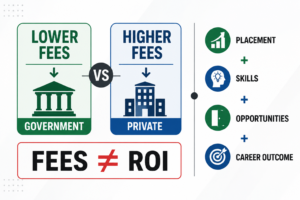
This is why college ROI matters.
2. Admission Process
Admission is another major difference.
Top government colleges often have highly competitive admission processes.
For engineering, for example, students may need to appear for entrance examinations such as:
- JEE Main
- JEE Advanced
- State-level entrance examinations
- Other recognised examinations
Admission can depend on:
- Entrance exam score
- Rank
- Counselling
- Category
- Availability of seats
- Course preference
Private colleges can have more varied admission processes.
Some may accept:
- JEE Main scores
- State entrance exam scores
- University entrance tests
- Class 12 marks
- Merit-based applications
- Other recognised admission routes
Some institutions may also offer eligible direct admission routes.
However, students should never assume that every private college has easy admission.
Many private universities have competitive entrance examinations and selection processes.
3. Academic Reputation
Government colleges have historically had a strong reputation in Indian higher education.
Institutions such as IITs, NITs and leading public universities have built strong academic and research ecosystems over many years.
But this doesn’t mean every government college is automatically better than every private college.
Private universities have also built strong reputations in specific fields.
The right way to compare academic quality is to look at:
- Faculty qualifications
- Curriculum
- Research opportunities
- Accreditation
- Industry partnerships
- Laboratories
- Academic performance
- Student outcomes
Don’t choose based on the ownership category alone.
4. Faculty and Teaching Quality
Faculty quality can significantly influence your college experience.
A good professor should ideally help students understand concepts, encourage practical learning and provide academic guidance.
Government institutions may have experienced faculty and strong academic environments.
Private universities may sometimes have faculty recruited specifically for industry-oriented teaching and specialised programmes.
But there is huge variation in both categories.
Instead of asking:
“Are government college professors better?”
or
“Are private college professors better?”
ask:
“What is the faculty profile of this particular college and course?”
Check:
- Faculty qualifications
- Industry experience
- Research work
- Faculty-to-student ratio where available
- Student reviews
- Department-specific faculty
This gives you a much better picture.
5. Infrastructure and Campus Facilities
This is an area where many private institutions compete aggressively.
Modern private campuses may offer:
- Smart classrooms
- Modern laboratories
- Libraries
- Sports facilities
- Hostels
- Cafeterias
- Innovation centres
- Incubation centres
- Computer labs
- Industry-oriented facilities
However, don’t assume that every private college has excellent infrastructure.
Similarly, government colleges can have excellent facilities, especially established institutions, while others may have more limited resources.
The question should always be:
“What facilities will I actually use during my course?”
A beautiful campus doesn’t automatically produce a better career.
Also Read : Courses After 12th: Best Career Options for Science, Commerce & Arts Students (2026 Complete Guide)
6. Placement Opportunities
This is probably the most important factor for students.
And this is where you need to be extremely careful.
Colleges often advertise:
Highest Package — ₹40 LPA
or
Highest Package — ₹60 LPA
But the highest package is only one data point.
Before choosing a college, check:
- Average package
- Median package
- Placement percentage
- Number of students placed
- Total graduating students
- Branch-wise placement
- Recruiters
- Internship opportunities
- Previous years’ placement reports
For example, if a college reports a ₹50 lakh highest package, don’t immediately assume most students are earning ₹50 lakh.
That number may represent one or a small number of exceptional offers.
This is why college placement data should always be analysed beyond the headline.

7. Private vs Government College: Who Has Better Placements?
There is no universal winner.
Top government institutions generally have strong placement ecosystems because of:
- Strong alumni networks
- Brand recognition
- Competitive student intake
- Established recruiter relationships
- Academic reputation
But some private universities also have strong recruiter networks and impressive placement outcomes.
The important distinction is:
Top Government College
Can offer excellent placement opportunities.
Average Government College
May not have the same placement ecosystem.
Top Private University
Can offer strong placements and industry exposure.
Average Private College
May have more limited opportunities.
Therefore:
Compare college with college—not government with private.
This is one of the most important principles in college selection.
8. Return on Investment
Let’s talk about college ROI.
ROI means the value you receive compared with the money you invest.
A simple way to think about it is:
Education Cost → Skills → Opportunities → Career Outcomes
Suppose:
College A
Total cost: ₹4 lakh
Average career outcome: Strong
College B
Total cost: ₹12 lakh
Average career outcome: Similar
College A may provide better financial ROI.
But if College B costs more and offers significantly better opportunities, the calculation changes.
That’s why students should compare:
Total fees + living costs + realistic placement outcomes
rather than just tuition.
9. Scholarships and Financial Aid
Government colleges often have various scholarship and fee-support schemes depending on eligibility.
Private colleges also provide scholarships.
These can be based on:
- Entrance exam performance
- Class 12 marks
- Sports
- Academic achievements
- Financial need
- Special categories
- University-specific criteria
A private college that initially looks expensive may become more affordable after a substantial scholarship.
Therefore, always ask:
“What scholarships am I eligible for?”
before rejecting a college because of its advertised fee.
10. Course and Specialisation Options
Another major difference is the variety of programmes.
Government institutions can offer excellent programmes, but the number of available courses depends on the institution.
Private universities often offer a wider range of modern specialisations such as:
- Artificial Intelligence
- Machine Learning
- Data Science
- Cybersecurity
- Cloud Computing
- FinTech
- Robotics
- Digital Marketing
- Business Analytics
However, don’t choose a course simply because its name sounds futuristic.
A degree titled “AI & Machine Learning” doesn’t automatically mean better career opportunities than traditional Computer Science.
Look at:
- Curriculum
- Faculty
- Labs
- Projects
- Internship opportunities
- Industry collaborations
- Placement data
11. Industry Exposure
Industry exposure can help students understand how classroom concepts are applied in real-world environments.
Private universities often promote:
- Industry partnerships
- Guest lectures
- Workshops
- Internships
- Live projects
- Certifications
- Industrial visits
Government institutions can also provide excellent industry exposure, particularly through established departments, research projects, internships and alumni networks.
Again, the institution matters more than its ownership.
12. Campus Life
College isn’t only about academics.
You will spend several years there.
Campus life may include:
- Student clubs
- Sports
- Cultural events
- Technical competitions
- Entrepreneurship
- Hackathons
- Festivals
- Student organisations
Private universities may have large, highly developed campuses with numerous clubs and activities.
Government colleges can also have strong student communities and vibrant campus cultures.
Your personality matters here.
If you enjoy competitions, clubs and networking, check what opportunities actually exist.
13. Alumni Network
A strong alumni network can be valuable.
Alumni can help with:
- Career advice
- Internships
- Industry connections
- Mentorship
- Job referrals
- Higher education guidance
Top government institutions often have very strong alumni networks because of their long history.
But several private universities are also developing large alumni communities.
Check where graduates are currently working.
That’s more useful than simply knowing how many alumni the institution claims to have.
14. Which Is Better for Engineering?
This question deserves a separate answer because engineering is one of the most common choices after Class 12.
Government Engineering College
Can be a strong option if you get admission to a reputable institution with:
- Good academic reputation
- Strong placements
- Affordable fees
- Good faculty
- Relevant branches
Private Engineering College
Can also be a strong option if it offers:
- Good infrastructure
- Strong placements
- Industry exposure
- Relevant curriculum
- Good internships
- Reasonable ROI
For students who don’t get their preferred government college, a good private university can be a much better choice than joining a weak government college simply because it is government-funded.
15. Which Is Better for BBA, BCA and Other Courses?
The same principle applies to management and other undergraduate programmes.
For BBA, look at:
- Industry exposure
- Internships
- Business projects
- Faculty
- Corporate connections
- MBA preparation
For BCA, look at:
- Programming curriculum
- Computer labs
- Projects
- Internships
- Software development opportunities
For commerce programmes, evaluate:
- Industry exposure
- Professional certifications
- Internships
- Placement opportunities
- Higher education pathways
The “government vs private” label should never be the only factor.
Private College vs Government College: Pros and Cons
Government College — Advantages
- Generally lower tuition fees
- Strong reputation at top institutions
- Competitive academic environment
- Strong alumni networks at established colleges
- Potentially excellent ROI
- Government scholarship opportunities
Government College — Disadvantages
- Highly competitive admission at top institutions
- Limited seats
- Infrastructure varies
- Course flexibility can vary
- Some institutions may have slower administrative processes
Private College — Advantages
- More admission pathways
- Modern infrastructure at many institutions
- Wide range of courses
- New-age specialisations
- Industry-oriented programmes
- Campus facilities
- Scholarships at many institutions
- Greater choice of locations and programmes
Private College — Disadvantages
- Often higher fees
- Quality varies significantly
- ROI may be poor at expensive colleges with weak outcomes
- Marketing claims may sometimes make comparison difficult
- Placement quality varies widely
16. Five Things to Check Before Choosing Any College
Whether it is government or private, ask these five questions.
1. What is the total cost?
Don’t look only at tuition.
2. What are the actual placement outcomes?
Check average, median and branch-wise data.
3. What will I learn?
Read the curriculum.
4. What opportunities will I get?
Look at internships, projects, clubs and industry exposure.
5. What happens after graduation?
Research alumni outcomes and higher-study options.
These five questions can prevent many expensive college mistakes.
17. Common Mistakes Students Make
Mistake 1: Choosing Government Just Because It Is Government
A weak government college is not automatically better than a strong private university.
Mistake 2: Choosing Private Just Because the Campus Looks Good
A beautiful campus cannot compensate for weak academics or poor placements.
Mistake 3: Looking Only at Highest Package
Always check the complete placement distribution.
Mistake 4: Ignoring Total Fees
Calculate the entire four-year cost.
Mistake 5: Following Friends
Your friend’s preferred college may not be right for your career.
Mistake 6: Ignoring the Course
A college can be good overall but weak in the specific programme you’re considering.
Mistake 7: Making a Decision Under Admission Deadline Pressure
Don’t let phrases like “seats filling fast” force you into a poor decision.
Take the time to compare the available options.
Private vs Government College: Which One Should You Choose?
Here’s a simple decision framework.
Choose a Government College if:
- You get a reputable institution
- Fees are a major concern
- The course aligns with your career goals
- Placement outcomes are strong
- You value a competitive academic environment
Consider a Private College if:
- You have access to a strong institution
- It offers your preferred course
- Infrastructure and industry exposure are important
- You have a reasonable scholarship or financial plan
- Placement outcomes justify the fees
- You want more flexibility in admission and programme choice
The key word is “strong.”
A strong private college can be a better choice than a weak government college.
And a strong government college can be a better choice than an expensive private institution with poor ROI.
A Simple College Comparison Formula
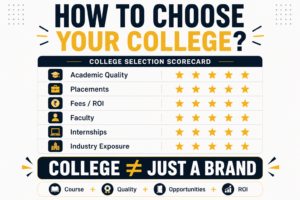
If you’re confused between two colleges, create a scorecard.
Give each college a score from 1 to 5 for:
Academic Quality — /5
Placement — /5
Fees — /5
ROI — /5
Faculty — /5
Infrastructure — /5
Internships — /5
Industry Exposure — /5
Campus Life — /5
Location — /5
Then compare the total.
You can also give more importance to factors that matter most to you.
For example, if budget is your biggest concern, give fees and ROI greater weight.
If your goal is software development, give curriculum, internships and placements greater weight.
This turns an emotional decision into a more structured one.
Final Verdict: Private vs Government College
So, which is better—private or government college?
The honest answer is:
Neither is automatically better. The better college is the one that gives you the right combination of education, opportunities, affordability and career outcomes.
A top government institution can provide exceptional education and ROI.
A good private university can provide excellent infrastructure, industry exposure and career opportunities.
At the same time, a low-quality college—whether government or private—can become a poor investment.
So don’t choose based only on:
Government vs Private
Choose based on:
Course + College Quality + Fees + Placements + Skills + Opportunities + ROI
And most importantly, don’t judge a college by one number.
Not the highest package.
Not the campus size.
Not the number of courses.
Not the admission deadline.
Look at the complete picture.
Your college is an important part of your career journey, but it is not the entire career.
The skills you build, internships you complete, projects you create, people you meet and opportunities you take advantage of will also shape your future.
So before taking admission, compare carefully, ask questions, check the data and make a decision that makes sense for your career and your family’s investment.
Because the goal isn’t to get into a college that simply sounds impressive.
The goal is to choose a college that helps you build an impressive future.