
School se ghar aate hi thakaan ho jaati hai. Phir homework, coaching, assignments aur practical files. Aur jab finally padhne baithte ho, tab samajh nahi aata ki pehle Physics padhein, Accountancy karein ya English revise karein.
Sound familiar?
If you’re a Class 12 student preparing for the 2027 board examinations, you’ve probably searched for the perfect study timetable at least once.
And chances are, you’ve seen routines that begin at 4 AM, include 10–12 hours of studying and barely leave time for anything else.
But here’s the problem.
A timetable that looks impressive on paper is useless if you cannot follow it consistently.
The best CBSE Class 12 study timetable 2027 is not necessarily the one with the longest study hours. It’s the one that helps you complete your syllabus, revise regularly, practise questions and improve your performance without exhausting yourself.
In this guide, we’ll create realistic study routines for Science, Commerce and Humanities students. We’ll also cover how to manage school, coaching, homework, mock tests and revision.
Whether you have two, four or six hours available for self-study, there’s a practical way to use that time.
1. Why Most Class 12 Study Timetables Fail
Let’s imagine two students.
Student A creates a timetable with 10 hours of daily self-study.
Student B creates a timetable with four focused hours.
Student A follows the routine for three days, becomes exhausted and stops.
Student B follows the routine consistently, completes weekly targets and analyses mistakes.
Who is more likely to make steady progress?
The second student has built a more sustainable system.
Most study timetables fail because students:
- Set unrealistic study-hour targets.
- Ignore school and coaching commitments.
- Spend too much time on favourite subjects.
- Don’t reserve time for revision.
- Keep changing their timetable.
- Measure progress only through hours studied.
- Don’t plan what to do when they miss a session.
Your timetable should solve these problems, not create more pressure.
The goal is to complete meaningful study tasks consistently, not simply to stay at your desk for longer.
2. How to Create Your CBSE Class 12 Study Timetable 2027
Before choosing your study hours, follow these five steps.
Step 1: Check Your Official Syllabus
Visit the CBSE Academic website and check the curriculum for the 2026–27 academic session.
Download your subject-wise syllabus.
Create a list of chapters and identify which topics are complete, incomplete or weak.
Step 2: Calculate Your Available Study Time
Write down your actual daily commitments.
For example:
| Activity | Approximate time |
|---|---|
| School and commuting | 7–9 hours |
| Coaching, if applicable | 1–2 hours |
| Meals and personal activities | 2–3 hours |
| Sleep | 8–9 hours |
| Self-study | Remaining available time |
These are illustrative ranges, not a fixed schedule.
If you have three hours available for self-study, create a three-hour timetable.
Don’t force yourself into a six-hour routine that conflicts with your daily responsibilities.
Step 3: Identify Your Weakest Subjects
Give additional attention to subjects where you struggle.
For example, if Mathematics is your weakest subject, schedule it during a period when you’re mentally fresh.
Step 4: Divide Study Time Into Three Activities
Your routine should include:
Learning: Completing new concepts or chapters.
Practice: Solving questions and writing answers.
Revision: Reviewing previously studied material.
Step 5: Set Weekly Targets
Instead of writing only “Study Chemistry for two hours,” write a specific task.
For example:
“Complete Electrochemistry revision and solve 15 relevant questions.”
Specific targets make progress easier to measure.
3. Best Daily Study Timetable for Class 12 Students With School
Here’s a realistic example for a student whose school ends in the afternoon.
| Time | Activity |
|---|---|
| 6:30–7:00 AM | Wake up and get ready |
| 7:00 AM–2:30 PM | School and commuting |
| 2:30–3:30 PM | Lunch and rest |
| 3:30–4:30 PM | Homework or pending schoolwork |
| 4:30–5:00 PM | Break |
| 5:00–6:00 PM | Difficult subject |
| 6:00–6:15 PM | Short break |
| 6:15–7:15 PM | Question-solving practice |
| 7:15–8:15 PM | Dinner and personal time |
| 8:15–9:00 PM | Second subject |
| 9:00–9:30 PM | Revision and next-day planning |
| 9:30–10:00 PM | Wind down and prepare for sleep |
Adjust the timings according to your school schedule, coaching and sleep requirements.
Why This Routine Works
It gives you time for school responsibilities, focused self-study and revision.
It also includes breaks.
You don’t need to fill every available minute with studying.
A manageable routine is easier to maintain throughout the academic year.
4. Two-Hour Study Timetable for Busy Class 12 Students
Some students have coaching, long commutes or additional responsibilities.
If you have only two hours available, don’t assume your preparation cannot improve.
Use those two hours carefully.
| Session | Duration | Task |
|---|---|---|
| Session 1 | 45 minutes | Weak chapter or difficult concept |
| Session 2 | 45 minutes | Questions and answer writing |
| Session 3 | 30 minutes | Revision and error correction |
| Total | 120 minutes |
Example for a PCM Student
45 minutes: Mathematics — Integrals practice.
45 minutes: Physics — numerical questions.
30 minutes: Chemistry — formula and reaction revision.
The next day, rotate your subjects.
The Most Important Rule
Avoid spending the entire two hours watching lectures unless you’re learning a genuinely unfamiliar concept.
Reserve time to practise independently.
5. Four-Hour CBSE Class 12 Study Timetable
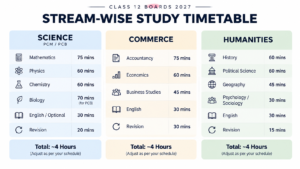
A four-hour routine can provide a useful balance of concept-building, practice and revision for students who have sufficient time outside school.
| Session | Duration | Activity |
|---|---|---|
| Session 1 | 60 minutes | Difficult subject |
| Session 2 | 60 minutes | Numerical or written practice |
| Session 3 | 45 minutes | Second subject |
| Session 4 | 45 minutes | Chapter-wise questions |
| Session 5 | 30 minutes | Revision and error notebook |
| Total | 240 minutes |
You can divide these sessions between the afternoon and evening.
Example
A Commerce student might follow:
- Accountancy: 60 minutes.
- Economics: 60 minutes.
- Business Studies: 45 minutes.
- English: 45 minutes.
- Revision: 30 minutes.
But don’t follow exactly the same subject distribution every day.
Rotate subjects based on upcoming tests, incomplete chapters and weak areas.
6. Six-Hour Study Timetable for Holidays and Study Leave
A six-hour self-study routine may be suitable for some students during holidays or study leave.
However, it isn’t necessary for everyone.
| Session | Duration | Task |
|---|---|---|
| Session 1 | 90 minutes | Difficult subject |
| Session 2 | 90 minutes | Second major subject |
| Session 3 | 60 minutes | Practice questions |
| Session 4 | 60 minutes | Third subject |
| Session 5 | 30 minutes | Language subject |
| Session 6 | 30 minutes | Revision and analysis |
| Total | 360 minutes |
Include proper breaks between sessions.
Don’t treat six hours as a minimum requirement for high marks.
If you’re learning effectively in less time, you don’t need to increase your hours simply to match someone else’s routine.
7. Class 12 Science Study Timetable: PCM and PCB
Science students need to balance understanding concepts, solving questions and practising written answers.
PCM Students: Physics, Chemistry and Mathematics
A sample four-hour distribution:
| Subject | Daily time |
|---|---|
| Mathematics | 75 minutes |
| Physics | 60 minutes |
| Chemistry | 60 minutes |
| English or optional subject | 25 minutes |
| Revision | 20 minutes |
Use this as a starting point and rotate subjects according to your needs.
Physics
Focus on conceptual understanding, numericals, derivations and diagrams.
Chemistry
Divide your preparation into Physical, Organic and Inorganic Chemistry.
Use different revision techniques for each.
Mathematics
Solve problems independently.
Maintain a notebook of recurring calculation and conceptual mistakes.
PCB Students: Physics, Chemistry and Biology
A sample four-hour distribution:
| Subject | Daily time |
|---|---|
| Biology | 70 minutes |
| Physics | 60 minutes |
| Chemistry | 60 minutes |
| English or optional subject | 30 minutes |
| Revision | 20 minutes |
For Biology, use active recall, diagrams and relevant application-based questions.
For Physics and Chemistry, reserve time for numerical and conceptual practice.
Managing JEE Main or NEET With Boards
If you’re preparing for an entrance examination alongside boards, don’t create completely separate learning plans for overlapping concepts.
Build the foundation first, then practise the relevant examination formats.
For JEE aspirants, our guide on JEE Main 2027 Important Chapters can help you identify topics to prioritise.
You can also explore JEE Main preparation without coaching for a structured self-study approach.
For additional chapter-wise practice and mock tests, visit Aaopadhein.org.
8. Class 12 Commerce Study Timetable
Commerce students should distribute their time according to each subject’s preparation requirements.
A sample four-hour timetable:
| Subject | Daily time |
|---|---|
| Accountancy | 75 minutes |
| Economics | 60 minutes |
| Business Studies | 45 minutes |
| English | 30 minutes |
| Revision | 30 minutes |
Accountancy
Practise questions regularly.
Focus on concepts, formats, adjustments and calculations.
Economics
Understand concepts and practise diagrams, explanations and numerical questions wherever relevant.
Business Studies
Focus on conceptual understanding, keywords and case-based questions.
English
Practise reading, writing and literature according to your syllabus.
Commerce Students Interested in Management Careers
If you’re considering BBA or MBA after Class 12, explore our BBA and MBA career roadmap.
It explains the academic pathways, entrance examinations, skills and career opportunities associated with management education.
9. Class 12 Humanities Study Timetable
Humanities students often have substantial reading, writing and revision requirements.
A sample four-hour timetable:
| Activity | Daily time |
|---|---|
| Major subject 1 | 60 minutes |
| Major subject 2 | 60 minutes |
| Major subject 3 | 45 minutes |
| English | 30 minutes |
| Answer-writing practice | 30 minutes |
| Revision | 15 minutes |
History
Prepare timelines and understand causes, events and consequences.
Political Science
Focus on concepts, important developments and structured written answers.
Geography
Practise maps, diagrams, concepts and data interpretation where required.
Psychology and Sociology
Use comparison tables, concept summaries and application-based questions.
The Humanities Preparation Rule
Don’t measure progress only by the number of pages you’ve read.
Ask yourself:
Can I explain the topic clearly and answer a question about it without looking at my notes?
If the answer is no, you need more active recall and practice.
10. Weekly Study Timetable for Class 12 Boards 2027
A daily timetable tells you when to study.
A weekly timetable helps you decide what to complete.
Here’s an example:
| Day | Main priority |
|---|---|
| Monday | Difficult subject + practice |
| Tuesday | Second major subject + revision |
| Wednesday | Difficult subject + written answers |
| Thursday | Third subject + practice |
| Friday | Weak chapters + language subject |
| Saturday | Chapter-wise tests |
| Sunday | Test analysis + weekly planning |
This doesn’t mean you should study only one subject each day.
The table shows your main priority. You can still rotate additional subjects throughout the week.
Sunday Review
At the end of every week, review:
- Chapters completed.
- Questions attempted.
- Mistakes corrected.
- Pending schoolwork.
- Topics requiring revision.
- Priorities for the following week.
If your weekly targets are too ambitious, reduce them.
A realistic plan you can complete is better than an overloaded plan you repeatedly abandon.
11. The Output-Based Study Method: Stop Counting Only Hours
Here’s a simple comparison.
Student A: “I studied Mathematics for three hours.”
Student B: “I solved 25 questions, corrected five mistakes and revised two formulas I kept forgetting.”
Student B has a clearer picture of what was achieved.
This is the idea behind output-based study goals.
Instead of measuring progress only through time, measure completed learning activities.
Convert Vague Goals Into Specific Targets
| Vague goal | Better study target |
|---|---|
| Study Physics | Revise a concept and solve 12 relevant questions |
| Read Biology | Review a topic and test recall without notes |
| Practise Accountancy | Complete one problem set and check adjustments |
| Revise History | Create a timeline and write two answers |
| Study English | Complete one writing task and one reading passage |
These targets are examples. Adjust them to the difficulty of the topic.
Why Output-Based Goals Help
They make your preparation measurable.
You can identify unfinished work and track improvement.
They also reduce the temptation to spend hours passively reading without testing yourself.
12. How to Include Revision in Your Class 12 Study Timetable
Many students make a timetable that includes only new chapters.
They complete the syllabus but forget earlier topics.
Revision should be part of your routine from the beginning.
Daily Revision
Spend a short period recalling previously studied concepts.
Weekly Revision
Revisit important topics and reattempt questions you answered incorrectly.
Monthly Revision
Use mixed practice questions and sample papers to check how well you remember material across chapters.
Example Revision Cycle
| Day | Activity |
|---|---|
| Monday | Study a new topic |
| Wednesday | Recall key concepts |
| Sunday | Practise questions |
| Following week | Reattempt mistakes |
The exact intervals can vary.
The important point is to revisit topics rather than studying each chapter only once.
For a more detailed preparation structure, explore our 30-day competitive exam study plan and adapt its planning principles to your board syllabus.
13. When Should You Start Solving CBSE Sample Papers?
You don’t need to wait until the entire syllabus is complete before practising board-style questions.
Start with chapter-wise questions while learning.
As your preparation progresses, begin attempting longer practice sets and full-length papers.
Use official resources from CBSE Academic to find the appropriate sample papers and marking schemes for your examination session.
A Practical Sample-Paper Routine
Step 1: Attempt questions independently.
Step 2: Compare your answers with the marking scheme.
Step 3: Identify missing points and incorrect methods.
Step 4: Revisit weak concepts.
Step 5: Reattempt incorrect questions.
Step 6: Track your improvement.
For students preparing for JEE Main alongside boards, our JEE Main mock test analysis guide explains how to review accuracy, timing and recurring mistakes.
14. How to Manage School, Coaching and Self-Study
If you attend school and coaching, your timetable will naturally look different from that of a student preparing entirely through self-study.
Don’t compare your routine with someone who has fewer daily commitments.
Use School Hours Effectively
Pay attention during lessons and identify doubts immediately.
Good classroom learning can reduce the amount of time needed to relearn concepts later.
Avoid Duplicating Every Lecture
If you already understand a topic from school or coaching, use your self-study time for questions and revision.
Rewatching an entire lecture isn’t always necessary.
Prioritise Pending Work
At the beginning of each week, identify important assignments, tests and unfinished chapters.
Schedule them before less urgent activities.
Protect Your Rest Time
Sleep, meals and breaks should be part of your planning.
A sustainable routine helps you maintain concentration over a longer period.
15. How to Change Your Study Timetable Before Board Exams
Your timetable shouldn’t remain exactly the same throughout the academic year.
Your preparation needs change as the examination approaches.
Phase 1: Syllabus Completion
Spend more time understanding concepts and completing unfinished chapters.
Phase 2: Question Practice
Increase your focus on written answers, numericals and chapter-wise tests.
Phase 3: Sample-Paper Preparation
Attempt timed papers, review marking schemes and identify recurring mistakes.
Phase 4: Final Revision
Focus on weak areas, key concepts, formulas and the nearest upcoming examination.
Use the official date sheet when planning the final weeks.
If you’re aiming for a high overall percentage, read our detailed guide on how to score 95% in Class 12 boards 2027.
It covers subject-wise preparation, revision and sample-paper strategies.
16. Seven Mistakes to Avoid While Following Your Study Timetable
1. Making an Unrealistic Routine
Don’t create a timetable that leaves no room for schoolwork, rest or unexpected commitments.
2. Studying Only Favourite Subjects
Allocate time according to your preparation gaps, not just your interests.
3. Ignoring Revision
Completing a chapter once doesn’t mean you’ll remember it during the examination.
4. Measuring Progress Only Through Hours
Track completed tasks, practice performance and corrected mistakes.
5. Avoiding Difficult Chapters
Schedule challenging topics when you’re mentally fresh.
6. Changing Your Timetable Every Two Days
Give your routine enough time to work before making major changes.
7. Giving Up After Missing One Day
If you miss a study session, adjust the next day’s plan.
You don’t need to restart your entire timetable.
17. Free Resources to Support Your Class 12 Study Routine
You don’t need ten different study apps and twenty different books.
Start with reliable resources.
Official Academic Resources
Check curriculum information, sample papers and academic updates.
Access information about prescribed textbooks and educational resources.
CBSE Previous-Year Question Papers
Use previous examination questions for practice.
Aaopadhein Preparation Resources
Explore available Class 11 and 12 board preparation resources, chapter-wise tests and mock tests.
Read detailed preparation guides, exam strategies and career roadmaps.
Explore college admissions, universities and career guidance after Class 12.
Frequently Asked Questions
1. What is the best CBSE Class 12 study timetable 2027?
The best timetable is one that fits your school schedule, preparation level and available study time. It should include concept learning, question practice and revision.
2. How many hours should a Class 12 student study daily?
There is no universal requirement. Some students may have two hours of self-study available, while others have more. Focus on productive study sessions and achievable targets.
3. Is studying four hours daily enough for Class 12 boards?
Four hours of focused self-study may be useful for many students, depending on their preparation level and other learning commitments. Study quality, consistency and revision matter.
4. Should I study every subject daily?
Not necessarily. You can rotate subjects across the week while giving extra attention to weak chapters and upcoming tests.
5. What is the best time to study difficult subjects?
Choose a time when you’re alert and able to concentrate. For some students, that’s the morning; for others, it’s the afternoon or evening.
6. How can I manage Class 12 boards with JEE Main or NEET?
Study overlapping concepts together, then allocate separate practice time for entrance-exam questions and board-style written answers.
7. How should I revise completed chapters?
Use active recall, regular revision and question practice. Reattempt questions you previously answered incorrectly.
8. Can I score 95% by following a study timetable?
A good timetable can support your preparation, but no timetable guarantees a particular score. Your result depends on your understanding, practice, consistency and examination performance.
9. What should I do if I cannot follow my timetable?
Identify why it isn’t working. Reduce unrealistic targets, adjust the schedule and prioritise essential tasks.
10. When should I start solving sample papers?
Start with chapter-wise questions during syllabus preparation. Move towards full-length timed papers as your preparation progresses.
Conclusion: Your Timetable Should Help You Study Better, Not Just Longer
The most important thing about your CBSE Class 12 study timetable 2027 is not how many hours it contains.
It’s whether you can follow it consistently and make measurable progress.
Start with a realistic routine.
Give more attention to weak chapters.
Practise questions independently.
Revise regularly.
Analyse your mistakes.
And don’t abandon your entire plan because you missed one study session.
A good timetable doesn’t need to be perfect. It needs to be practical enough to follow.
Start Your Class 12 Boards 2027 Preparation With Aaopadhein
Need chapter-wise practice and mock tests?
Visit Aaopadhein.org to explore available study resources for Class 11 and 12 students.
Planning your career after Class 12?
Explore Aaopadhein.com for college information and career guidance.
Plan your day. Complete your targets. Track your progress.