You have completed several chapters, revised your notes and solved questions from your textbooks. But when someone gives you a full three-hour sample paper, suddenly things feel different.
You know the answers, but you’re taking too long. You spend fifteen minutes on one question. You forget a point you revised yesterday. And when the time ends, two questions are still unanswered.
Sounds familiar?
This is exactly why practising CBSE Class 12 Sample Papers 2027 is an important part of board exam preparation.
Sample papers help you understand the examination format, practise writing answers within the available time and identify weaknesses before the actual examination.
But there’s a difference between simply solving a sample paper and using it to improve your performance.
In this guide, we’ll discuss how to practise CBSE Class 12 sample papers properly, how to analyse your answers, what the marking scheme can teach you and how to build a practical 30-day revision strategy.
Whether you’re from Science, Commerce or Humanities, the approach can help you prepare more systematically.
1. Why Are CBSE Class 12 Sample Papers Important?
Think about how you prepare for a school sports competition.
You don’t just learn the rules. You practise under conditions similar to the actual competition.
Board examinations work in a similar way.
Studying a chapter helps you understand the subject. Solving a complete sample paper helps you practise using that knowledge within the examination format.
Understand the Question Paper Structure
CBSE sample papers help students become familiar with the structure and types of questions used in the applicable subject examination.
Depending on the subject, these may include objective questions, short-answer questions, long-answer questions, case-based questions or other prescribed formats.
You should always check the official sample paper for your particular subject rather than assuming every subject follows an identical structure.
Improve Time Management
Some students know the answers but cannot complete the paper on time.
Full-length practice helps you understand which questions take longer and where you need to improve your writing speed or question selection.
Identify Weak Chapters
A sample paper covers multiple areas of the syllabus.
This helps reveal whether you can recall and apply concepts from different chapters without being told which topic each question belongs to.
Learn Better Answer Presentation
In written examinations, presenting relevant points, calculations, explanations and diagrams clearly can help the examiner assess your answer.
The official marking scheme helps you understand what is expected for different questions.
Reduce Uncertainty Before the Examination
Practising the paper format regularly makes the examination process more familiar.
It cannot eliminate every source of stress, but it can help you approach the actual paper with a clearer strategy.
2. Where to Find Official CBSE Class 12 Sample Papers for 2027
Your first preference should be official CBSE resources.
Visit the CBSE Academic website and look for the Sample Question Papers section for Class XII and the 2026–27 academic session.
When the relevant documents are available, check both:
- Sample Question Paper (SQP)
- Marking Scheme (MS)
The sample paper shows the question format, while the marking scheme provides guidance on expected answers and mark allocation.
Also check the latest curriculum and examination instructions for your subject.
Important: If the official 2026–27 sample paper for a subject has not been released, use the most recent available official paper for practice while recognising that its format may differ from the final 2027 requirements.
Avoid assuming that a third-party paper labelled “2027” necessarily follows the latest official pattern.
3. When Should You Start Solving Sample Papers?
One common mistake is waiting until the entire syllabus is completed before attempting any examination-style questions.
You can start earlier, but the type of practice should change as your preparation progresses.
When Your Syllabus Is Incomplete
Focus on chapter-wise questions and short practice sets.
For example, after completing a chapter in Physics, solve the relevant textbook exercises and board-style questions.
This helps you build confidence without expecting yourself to answer questions from chapters you haven’t studied.
When Most Chapters Are Complete
Introduce mixed-topic practice and occasional full-length sample papers.
Your initial marks may be lower because some chapters still need revision.
That’s fine. Use the results to identify what you should study next.
During Final Revision
Make full-length sample-paper practice a regular activity.
Practise under realistic conditions, review the marking scheme and revise weak chapters between papers.
Don’t attempt so many papers that you have no time to learn from your mistakes.
4. How to Solve a CBSE Class 12 Sample Paper Properly

Simply opening a PDF and answering a few questions is useful for revision, but it doesn’t fully simulate the examination.
For full-length practice, follow these steps.
Step 1: Choose the Correct Paper
Select the official sample paper for your subject and academic session.
Check the duration, maximum marks, instructions and permitted materials.
For subjects with practical or internal-assessment components, remember that the theory paper may not represent the entire subject assessment.
Step 2: Create Examination-Like Conditions
Sit at a desk with the materials you would normally use in the examination.
Keep your phone away and avoid checking textbooks or solutions during the attempt.
Use the time specified on the sample paper.
Step 3: Read the Instructions Carefully
Before answering, check:
- Total number of questions.
- Compulsory questions.
- Internal choices.
- Section-wise instructions.
- Word limits, where specified.
- Instructions for diagrams or calculations.
These details can vary across subjects.
Step 4: Allocate Your Time
Plan your time according to the marks and complexity of the questions.
Don’t spend an excessive amount of time on a low-mark question while leaving higher-mark questions unanswered.
Keep some time for reviewing your answer sheet.
Step 5: Complete the Paper Without Interruptions
During a full-length practice session, avoid pausing the timer or checking solutions.
If you cannot answer a question, move on according to the paper’s instructions and return to it if time permits.
Step 6: Review Your Performance
Once the paper is complete, check your answers using the official marking scheme and suitable reference material.
This is where the most valuable learning begins.
5. How to Use the CBSE Marking Scheme
Many students download sample papers but never open the marking scheme.
That’s a missed opportunity.
The marking scheme helps you understand the expected content and how marks are allocated.
However, it should be treated as assessment guidance, not simply a list of sentences to memorise.
Example: A Three-Mark Question
Suppose a question asks you to explain three relevant characteristics of a concept.
A strong response should address the requirements of the question clearly and accurately.
If you write one detailed point and repeat it in different words, you may not demonstrate all the required elements.
The marking scheme helps you identify the distinct points or steps expected.
Example: A Numerical Question
In subjects such as Physics, Chemistry, Mathematics and Accountancy, your method may matter as well as the final answer.
Review whether you have:
- Selected an appropriate formula or method.
- Substituted values correctly.
- Completed the calculations accurately.
- Included relevant units.
- Presented the final answer clearly.
Follow the actual subject-specific marking scheme for the question.
Don’t Memorise Model Answers Blindly
Your goal is to understand the content that earns marks.
For theory questions, learn how to identify the key ideas and express them accurately in your own words, where appropriate.
For numerical questions, understand the solution method rather than memorising a sequence of steps.
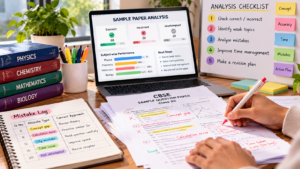
6. How to Analyse Your Sample Paper
After checking your answers, divide your mistakes into four categories.
| Mistake type | Example | What to do |
|---|---|---|
| Conceptual | You misunderstood a principle | Revise the concept |
| Recall | You forgot an important fact or definition | Use active recall and short revision notes |
| Presentation | You omitted relevant steps or points | Practise structured answers |
| Time management | You knew the answer but couldn’t finish | Practise timed questions |
Step 1: Record Your Marks
Note your total score and, where useful, your performance in different sections.
Step 2: Identify Lost Marks
Review each incorrect or incomplete answer.
Ask whether the issue was knowledge, presentation, calculation or time.
Step 3: Prioritise Important Weaknesses
Don’t try to revise every chapter immediately.
Choose the topics responsible for the most significant or recurring mistakes.
Step 4: Correct the Mistakes
Revisit the relevant concepts and rewrite or resolve selected questions.
Step 5: Retest Yourself
A few days later, attempt similar questions without referring to the solutions.
This helps you check whether you have actually improved.
7. Subject-Wise Sample Paper Strategy for Science Students
Physics
Physics requires both conceptual understanding and numerical application.
While reviewing your paper, pay attention to diagrams, formulas, derivations and calculations where relevant.
If you lose marks in numerical questions, identify whether the problem comes from the concept, formula selection or arithmetic.
If you struggle with explanations, practise writing concise answers that address the question directly.
Chemistry
For Chemistry, analyse Physical, Organic and Inorganic Chemistry according to your syllabus.
In Physical Chemistry, review calculations and concept application.
In Organic Chemistry, check your understanding of reactions, reasoning and relationships between concepts.
In Inorganic Chemistry, identify factual or conceptual gaps and revise the relevant textbook material.
Mathematics
Mathematics sample papers help you practise solving different types of questions within a limited time.
After each paper, identify lengthy questions, repeated algebraic mistakes and methods you find difficult.
Reattempt incorrect problems independently.
For students also preparing for engineering entrance examinations, read our JEE Main and Class 12 Boards combined preparation guide.
Biology
For Biology, focus on understanding concepts, recalling important terminology and answering questions according to their specific requirements.
Practise relevant diagrams, explanations and application-based questions.
Compare your answers with the official marking scheme to identify missing points.
8. Sample Paper Strategy for Commerce Students
Commerce students should not follow exactly the same revision method for every subject.
Accountancy
Practise complete numerical questions under timed conditions.
Review calculations, formats, working notes and presentation requirements.
A mistake in an early calculation can affect later parts of an answer, so examine your working carefully.
Business Studies
Focus on understanding concepts and applying them to situations.
When practising case-based questions, identify the relevant principle or concept before writing the answer.
Use appropriate terminology and explain your reasoning clearly.
Economics
Balance conceptual understanding with numerical and analytical practice where required.
Pay attention to definitions, diagrams, calculations and explanations relevant to the syllabus.
After each paper, identify whether you lost marks because of weak concepts or incomplete answers.
9. Sample Paper Strategy for Humanities Students
Humanities subjects often require students to organise information and construct clear explanations.
History
Practise identifying the exact demand of the question.
Organise relevant facts and arguments logically rather than writing everything you remember about a chapter.
Political Science
Focus on conceptual clarity, relevant examples and structured explanations.
For longer answers, organise your response into meaningful points or paragraphs.
Geography
Practise subject-specific questions, including map work, diagrams and data interpretation where prescribed.
Use the applicable marking scheme to understand expected answers.
Psychology and Other Humanities Subjects
Practise definitions, conceptual applications, case-based questions and written explanations as relevant to the subject.
The key is to follow your specific curriculum and examination format rather than adopting a single strategy for every Humanities paper.
10. How Many Sample Papers Should You Solve?
There is no official number that guarantees a particular board examination score.
The ideal number depends on your preparation level, available time and the quality of your analysis.
A practical approach is:
| Preparation stage | Suggested activity |
|---|---|
| Early preparation | Chapter-wise board questions |
| Syllabus mostly complete | Occasional full-length sample papers |
| Intensive revision | Regular timed papers with analysis |
| Final days | Targeted revision and selected practice |
For example, attempting one full-length paper for a subject and carefully analysing it may be more beneficial than attempting three papers without reviewing your mistakes.
Remember that a complete paper also requires time for checking, correction and revision.
11. A 30-Day CBSE Class 12 Sample Paper Revision Plan
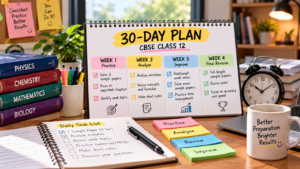
This plan assumes you have already studied a substantial portion of your syllabus.
Adapt it according to your subjects and the examination schedule.
Days 1–5: Understand Your Current Preparation Level
Day 1: Review your syllabus and identify incomplete chapters.
Day 2: Attempt a timed practice paper for your first major subject.
Day 3: Analyse the paper and revise weak topics.
Day 4: Practise questions from the chapters where you lost marks.
Day 5: Attempt a timed practice paper for your second major subject.
Days 6–10: Correct Fundamental Mistakes
Day 6: Analyse the second paper and record mistakes.
Day 7: Revise concepts that caused repeated errors.
Day 8: Practise a third subject using mixed-topic questions.
Day 9: Review written-answer presentation and numerical steps.
Day 10: Reattempt selected incorrect questions from earlier papers.
Days 11–15: Strengthen Weak Subjects
Day 11: Attempt another full-length paper in a subject that needs improvement.
Day 12: Analyse mistakes and identify recurring patterns.
Day 13: Revise important concepts and practise related questions.
Day 14: Complete a timed practice set for another subject.
Day 15: Review your progress and adjust the remaining schedule.
Days 16–20: Improve Time Management
Day 16: Attempt a full-length paper under examination conditions.
Day 17: Review questions that took too long.
Day 18: Practise writing concise, complete answers.
Day 19: Revise weak chapters and important formulas or concepts.
Day 20: Attempt another paper if your revision is sufficiently complete.
Days 21–25: Consolidate Learning
Day 21: Analyse your most recent paper.
Day 22: Revisit the three topics causing the most difficulty.
Day 23: Practise subject-specific diagrams, calculations or written answers.
Day 24: Review previous errors and revision notes.
Day 25: Attempt a selected paper or timed question set.
Days 26–30: Final Review
Day 26: Analyse remaining mistakes.
Day 27: Revise important concepts and formulas.
Day 28: Practise questions you previously found difficult.
Day 29: Review official examination instructions and subject requirements.
Day 30: Complete light revision, organise your materials and maintain adequate rest.
This is a flexible framework, not a requirement to attempt a full-length paper every day.
Adjust the plan around your actual board examination dates.
12. How to Improve Answer Presentation
A correct idea may not receive full credit if your answer does not address everything the question requires.
Develop a clear writing approach.
Read the Command Words
Pay attention to words such as:
- Define
- Explain
- Differentiate
- Analyse
- Justify
- Calculate
- Evaluate
Each asks for a particular type of response.
Match Your Answer to the Question
Don’t write a full-page explanation for a question that asks for a short definition.
Similarly, don’t provide a one-line response when the question requires multiple explanations or steps.
Use Relevant Headings and Points
For suitable theory questions, organise your answer using short paragraphs or numbered points.
This can improve clarity and help you avoid repeating information.
Show Necessary Working
For numerical questions, present the relevant calculations and steps according to the subject requirements.
Keep Your Writing Readable
You don’t need decorative handwriting.
Focus on clear, legible writing and organised answers.
13. Five Common Sample Paper Mistakes
Mistake 1: Checking Answers During the Test
This prevents you from accurately assessing your independent performance.
Check solutions only after completing the timed attempt.
Mistake 2: Ignoring the Marking Scheme
Without reviewing the marking scheme, you may not understand why an answer was incomplete.
Mistake 3: Practising Only Favourite Subjects
It’s natural to prefer subjects you find easier.
However, weaker subjects often need more structured practice.
Mistake 4: Focusing Only on Marks
Your score is important, but your mistakes reveal what needs improvement.
Mistake 5: Attempting Too Many Papers Without Revision
Practice is useful only when you learn from it.
Reserve time for correcting mistakes and strengthening concepts.
14. A Simple Sample Paper Analysis Tracker
After every paper, complete this table.
| Field | Your response |
|---|---|
| Subject | |
| Date | |
| Paper attempted | |
| Marks scored | |
| Questions left unanswered | |
| Main conceptual mistakes | |
| Main presentation mistakes | |
| Time-management issues | |
| Chapters to revise | |
| Date for reattempting weak questions |
Over time, this tracker can help you recognise recurring problems and measure progress.
You can maintain it in a notebook or spreadsheet.
15. How to Balance Sample Papers With Regular Revision
Students sometimes become so focused on sample papers that they stop revising the actual syllabus.
This can create problems when a new paper contains questions they haven’t practised before.
A balanced routine includes:
Concept revision: Review chapters and topics that need reinforcement.
Question practice: Solve relevant textbook and examination-style questions.
Timed practice: Attempt sample papers or shorter timed sets.
Error correction: Analyse mistakes and reattempt questions.
For more guidance on structuring your daily routine, read our study timetable for competitive exams, adapting it to your board examination requirements.
16. Practise With Aaopadhein
If you’re preparing for Class 12 Boards alongside competitive examinations, you can use online practice to check your understanding.
Visit Aaopadhein.org to explore available board examination practice resources, chapter-wise questions and mock tests.
Use these resources alongside your official curriculum, prescribed textbooks and CBSE sample papers.
Frequently Asked Questions
1. Where can I download CBSE Class 12 Sample Papers 2027?
Visit the official CBSE Academic website and look for the Class XII sample question papers and marking schemes for the 2026–27 academic session.
2. Are CBSE sample papers enough to score 95% in Class 12?
No resource can guarantee a particular percentage. Sample papers are useful for examination practice, but students also need syllabus coverage, textbook study, revision and effective answer presentation.
3. How many sample papers should I solve before the board exams?
There is no compulsory number. Choose a frequency that allows you to attempt papers properly, analyse mistakes and revise weak concepts.
4. Should I solve sample papers before completing the syllabus?
You can begin with chapter-wise questions and short practice sets. Full-length papers become more useful as your syllabus coverage improves.
5. Are official CBSE sample papers better than private sample papers?
Official sample papers are the primary reference for the applicable examination format. Additional practice papers can be useful, but check their alignment with the current syllabus and official pattern.
6. How should I check my sample paper answers?
Use the official marking scheme, prescribed textbook and appropriate subject resources. Identify missing points, incorrect calculations, conceptual errors and presentation problems.
7. Can I prepare for boards and JEE Main together?
Yes. Many concepts overlap, especially in Physics, Chemistry and Mathematics. However, students should practise the question formats and skills required for each examination separately.
8. What should I do if my sample paper marks are low?
Identify why you lost marks. Revise weak concepts, practise written answers or calculations, improve time management and reattempt similar questions.
Conclusion
CBSE Class 12 sample papers are not simply practice tests to complete before your examinations.
They are tools for understanding your preparation, improving answer presentation and identifying mistakes while you still have time to correct them.
Start with the official sample papers, follow the relevant examination instructions and analyse your answers using the marking scheme.
Most importantly, don’t judge your preparation by one test score.
Practise the paper. Understand your mistakes. Correct them. Then practise again.