If you’re in Class 12 and preparing for JEE Main 2027, you’ve probably faced this situation: your school teacher wants you to focus on board exams, your coaching classes are moving through JEE-level questions, and you’re wondering how to manage both without compromising your marks.
The good news? You don’t need two completely separate study plans.
JEE Main 2027 and Class 12 Boards preparation can work together because many Physics, Chemistry and Mathematics concepts overlap. What changes is how you practise and present your answers.
Board examinations generally require clear explanations, appropriate steps and familiarity with the prescribed curriculum. JEE Main tests your understanding and ability to apply concepts to solve problems under time pressure.
The goal is to study common concepts once, practise them in two different ways and revise consistently.
Here’s how to build a realistic plan.
1. Understand the Difference Between JEE Main and Board Exams
Before creating your timetable, understand what each examination expects.
| Factor | Class 12 Boards | JEE Main |
|---|---|---|
| Main focus | Curriculum knowledge and subject understanding | Concept application and problem-solving |
| Question format | Depends on the board and subject | Computer-based entrance examination |
| Preparation | Textbooks, written answers, sample papers | Concepts, numerical problems, PYQs and mock tests |
| Time management | Written-answer planning and completion | Question selection, accuracy and speed |
| Revision | Definitions, derivations, explanations and problems | Formulas, concepts and mixed-topic practice |
Both require strong conceptual understanding.
For example, when studying Current Electricity, you need to understand Ohm’s law, resistance and circuit behaviour.
For boards, you may need to explain relationships, show calculations and present derivations where required.
For JEE Main, you may need to apply the same concepts to unfamiliar numerical problems.
The smart approach is to learn the concept thoroughly before switching between board-style and JEE-style practice.
2. Stop Treating Boards and JEE as Two Separate Syllabuses
One common mistake is studying a chapter for boards and then starting the same chapter from scratch for JEE Main.
This often leads to unnecessary repetition.
Instead, divide your preparation into three stages.
Stage 1: Learn the Concept
Start with your prescribed textbook, class notes and a trusted reference resource.
Understand the definitions, principles, formulas and applications.
Don’t rush into difficult questions before you understand the basics.
Stage 2: Practise Board-Level Questions
After understanding the concept, practise questions aligned with your board syllabus.
For Physics, this might involve explanations, derivations and numerical problems.
For Chemistry, it could involve chemical principles, reactions, reasoning and calculations.
For Mathematics, focus on solving problems accurately and presenting the necessary steps.
Stage 3: Practise JEE-Level Questions
Now move to objective questions, previous-year questions and application-based problems.
This helps you understand how the same concepts can appear in different formats.
For example, after completing Electrostatics:
- Revise the underlying concepts and formulas.
- Practise prescribed textbook questions.
- Solve board-style numerical and theory questions.
- Attempt relevant JEE Main previous-year questions.
- Review incorrect answers before moving on.
This integrated approach reduces repeated learning while preparing you for both examinations.
3. How to Divide Study Time Between Boards and JEE Main
There is no universal timetable that works for every student.
Your study schedule should depend on syllabus coverage, school hours, examination dates and your strengths.
A useful starting point is to divide your available self-study time into three activities:
- Learning and revising concepts.
- Practising JEE-level questions.
- Practising board-style questions and written answers.
For example, if you have four hours of focused self-study on a school day, you might use:
| Activity | Time |
|---|---|
| Concept learning and revision | 90 minutes |
| JEE question practice | 90 minutes |
| Board questions and written practice | 45 minutes |
| Error review and planning | 15 minutes |
This is an illustrative timetable, not a compulsory routine.
If your board examinations are approaching, you may need to devote more time to written practice and sample papers.
If JEE Main is approaching first, you may temporarily prioritise full-length mock tests and JEE-specific revision.
The key is to adjust your schedule without abandoning either examination completely.
4. A Practical Weekly Timetable for JEE and Boards

Rather than studying every subject equally every day, organise your week around concepts, practice and revision.
| Day | Main focus | Supporting activity |
|---|---|---|
| Monday | Physics concepts and JEE problems | Board-style Physics questions |
| Tuesday | Chemistry concepts and practice | NCERT revision |
| Wednesday | Mathematics problem-solving | Board-style Mathematics practice |
| Thursday | Physics and Chemistry weak topics | Previous-year questions |
| Friday | Mathematics revision | Mixed-topic practice |
| Saturday | Timed test or sample paper | Error analysis |
| Sunday | Weekly revision and unfinished topics | Planning and rest |
If you attend coaching classes, use this timetable to organise the work that remains after your classes.
Avoid filling every available hour with study tasks. Include meals, adequate sleep, movement and breaks.
Consistency is more useful than following an exhausting schedule for a few days and then abandoning it.
5. Subject-Wise Preparation Strategy
Physics: Build Concepts Before Increasing Speed
Physics can feel challenging because it requires both conceptual understanding and mathematical application.
For board preparation:
- Study the prescribed theory carefully.
- Understand derivations where included in your syllabus.
- Practise diagrams and numerical problems.
- Learn how to present solutions clearly.
For JEE Main:
- Solve application-based numerical questions.
- Practise combining multiple concepts.
- Review formulas and their conditions.
- Work on accuracy before attempting to solve faster.
Suppose you’re studying Ray Optics.
First, understand the principles and relevant diagrams. Then solve board-style questions. Finally, practise JEE Main questions involving the same concepts.
Don’t memorise formulas without understanding when they apply.
Chemistry: Use NCERT Carefully
NCERT is an important foundation for CBSE Class 12 Chemistry and for several concepts relevant to JEE Main.
However, JEE preparation should also follow the official entrance examination syllabus and include suitable problem practice.
For Physical Chemistry, focus on conceptual understanding and numerical practice.
For Organic Chemistry, understand reaction mechanisms and relationships between concepts instead of memorising isolated reactions.
For Inorganic Chemistry, revise prescribed concepts, properties and relevant factual information regularly.
Create concise revision notes, but don’t spend hours rewriting entire chapters.
Mathematics: Practise Different Question Formats
Mathematics requires consistent problem-solving.
For boards, practise the prescribed exercises and learn to present solutions clearly.
For JEE Main, develop the ability to recognise which mathematical method is appropriate.
For example, while studying Applications of Derivatives, you may encounter board-style questions requiring a clear step-by-step solution and JEE-style problems that test your ability to apply the same principles efficiently.
After studying a topic, practise both formats.
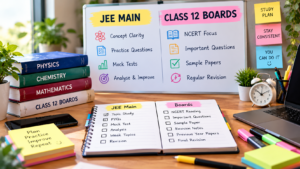
You can also use our JEE Main 2027 important chapters guide to organise revision priorities. Remember to cover the full applicable syllabus rather than studying only a shortlist.
6. How to Use NCERT for Both Examinations
Students often ask whether NCERT is enough for JEE Main.
The answer depends on the subject, topic and depth of practice required.
NCERT provides an important conceptual foundation, particularly for students following the CBSE curriculum. But understanding textbook examples alone does not necessarily prepare you for every JEE Main question.
A practical approach is:
Step 1: Read the chapter and understand the concepts.
Step 2: Solve relevant textbook examples and exercises.
Step 3: Practise questions in the format required for your board examination.
Step 4: Attempt JEE Main previous-year questions from the corresponding topics.
Step 5: Identify concepts that require further practice or clarification.
Check the latest CBSE Academic website for applicable curriculum and sample papers, and the official JEE Main website for entrance examination updates.
If you’re studying under a board other than CBSE, use that board’s prescribed curriculum and official resources.
7. How to Manage Mock Tests and Board Sample Papers
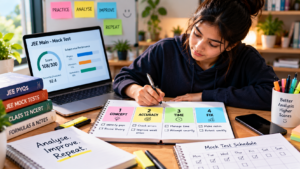
Mock tests are important, but attempting them without analysis will not automatically improve your performance.
You need two forms of examination practice.
JEE Main Mock Tests
Use full-length and topic-wise mock tests to practise question selection, speed, accuracy and time management.
After each test, identify:
- Questions answered incorrectly.
- Questions skipped because of weak concepts.
- Questions left unanswered because of time.
- Repeated calculation errors.
- Topics requiring further revision.
Read our JEE Main mock test strategy to understand how to plan timed practice.
Board Sample Papers
Board sample papers help you become familiar with question formats, expected answer presentation and examination timing.
Practise completing papers within the prescribed duration.
Review whether your answers contain the required explanations, steps, diagrams and units where appropriate.
Use official sample papers and marking schemes whenever available.
How Often Should You Take Tests?
During early preparation, chapter-wise tests may be more useful than frequent full-length papers.
As syllabus coverage improves, introduce more full-length practice.
Near an examination, increase the practice relevant to that examination while leaving enough time for revision and error correction.
Don’t measure preparation only by the number of papers you complete.
One carefully analysed test can teach you more than several tests whose mistakes you never review.
8. A Four-Week Combined Revision Plan
If you’ve covered a substantial portion of the syllabus, use this four-week framework to organise revision.
| Week | Focus | Action |
|---|---|---|
| Week 1 | Identify gaps | Review syllabus coverage, revise weak chapters and take diagnostic tests |
| Week 2 | Strengthen concepts | Practise board and JEE questions from weak topics |
| Week 3 | Improve examination skills | Attempt timed papers and analyse mistakes |
| Week 4 | Consolidate revision | Review formulas, error notes and important concepts |
This plan should be adapted to the time remaining before your examinations.
If you’re still learning large portions of the syllabus, don’t replace necessary concept learning with repeated full-length tests.
For a broader preparation framework, see our JEE Main preparation guide.
9. Five Mistakes That Can Hurt Both Your JEE and Board Preparation
Mistake 1: Ignoring Boards Completely
Focusing exclusively on entrance preparation may leave you underprepared for written answers, board-specific requirements and subjects outside JEE.
Check the eligibility requirements of the institutions and programmes you plan to apply to.
Mistake 2: Memorising Without Understanding
Memorising formulas and solutions without understanding their application makes unfamiliar questions more difficult.
Spend time learning why a method works.
Mistake 3: Using Too Many Study Resources
Switching constantly between books, teachers, videos and question banks can create confusion.
Choose reliable core resources and use additional materials to address specific gaps.
Mistake 4: Avoiding Weak Chapters
It may feel easier to keep revising chapters you’re already good at.
But repeatedly avoiding weak topics can leave important gaps.
Prioritise them according to the applicable syllabus, their relevance and your current understanding.
Mistake 5: Sacrificing Sleep and Recovery
Studying late every night may seem productive, but insufficient sleep can affect attention, memory and concentration.
Build a sustainable routine that includes rest and regular breaks.
10. What Should You Do When Exams Get Closer?
Your study priorities should change according to the examination calendar.
When JEE Main is approaching, give greater attention to timed objective-question practice, mock-test analysis and relevant revision.
When board examinations are approaching, increase written-answer practice, prescribed textbook revision and official sample-paper practice.
After one examination is completed, reassess the remaining syllabus and shift your preparation accordingly.
Avoid following the same fixed timetable regardless of how close the examinations are.
11. A Simple Daily Checklist
Before ending your study session, ask yourself:
- Did I understand at least one important concept properly?
- Did I practise questions independently?
- Did I review my mistakes?
- Did I make progress on a weak topic?
- Do I know what to study tomorrow?
You don’t need to achieve everything perfectly every day.
What matters is that your preparation moves forward consistently.
12. Practise With Aaopadhein
Once you’ve revised a chapter, test your understanding rather than relying only on reading notes.
Visit Aaopadhein.org to explore available chapter-wise tests, topic-wise practice, previous-year questions and mock-test resources for competitive examinations.
Use the results to identify gaps and plan your next revision session.
Frequently Asked Questions
1. Can I prepare for JEE Main 2027 and Class 12 Boards together?
Yes. Many concepts overlap, especially for students studying Physics, Chemistry and Mathematics. Learn the common concepts thoroughly and then practise the different question formats required for each examination.
2. How many hours should I study daily for JEE and boards?
There is no fixed number suitable for every student. Your schedule should depend on school hours, coaching, syllabus coverage and personal learning needs. Focus on consistent, effective study rather than simply increasing the number of hours.
3. Is NCERT enough for JEE Main 2027?
NCERT is an important foundation, but JEE Main preparation also requires appropriate application-based questions, previous-year questions and timed practice aligned with the official syllabus.
4. Should I focus more on JEE or board examinations?
Your priorities should depend on the examination schedule, your preparation level and the eligibility requirements of your preferred colleges. Avoid neglecting either examination.
5. When should I start JEE Main mock tests?
Start with chapter-wise tests as you complete topics. Introduce mixed-topic and full-length tests as your preparation develops. Don’t wait until the entire syllabus is complete before practising under timed conditions.
6. How can I avoid burnout while preparing for both examinations?
Set realistic daily goals, take regular breaks, maintain adequate sleep and avoid trying to complete too many resources simultaneously. Review your timetable when it becomes difficult to sustain.
7. Can I score well in boards and JEE Main with one study plan?
A combined plan can help you prepare efficiently because of overlapping concepts. However, no timetable guarantees particular marks or a percentile. Your results will depend on preparation, practice and examination performance.
Conclusion
Preparing for JEE Main 2027 and Class 12 Boards together doesn’t mean studying everything twice.
Start by understanding common concepts, practise board-style and JEE-style questions separately, and revise your mistakes regularly.
Build a timetable that fits your actual routine rather than copying someone else’s schedule.
Most importantly, don’t measure your progress only by the number of hours you study. Focus on what you’ve understood, what you’ve practised and what you need to improve next.
One syllabus overlap. Two examination formats. One practical preparation strategy.