
Preparing for JEE Main is not just about completing the syllabus. You also need to learn how to apply concepts, solve questions within a limited time and avoid unnecessary mistakes under exam pressure.
This is where mock tests become important.
Many students spend months studying Physics, Chemistry and Mathematics but postpone taking full-length mock tests until the exam is close. Others attempt several tests every week without analysing their performance. Both approaches can limit the benefits of mock-test practice.
A good JEE Main mock test strategy helps you identify weak areas, improve question selection, manage time and become familiar with the computer-based examination format.
In this guide, you will learn when to start mock tests for JEE Main 2027, how many tests to attempt, how to analyse your results and how to build a practical testing schedule alongside your regular studies.
Quick Overview: JEE Main Mock Test Strategy
| Question | Practical recommendation |
|---|---|
| When should you start? | Start chapter-wise tests while studying and full-length tests as your preparation develops. |
| How often should you take mock tests? | Begin with one full-length test every one or two weeks when you have sufficient syllabus coverage; increase frequency as the exam approaches. |
| How long should a full-length test take? | Follow the duration and instructions specified in the latest official examination pattern. |
| What should you do after a test? | Analyse incorrect, skipped, guessed and time-consuming questions. |
| Should you attempt every question? | No. Prioritise questions you can solve accurately within a reasonable time. |
| Are mock tests enough? | No. Combine them with concept revision, previous-year questions and syllabus coverage. |
These are general preparation recommendations, not official NTA rules. Adjust your schedule according to your current preparation level and the latest examination information.
1. When Should You Start Taking JEE Main Mock Tests?
There is no single starting date that works for every student. The right time depends on how much of the syllabus you have covered and whether you can solve questions independently.
The important thing is to avoid treating mock tests as something you should do only after completing the entire syllabus.
Stage 1: When You Have Just Started Preparation
If you are beginning your JEE Main preparation, focus on understanding concepts and solving basic questions.
You do not need to take a full-length test every few days at this stage. Instead, use chapter-wise and topic-wise tests to check whether you understand what you have studied.
For example, after completing Laws of Motion in Physics, attempt questions specifically related to that chapter.
Similarly, after studying Chemical Bonding in Chemistry or Matrices in Mathematics, solve a short test on the topic.
This approach helps you identify conceptual gaps before moving to more advanced questions.
Your goal at this stage: Build accuracy and confidence in individual chapters.
Stage 2: When You Have Covered a Reasonable Part of the Syllabus
Once you have studied several chapters across Physics, Chemistry and Mathematics, begin introducing mixed-topic tests.
These tests help you practise switching between different concepts rather than solving questions from one chapter at a time.
You can also begin taking full-length mock tests occasionally to understand the overall examination experience.
Do not worry if your initial score is lower than expected. Your first few tests are useful for establishing a baseline.
Pay attention to questions you could not solve, topics you had forgotten and questions that consumed too much time.
Your goal at this stage: Connect concepts, identify weak areas and develop a testing routine.
Stage 3: During Intensive Revision
As the examination approaches and your syllabus coverage improves, make full-length mock tests a regular part of your schedule.
Use them to practise:
- Managing the examination duration.
- Deciding which questions to attempt first.
- Avoiding unnecessary calculations.
- Handling difficult questions without losing confidence.
- Maintaining accuracy under time pressure.
- Reviewing answers before submitting the test.
If you are preparing for JEE Main 2027, adjust the frequency of full-length tests according to the officially announced examination schedule.
Do not sacrifice essential revision simply to increase your mock-test count.
2. How Many Mock Tests Should You Attempt for JEE Main 2027?
Students frequently ask how many mock tests they should complete before JEE Main.
There is no universally correct number. A student who analyses every test carefully may benefit more than someone who attempts many tests without learning from them.
Use the following schedule as a starting point.
| Preparation stage | Suggested practice frequency | Main objective |
|---|---|---|
| Early preparation | Chapter-wise tests after completing topics | Check conceptual understanding |
| Developing preparation | One mixed-topic test each week | Identify gaps across chapters |
| Intermediate preparation | One full-length mock every one or two weeks, depending on readiness | Build familiarity with the complete paper |
| Intensive revision | Around one or two full-length mocks per week, if time permits | Improve timing and question selection |
| Final revision | Adjust mock frequency to leave sufficient time for analysis and revision | Consolidate learning and maintain confidence |
This is a flexible plan, not a compulsory timetable. Students with limited syllabus coverage may need more concept practice, while students who have completed most of the syllabus can spend more time on full-length tests.
Why Taking More Tests Is Not Always Better
Imagine two students.
Student A attempts five mock tests in a week but rarely revisits incorrect answers.
Student B attempts two mock tests, analyses each one carefully, revises weak concepts and practises similar questions.
Student B may gain more from the process because each test leads to a specific improvement.
A mock test should not be treated as a score-generating activity alone. It is a diagnostic tool that helps you decide what to study next.
3. How to Attempt a JEE Main Mock Test Effectively
Taking a mock test at home should resemble the real examination as closely as possible.
If you frequently pause the test, check your phone or look at solutions midway, you may not develop the time-management skills required for the actual examination.
Follow these steps to make your practice more effective.
Step 1: Create Exam-Like Conditions
Choose a quiet place and keep your phone and other distractions away.
Attempt the test in one sitting, following the duration, question structure and instructions applicable to the examination pattern you are practising.
Use a timer and avoid checking solutions before the test ends.
Practising under realistic conditions helps you understand how you respond to time pressure.
Step 2: Start with a Clear Attempt Strategy
Before beginning, decide how you will approach the paper.
You may choose to start with the subject in which you are most confident. Another student may prefer a different order.
The important thing is to use a strategy that suits your strengths and practise it consistently.
During the test:
- Read questions carefully before calculating.
- Identify questions you can solve confidently.
- Avoid spending too long on a single difficult problem.
- Mark questions for review if the test interface permits it.
- Return to time-consuming questions after attempting easier ones.
- Keep track of the remaining time.
Do not assume that every question deserves an attempt.
Step 3: Recognise When to Move On
One of the most common mistakes during JEE Main preparation is spending too much time on a question simply because you have already invested several minutes in it.
Suppose you have spent several minutes on a Mathematics problem but have not found a clear solution path.
Continuing to struggle may cost you the opportunity to solve two easier questions later.
If you are stuck, move on and return to the question if time permits.
The objective is not to solve every question in the order presented. It is to maximise your performance across the paper.
Step 4: Protect Your Accuracy
Speed matters, but speed without accuracy can reduce your score.
Before submitting an answer, check the calculation, sign, units and options where appropriate.
Pay particular attention to errors caused by:
- Misreading the question.
- Using the wrong formula.
- Making arithmetic mistakes.
- Confusing similar concepts.
- Selecting the wrong option despite reaching the correct result.
Avoid rushing through questions merely to increase the number attempted.
The ideal strategy balances question selection, accuracy and time management.
4. How to Manage Time During a JEE Main Mock Test
Time management should be practised before the actual examination, not improvised on exam day.
The exact examination duration, marking scheme and question structure should be checked against the latest official information.
Use a Two-Pass Approach
A practical method is to divide your paper into two passes.
Pass 1: Solve the questions you can handle confidently.
Move through the paper and identify questions that you understand and can solve without excessive effort.
Avoid getting stuck on lengthy calculations or unfamiliar concepts.
Pass 2: Revisit selected questions.
Once you have attempted the questions you can solve confidently, return to the ones that need additional thought.
Use the remaining time strategically. Do not spend it all on one particularly difficult question.
Practise Subject-Wise Time Allocation
Your strongest subject may not require as much time as your weakest one. However, giving all your time to the weakest subject is not necessarily a good strategy either.
After each mock test, check:
- How much time did you spend on Physics?
- How much time did you spend on Chemistry?
- How much time did you spend on Mathematics?
- Which subject gave you the best return on time invested?
- Which subject contained the most unanswered questions?
Use these observations to adjust your next test strategy.
Do not copy another student’s time allocation without considering your own performance.
5. How to Analyse Your JEE Main Mock Test Results

Mock-test analysis is one of the most important parts of the preparation process.
Your score tells you how you performed in one test. Your analysis helps you understand why you performed that way and what you should do next.
After every test, review the following four categories.
Category 1: Incorrect Answers
For each incorrect answer, identify the actual reason for the mistake.
Was the concept unclear? Did you use the wrong formula? Did you make a calculation error? Did you misread the question?
The solution depends on the cause.
If the concept was unclear, revisit the relevant theory.
If you forgot a formula, revise it and practise applying it.
If the mistake occurred during calculation, solve similar questions more carefully.
Do not simply read the correct solution and move on. Try solving the question again without looking at the answer.
Category 2: Unattempted Questions
An unattempted question is not automatically evidence of weak preparation.
You may have skipped it because it was genuinely difficult or because you ran out of time.
These situations require different responses.
If you skipped a question because you did not understand the concept, revise that topic.
If you understood the question but did not have enough time, practise question selection and time management.
If you skipped a question that you could have solved easily, examine whether you overlooked it or spent too much time elsewhere.
Category 3: Correct Answers Based on Guesswork
Correct answers obtained through guessing can create a false sense of confidence.
Revisit these questions and confirm that you understand the underlying concept.
If you cannot explain why the answer is correct, treat the question as an area requiring further study.
Under a negative-marking scheme, random guessing may also reduce your score. Follow the marking scheme and instructions specified for the examination you are practising.
Category 4: Questions That Took Too Long
Some questions may be conceptually straightforward but involve lengthy calculations.
Identify whether there was a more efficient solution method or whether the question was a poor use of your available time.
Compare your approach with a reliable solution after attempting the question independently.
Practise similar problems to improve familiarity with common methods.
Maintain a Mock-Test Analysis Sheet
Record the results of every full-length test in a simple spreadsheet or notebook.
| Test | Score | Main issue | Weak subject or topic | Action before next test |
|---|---|---|---|---|
| Mock 1 | Record your score | Calculation errors | Physics | Practise similar numericals |
| Mock 2 | Record your score | Time management | Mathematics | Review question selection |
| Mock 3 | Record your score | Conceptual gaps | Chemistry | Revise weak concepts |
| Mock 4 | Record your score | Inconsistent accuracy | Mixed topics | Revisit incorrect answers |
These are illustrative examples, not predicted student scores.
Over time, your analysis sheet should reveal whether your mistakes are becoming less frequent and whether your approach to the paper is improving.
For a more detailed discussion of choosing between different practice methods, read our article on <a href=”https://aaopadhein.blog/mock-tests-vs-pyqs-which-is-more-important/“>mock tests vs previous-year questions (PYQs)</a>.
6. How to Improve Your JEE Main Mock Test Score
If your mock-test scores are not improving, attempting more tests without changing your preparation method may not help.
Use the following process to turn test results into a practical improvement plan.
Step 1: Identify Your Three Biggest Weaknesses
After each test, list the three problems that affected your performance most.
For example:
- Weak understanding of electrostatics.
- Excessive time spent on difficult Mathematics questions.
- Repeated calculation mistakes in Chemistry.
Focus on these issues rather than trying to fix everything at once.
Step 2: Revise the Relevant Concepts
Return to your notes, textbooks or trusted learning resources.
Revise the concepts that caused mistakes and solve a few basic questions to check your understanding.
If you cannot solve basic questions correctly, attempting more advanced problems may not be the best next step.
Step 3: Practise Similar Questions
Once you understand the concept, solve questions of similar difficulty.
This helps you determine whether you have corrected the underlying problem rather than simply memorised one solution.
Previous-year questions can also help you understand how concepts have been tested in actual examinations.
For chapter selection and revision priorities, refer to our guide to <a href=”https://aaopadhein.blog/jee-main-2027-important-chapters/“>JEE Main 2027 important chapters</a>.
Step 4: Retest After Revision
After revising a weak topic, attempt a short test on that topic.
Later, check whether you can solve similar questions during a mixed-topic or full-length mock test.
This connects revision with measurable practice.
Step 5: Track More Than Your Total Score
Your score matters, but it is not the only useful indicator.
Track the number of incorrect answers, avoidable mistakes, questions left unanswered due to time pressure and the topics that repeatedly cause difficulty.
A student may be making genuine progress even when scores fluctuate between tests of different difficulty levels.
Compare results cautiously, particularly when the tests differ in difficulty or question composition.
7. JEE Main Mock Test Strategy for Students Who Have Not Completed the Syllabus
Many students delay mock tests because they have not finished the entire syllabus.
However, waiting until every chapter is complete can leave too little time to develop test-taking skills.
You can start practising in stages.
If you have completed only a few chapters:
- Take topic-wise tests after completing each chapter.
- Revise the concepts you find difficult.
- Practise questions from previously completed chapters.
If you have completed around half the syllabus:
- Add mixed-topic tests.
- Take occasional full-length mocks if you can benefit from the experience.
- Use your results to identify high-priority gaps in your preparation.
If most of the syllabus is complete:
- Increase full-length mock-test practice according to your available time.
- Review mistakes after each test.
- Revise weak chapters alongside mock-test practice.
Do not ignore the remaining syllabus simply to complete more full-length tests.
Your schedule should balance syllabus coverage, revision, question practice and test analysis.
8. A Four-Week JEE Main Mock Test Practice Plan
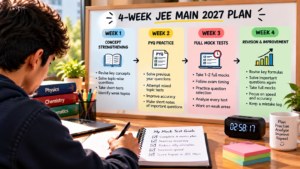
If you already have reasonable syllabus coverage, this four-week plan can help you establish a more structured routine.
Adapt it according to your preparation level and the time remaining before the examination.
| Week | Main focus | Suggested activities |
|---|---|---|
| Week 1 | Establish a baseline | Attempt one full-length mock, analyse mistakes and identify weak topics |
| Week 2 | Correct recurring errors | Revise weak chapters, practise related questions and attempt another mock |
| Week 3 | Improve execution | Practise question selection, timing and accuracy; attempt one or two mocks if time permits |
| Week 4 | Consolidate learning | Review previous mistakes, revise important concepts and attempt a mock under realistic conditions |
Daily Routine Between Mock Tests
Your non-test days should also contribute to improvement.
A practical routine could include:
- Concept revision: Review one or two weak topics.
- Question practice: Solve questions related to those topics.
- Error review: Reattempt questions you previously answered incorrectly.
- Formula revision: Review relevant formulas and key concepts.
- Short assessment: Take a topic-wise test to check your understanding.
You do not need to follow the same routine every day. Adjust the balance according to your needs.
For help organising your preparation hours, see our guide to a <a href=”https://aaopadhein.blog/study-timetable-for-competitive-exams/“>study timetable for competitive exams</a>.
9. Common Mistakes Students Make While Taking Mock Tests
Avoid these mistakes if you want your practice to translate into better examination performance.
Taking Tests Without Analysing Them
A test is incomplete as a learning activity if you never review the questions you got wrong.
Reserve time for analysis before scheduling your next test.
Comparing Every Score with Other Students
Different students may be attempting tests of different difficulty levels and at different stages of preparation.
Use other students’ experiences as a source of learning, not as the only measure of your progress.
Changing Your Strategy After Every Test
One difficult paper does not necessarily mean your entire approach is wrong.
Look for recurring patterns before making major changes to your strategy.
Ignoring the Syllabus
Mock tests are not a substitute for learning the syllabus.
Continue studying and revising the topics required for the examination.
Attempting Too Many Tests at the Cost of Revision
More testing is useful only when it supports learning.
If frequent mock tests leave you with no time to revise mistakes, reduce their frequency and improve the quality of your analysis.
Treating One Score as a Prediction of Your Final Result
A mock-test score reflects performance on a particular paper under particular conditions.
It cannot guarantee your eventual JEE Main score, percentile or rank.
Use the results to identify what you can improve rather than to make fixed predictions about the final examination.
10. Where Can You Practise JEE Main Mock Tests?
Choose practice resources that match the current syllabus and examination pattern.
You can consider the following options:
1. Official JEE Main website
Visit the <a href=”https://jeemain.nta.nic.in/“>official JEE Main website</a> for examination notices, information bulletins, question papers and other official updates when available.
2. National Test Abhyas
The <a href=”https://nta.ac.in/Abhyas“>National Test Abhyas platform</a> is provided by the National Testing Agency. Check the current availability of relevant tests and features before using it.
3. Aaopadhein study resources
Visit <a href=”https://aaopadhein.org/“>Aaopadhein</a> to explore available study materials, mock tests and practice resources for competitive examinations.
Before starting a test, confirm that its syllabus, question format and marking scheme are appropriate for your preparation needs.
Frequently Asked Questions
1. When should I start taking mock tests for JEE Main 2027?
Start with chapter-wise tests as you complete topics. Introduce mixed-topic and full-length tests as your syllabus coverage improves. You do not need to wait until the entire syllabus is finished before practising under timed conditions.
2. How many mock tests should I take before JEE Main?
There is no fixed number that guarantees success. Your test frequency should depend on your preparation level and the time available. Prioritise careful analysis and revision over completing a large number of tests without learning from them.
3. Should I take a full-length mock test every day?
Not necessarily. Daily full-length tests may leave insufficient time for concept revision and error correction. Choose a frequency that allows you to complete the test, analyse your performance and work on weaknesses before the next one.
4. What should I do if my JEE Main mock-test score is low?
Identify why your score was low. Check whether the problem came from conceptual gaps, incomplete syllabus coverage, calculation errors, poor time management or unsuitable question selection. Revise the relevant areas and practise similar questions before your next full-length test.
5. Are mock tests more important than previous-year questions?
Both serve different purposes. Previous-year questions help you understand how concepts have appeared in actual examinations, while mock tests help you practise the complete paper under timed conditions. Combining both is generally more useful than relying exclusively on either one.
6. Should I attempt a mock test before completing the syllabus?
Yes, you can begin with chapter-wise and mixed-topic tests. Full-length tests can also be useful for assessing time management and identifying gaps, provided you understand that your score will reflect the chapters you have and have not studied.
7. How should I analyse a JEE Main mock test?
Review incorrect answers, unattempted questions, guessed answers and questions that took too long. Identify the reason for each mistake, revise the relevant concept and solve similar questions. Record recurring errors so that you can track improvement.
8. Can mock tests guarantee a high JEE Main percentile?
No. Mock tests can help you practise and identify weaknesses, but they cannot guarantee a particular score, percentile or rank. Results depend on several factors, including preparation, accuracy, examination performance and the actual paper.
Conclusion
A good JEE Main mock test strategy is not about taking the maximum number of tests. It is about using each test to understand your preparation, identify mistakes and make specific improvements.
Start with chapter-wise practice, introduce full-length tests as your preparation develops and analyse every test carefully. Continue revising concepts and practising previous-year questions alongside your testing schedule.
Most importantly, do not let one low score discourage you or one high score make you complacent. Focus on the mistakes you can correct and the skills you can improve before the next test.
Prepare, practise, analyse and revise. Make every mock test an opportunity to learn something useful.