
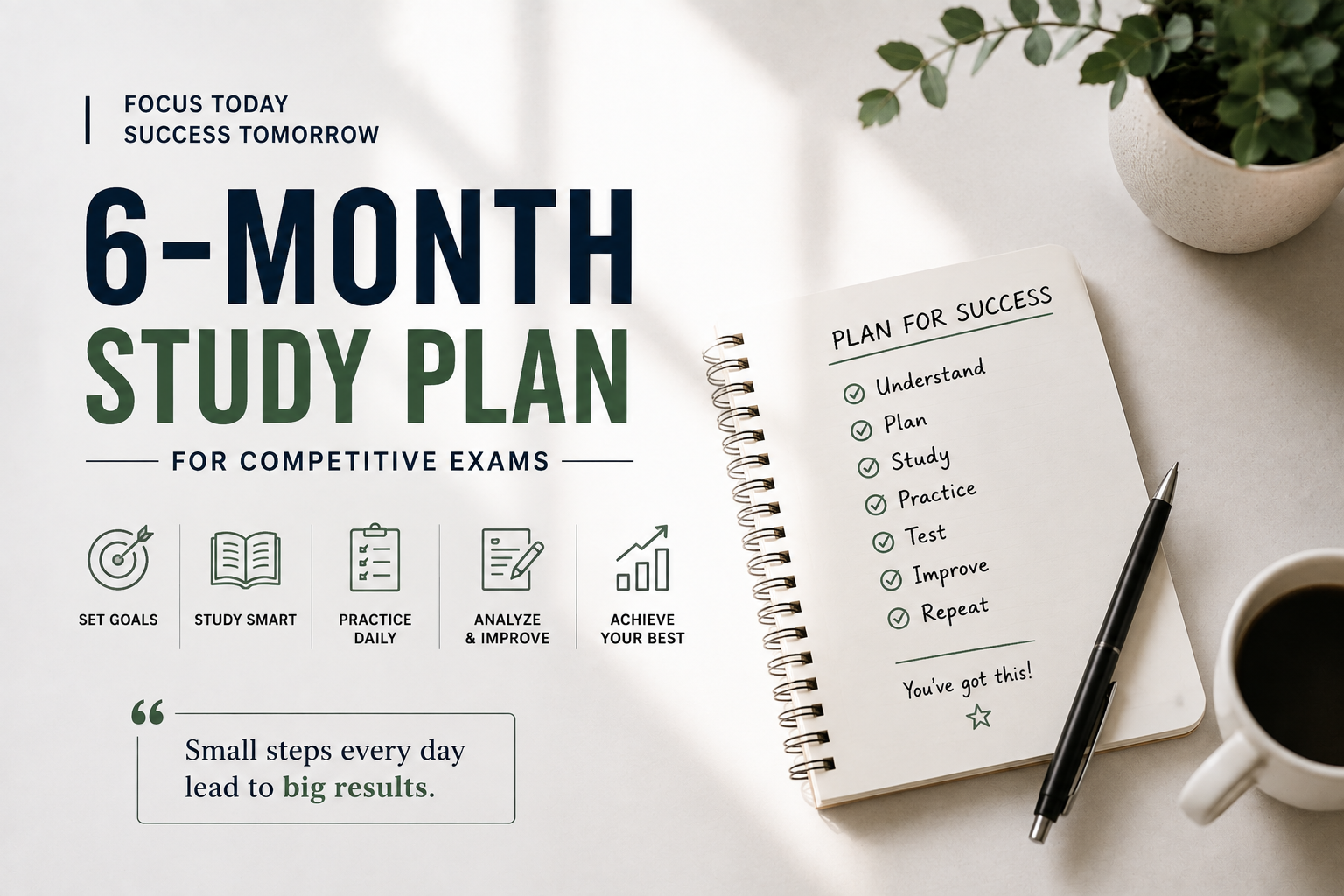
6 Month Study Plan for Competitive Exams: Imagine this.
You have six months before your exam.
Instead of spending those six months jumping between random YouTube videos, changing books every few weeks, scrolling through your phone, and worrying about how much everyone else is studying, you decide to follow one simple plan.
You study consistently.
You solve Previous Year Question Papers.
You take Mock Tests.
You analyse your mistakes.
And most importantly, you keep showing up every day.
Six months later, you are still the same student—but your preparation, confidence, speed and score can look completely different.
The good news is that you don’t need to be a genius to improve your performance in a competitive exam. You need the right strategy, consistent practice and a realistic study plan.
Whether you are preparing for JEE, CUET, SSC, Banking exams, Defence exams or another competitive examination, this 6-month study plan can help you organise your preparation and make the next six months more productive.
Why Six Months Can Make a Difference
Competitive exams are not usually won by studying for a few days before the examination. They are built through months of learning, practice, revision and testing.
The biggest advantage of having six months is that you have enough time to divide your preparation into different stages.
Instead of thinking:
“I have so much syllabus left. How will I finish?”
Think:
“What should I complete this month, this week and today?”
This small change in approach can make preparation much more manageable.
A good competitive exam preparation strategy should include four major components:
- Concept building
- Question practice
- PYQ practice
- Mock tests and analysis
Revision and consistency connect all four.
The 6-Month Preparation Framework
A simple way to structure your preparation is to divide the six months into six stages.
Month 1: Understand & Build
Month 2: Strengthen Concepts
Month 3: Master Previous Year Questions
Month 4: Increase Practice & Start Regular Mocks
Month 5: Identify and Eliminate Weaknesses
Month 6: Revision & Exam Simulation
This doesn’t mean every student has to follow the exact same timetable. Your exam, syllabus, current preparation level and available study time will determine the pace.
The framework simply gives you a direction.
Month 1: Understand the Exam and Build Your Foundation
Before studying for hours, understand what you are actually preparing for.
Many students make the mistake of opening a book immediately without checking the official syllabus or exam pattern.
During the first month, focus on understanding:
- Complete syllabus
- Exam pattern
- Number of sections
- Marking scheme
- Duration
- Previous year trends
- Important topics
- Your current strengths and weaknesses
Take one or two Previous Year Question Papers and look at the questions without worrying too much about your score.
Ask yourself:
- Which topics appear frequently?
- Which subjects are easier for me?
- Where am I making mistakes?
- Which topics do I already understand?
- Which chapters require more attention?
This gives you a realistic starting point.
Your Month 1 Goal
Build the foundation and create a sustainable study routine.
Don’t worry about completing everything immediately.
The goal is to understand the battlefield before entering it.
Month 2: Strengthen Your Concepts
Once you understand the syllabus, Month 2 should focus heavily on concept building.
For every topic:
Learn → Understand → Practise → Revise
Don’t spend your entire day watching lectures.
A lecture may explain a concept, but solving questions is what tells you whether you actually understood it.
For example, if you are preparing for a mathematics-based examination, don’t stop after understanding a formula. Solve different types of questions based on that formula.
Similarly, for subjects involving theory, don’t just read chapters repeatedly. Try questions and identify what you can and cannot recall.
Focus on:
- Important concepts
- Fundamental formulas
- Basic question types
- Topic-wise practice
- Short notes
- Regular revision
Your aim should be to gradually move from:
“I have studied this topic.”
to:
“I can solve questions from this topic.”
There is a big difference between the two.
Month 3: Make PYQs Your Best Friend
By the third month, you should start giving serious attention to Previous Year Question Papers.
PYQs are valuable because they show you what the actual examination expects.
Instead of randomly solving hundreds of questions, study the pattern behind them.
Look for:
- Repeated concepts
- Frequently tested topics
- Question difficulty
- Common traps
- Time-consuming questions
- Frequently used concepts
Use the Three-Round PYQ Strategy
Round 1: Understand
Solve questions without worrying too much about time.
Understand why an answer is correct and why your answer was wrong.
Round 2: Solve Independently
Return to the same topics later and attempt questions without looking at solutions.
Round 3: Timed Practice
Now solve questions under time pressure.
This gradually builds exam temperament.
Keep an error log or mistake notebook.
Whenever you make a mistake, record:
- Question/topic
- Your mistake
- Correct approach
- Why you made the mistake
- What you need to remember
Your mistake notebook can become one of your most useful revision resources.
Month 4: Practice More and Introduce Mock Tests
Now your preparation should start shifting from learning mode to performance mode.
This is where Online Mock Tests and Practice Tests become extremely important.
Start with manageable testing frequency and gradually increase it.
For example:
Beginning of Month 4:
One mock or full-length test per week.
Later in Month 4:
Two or more tests per week, depending on your exam.
Don’t focus only on your marks.
The real value of a mock test comes from its analysis.
After every test, ask:
What went wrong?
Was it:
- Lack of knowledge?
- Silly mistake?
- Calculation error?
- Poor time management?
- Guessing?
- Confusion between two options?
- Spending too much time on one question?
A student who scores 120 but carefully analyses every mistake can improve faster than a student who scores 150 but simply checks the answer and moves on.
Remember:
Taking a mock test tells you your score. Analysing the mock tells you how to improve it.
Month 5: Find and Eliminate Your Weak Areas
By Month 5, you should have enough test data to identify patterns.
Maybe you are consistently losing marks in one particular subject.
Maybe you know the concepts but take too long to solve questions.
Maybe your accuracy drops when you are under time pressure.
This month is about fixing those problems.
Use this simple cycle:
Identify → Practise → Test → Analyse → Revise
For example:
If your accuracy in a particular topic is poor:
- Revisit the concept.
- Solve basic questions.
- Move to exam-level questions.
- Attempt a sectional test.
- Analyse mistakes.
- Revise again.
Don’t try to eliminate every weakness in one week.
Work systematically.
Month 6: Revision and Exam Simulation
The final month should not become a panic month.
This is not the time to collect five new books, subscribe to ten new channels or completely change your strategy.
Focus on:
- Revision
- PYQs
- Mock tests
- Short notes
- Formula revision
- Error log
- Weak topics
- Exam-time practice
Try to recreate actual exam conditions during full-length tests.
Sit at the same time as your actual examination whenever practical.
Keep your phone away.
Follow the actual test duration.
Avoid unnecessary breaks.
This helps reduce the shock of sitting for a high-pressure examination.
The goal of the final month is simple:
Convert preparation into performance.
Visit Us On Instagram:https://www.instagram.com/reel/DX8l8jCSY3j/?igsh=MTZ2b2Q5cDd0eXNieg==
The 70-20-10 Preparation Framework
A useful planning framework for the six-month journey is:
70% — Practice
Spend the majority of your preparation time solving questions, PYQs, sectional tests and mock tests.
20% — Revision
Regularly revise concepts, formulas, notes and mistakes.
10% — New Learning
Use the remaining time to cover new concepts or topics.
This is not a universal formula that every student must follow exactly. Your percentage can change depending on how much syllabus you have already completed.
If you are starting from zero, you may initially need more time for learning.
If your syllabus is almost complete, practice and revision should take a larger share of your time.
A Practical Daily Study Plan
You don’t necessarily need to study 12–14 hours every day.
What matters is focused and consistent study.
A sample daily schedule could look like this:
| Activity | Suggested Time |
| Concept Learning | 2–3 hours |
| Question Practice | 2 hours |
| PYQs | 1 hour |
| Revision | 45 minutes |
| Test/Analysis | 30–60 minutes |
This is only a framework.
A school or college student may have fewer hours available, while a full-time aspirant may have more.
Don’t copy someone else’s timetable blindly.
Build a routine that you can realistically follow for six months.
Follow a Simple Weekly Study Cycle
A weekly routine can make your preparation easier to manage.
Monday to Friday
Focus on:
Concepts + Question Practice
Saturday
Focus on:
PYQs + Weak Topics
Sunday
Focus on:
Mock Test + Analysis + Revision
You can adjust this structure depending on your exam schedule.
The important thing is to have dedicated time for both learning and testing.
How to Use Mock Tests Correctly
A common mistake is treating mock tests as scorecards.
They are actually diagnostic tools.
After every Mock Test, divide your questions into four categories:
1. Correct and Confident
These are your strengths.
2. Correct but Guesswork
You need to improve your conceptual confidence.
3. Incorrect but Attempted
Identify the reason for the mistake.
4. Not Attempted
Ask whether you didn’t know the concept or simply ran out of time.
This analysis will tell you much more than your total score.
How to Improve Your Speed and Accuracy
Speed without accuracy is dangerous.
Accuracy without speed can also become a problem in time-bound examinations.
You need both.
Try these techniques:
- Practise with a timer.
- Solve easy questions first.
- Don’t spend too long on one question.
- Track repeated mistakes.
- Learn shortcuts only after understanding the concept.
- Take sectional tests.
- Gradually increase difficulty.
Your goal shouldn’t be:
“I have to attempt everything.”
It should be:
“I have to maximise my score within the available time.”
10 Mistakes That Can Waste Your Six Months
Six months sounds like a lot of time, but it can disappear quickly.
Avoid these common mistakes:
1. Waiting for the Notification
Don’t wait until the application form arrives to begin preparation.
2. Watching Lectures All Day
Learning without practice creates a false sense of preparation.
3. Ignoring PYQs
PYQs are among the most useful resources for understanding the actual exam.
4. Avoiding Mock Tests
A mock test may expose your weaknesses, but that’s exactly why you need it.
5. Not Analysing Mocks
Taking tests without analysing them wastes much of their value.
6. Changing Resources Constantly
One good book used properly is better than five unfinished books.
7. Ignoring Revision
If you don’t revise, previously learned concepts gradually become weaker.
8. Comparing Study Hours
Someone studying eight focused hours may achieve more than someone sitting with books for twelve distracted hours.
9. Following Someone Else’s Timetable
Your preparation should match your exam and your current level.
10. Letting Social Media Control Your Routine
Five minutes of scrolling can easily become an hour.
Your phone isn’t necessarily the enemy. Uncontrolled use is.
What Should You Do If You Are Starting From Zero?
Don’t panic.
Starting late does not mean you cannot improve.
First, understand the syllabus and identify high-priority topics.
Then divide your remaining time between:
Concepts → PYQs → Practice → Mocks → Revision
Don’t try to become perfect in every chapter immediately.
Build strong areas first, improve weak areas gradually, and keep testing yourself.
A realistic plan followed consistently is better than a perfect plan followed for three days.
Exam-Specific Preparation Approach
The basic six-month framework works across exams, but the emphasis should change depending on the examination.
JEE and Engineering Entrance Exams
Focus more on:
- Concept clarity
- Problem solving
- JEE Main Preparation
- Previous year questions
- Numerical practice
- Mock tests
For students preparing for engineering entrance examinations, Engineering Entrance Preparation and regular practice should be an important part of the routine.
CUET
Focus on:
- Official syllabus
- Subject preparation
- Concept revision
- Practice questions
- CUET Preparation
- Mock tests
Students should also keep track of official examination updates and changes.
SSC and Government Exams
Focus on:
- Quantitative Aptitude
- Reasoning
- English
- General Awareness
- Current Affairs
- Government Exam Preparation
- PYQs
- Sectional tests
- Full-length mocks
For aspirants preparing for government jobs, combining Government Exam Preparation with regular Online Mock Tests can help build exam familiarity.
Banking Exams
Banking examinations generally require a strong focus on:
- Speed
- Accuracy
- Quantitative Aptitude
- Reasoning
- English
- General Awareness
- Sectional practice
- Mock tests
Here, time management becomes especially important because solving questions quickly is not enough—you also need to minimise errors.
How Aaopadhein Can Help With Your Preparation
A good preparation plan is only the beginning. You also need the right resources to execute it.
Students preparing for competitive examinations can use Online Mock Tests, Practice Tests, Previous Year Question Papers, Free Study Resources, and Government Exam Preparation resources available through Aaopadhein.org.
If you’re still confused about which examination, course or career path is right for you, Career Counselling, Student Guidance, and Higher Education Guidance can help you make a more informed decision.
You don’t have to prepare blindly.
Use your syllabus, previous papers, test performance and progress data to decide what you should study next.
Your 6-Month 6 Month Study Plan for Competitive Exams at a Glance
Here’s the entire framework in one place:
| Month | Main Focus | Target |
| Month 1 | Syllabus + Basics | Build Foundation |
| Month 2 | Concepts + Practice | Strengthen Fundamentals |
| Month 3 | PYQs | Understand Exam Pattern |
| Month 4 | Mocks + Practice | Improve Speed & Accuracy |
| Month 5 | Weak Areas | Eliminate Mistakes |
| Month 6 | Revision + Simulation | Maximise Exam Performance |
Keep this table somewhere visible while preparing.
Frequently Asked Questions
Is six months enough to prepare for a competitive exam?
It depends on the examination, your current preparation level, syllabus and the number of hours you can consistently dedicate. Six months can provide a meaningful preparation window if used with a structured strategy.
How many hours should I study every day?
There is no universal number. Focused and consistent study is more important than simply counting hours. Build a schedule that you can realistically maintain for several months.
When should I start solving PYQs?
Start as early as possible. Initially, use them to understand question patterns. As your preparation improves, solve them independently and eventually under timed conditions.
When should I start taking mock tests?
You don’t need to wait until the entire syllabus is complete. Start with topic or sectional tests and gradually move toward full-length Mock Tests as your preparation progresses.
Are mock tests more important than studying theory?
Both are important, but they serve different purposes. Theory builds your understanding, while tests show whether you can apply that knowledge accurately and within a time limit.
What if I miss my daily study target?
Don’t abandon the entire plan because of one bad day. Review what happened, adjust the next day’s target realistically and continue.
Consistency means getting back on track—not being perfect every single day.
Final Thoughts: Your Next Six Months Matter
Six months may not sound like a long time.
But six months of focused preparation can completely change your level of confidence and performance.
You don’t need to study every waking hour.
You don’t need hundreds of resources.
And you don’t need to become a genius overnight.
You need a system.
Study the concepts.
Solve the questions.
Practise the PYQs.
Take the mocks.
Analyse your mistakes.
Revise.
Repeat.
Most importantly, don’t confuse motivation with preparation.
You may feel motivated today and exhausted tomorrow. That’s normal.
Your plan should work even on the days when motivation doesn’t.
So if you are preparing for an upcoming competitive exam, don’t ask yourself:
“Can I really improve my score in six months?”
Instead ask:
“What can I do today that my future self will thank me for?”
Start with one topic.
Solve a few questions.
Analyse one mistake.
Then do it again tomorrow.
Six months of small, consistent actions can create a result that looks anything but small.
And when you finally sit for your exam, you won’t just be hoping for a good score—you’ll know that you prepared for it.