
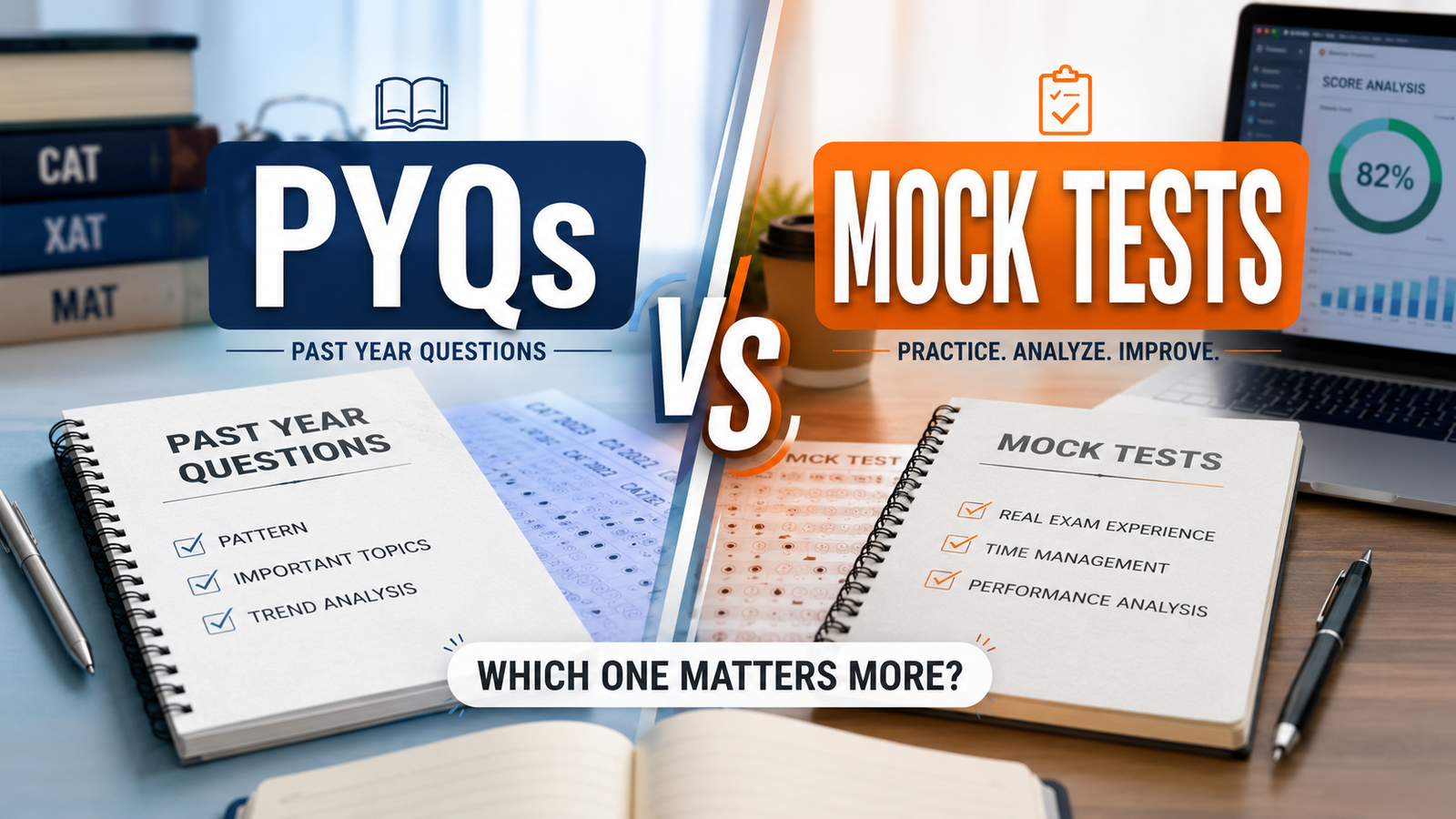
Mock Tests vs PYQs : If you are preparing for a competitive exam, you have probably heard the same two pieces of advice again and again:
“Solve Previous Year Question Papers.”
and
“Give as many Mock Tests as possible.”
But there is one question that confuses almost every student:
Mock Tests vs PYQs — which one is more important?
Should you spend your time solving questions that appeared in previous exams? Or should you take full-length mock tests to simulate the real examination?
The honest answer is: you need both, but they serve different purposes.
PYQs help you understand what the exam actually asks, while mock tests help you understand how well you can perform under exam conditions.
If PYQs teach you the language of the exam, mock tests teach you how to play the game.
In this guide, we will compare Mock Tests vs PYQs, understand their differences, benefits, limitations, the right time to use each, and how to combine both into an effective competitive exam preparation strategy.
What Are PYQs?
PYQ stands for Previous Year Questions or Previous Year Question Papers.
These are questions that were actually asked in previous editions of an examination.
For example, if you are preparing for JEE Main, CUET, SSC, Banking, Railway, Defence or another competitive examination, PYQs allow you to see the kinds of questions that candidates have faced in earlier years.
PYQs can help you understand:
- Question patterns
- Frequently tested concepts
- Difficulty level
- Important topics
- Question framing
- Repeated concepts
- Time required for different types of questions
This is why PYQ practice should be an important part of almost every serious preparation strategy.
What Are Mock Tests?
A mock test is a practice examination designed to replicate the actual exam experience.
A good Online Mock Test generally follows the actual examination’s structure as closely as possible.
Depending on the exam, it may replicate:
- Number of questions
- Section structure
- Time limit
- Marking scheme
- Difficulty level
- Question distribution
Mock tests are particularly useful for improving:
- Speed
- Accuracy
- Time management
- Question selection
- Exam temperament
- Confidence
Unlike PYQs, a mock test doesn’t necessarily contain questions that appeared in the actual examination.
Instead, it gives you an opportunity to practise performing under pressure.
Mock Tests vs PYQs: The Basic Difference
The easiest way to understand the difference is this:
| PYQs | Mock Tests |
| Actual previous exam questions | Simulated exam questions |
| Show real exam trends | Simulate exam conditions |
| Help understand question patterns | Help improve speed and time management |
| Useful for topic analysis | Useful for performance analysis |
| Best for understanding the examiner | Best for testing the student |
| Help identify important concepts | Help identify performance weaknesses |
| Can be solved topic-wise | Usually taken as sections or full exams |
| Essential for understanding the exam | Essential for exam-day practice |
So asking “Which is better?” is slightly misleading.
The better question is:
“What should I use PYQs for, and what should I use mock tests for?”
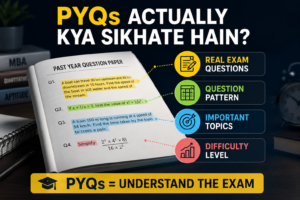
Why PYQs Are So Important
Imagine you are preparing for an exam without ever looking at its previous questions.
You may study everything.
But how do you know what the examination actually considers important?
That’s where PYQs become extremely valuable.
1. PYQs Show the Real Question Pattern
A syllabus tells you what can be tested.
PYQs show you what has actually been tested.
That distinction matters.
For example, a syllabus may contain ten different topics, but previous papers may show that some concepts appear much more frequently than others.
This helps you prioritise your preparation.
2. PYQs Help Identify Important Topics
When you solve multiple years of questions, patterns start becoming visible.
You may notice that:
- Certain concepts appear repeatedly.
- Some chapters consistently carry questions.
- Some question types are common.
- Certain concepts are tested in different ways.
This information can make your exam preparation strategy much more focused.
3. PYQs Help You Understand Difficulty Level
Students often prepare using questions that are either much easier or much harder than the actual examination.
PYQs give you a realistic benchmark.
You can ask:
“Are the questions I’m practising actually comparable to the level of my exam?”
That is a much better question than simply asking how many questions you solved.
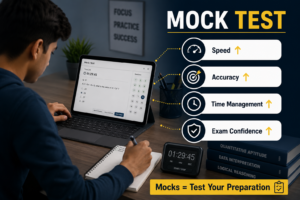
Why Mock Tests Are Equally Important
Now imagine that you have solved hundreds of PYQs.
You know the syllabus.
You understand the important topics.
But you have never attempted a complete test within the actual time limit.
You may still struggle on exam day.
Why?
Because knowing the concepts and performing under pressure are two different skills.
That’s where Mock Tests come in.
1. Mock Tests Improve Time Management
Competitive exams are usually time-bound.
You may know the answer to a question, but if you spend five minutes on it, you may lose the opportunity to solve several easier questions.
Mock tests help you understand:
- How much time you spend per question
- Which sections take longer
- When you should skip a question
- When you should move to another section
- How much time you should reserve for review
Over time, this improves your exam time management.
2. Mock Tests Improve Speed and Accuracy
Speed alone isn’t enough.
If you solve questions quickly but make too many mistakes, your score may not improve.
Similarly, if you solve everything accurately but take too long, you may not complete the paper.
A good mock test helps you work on both:
Speed + Accuracy
This is especially important in examinations where there is negative marking.
3. Mock Tests Reveal Your Actual Performance
Your preparation may feel strong while studying.
But your mock score gives you measurable evidence.
For example:
You may think your mathematics is strong.
Then your mock analysis shows that you are losing marks because of calculation mistakes.
Or perhaps your concepts are good, but you spend too much time on difficult questions.
This is valuable information.
A mock test acts like a mirror.
It shows you what is actually happening, not what you think is happening.
PYQs vs Mock Tests: Which Should You Start With?
This is where many students make a mistake.
They start taking full-length mock tests before understanding the exam.
If you are still building your concepts, a low score doesn’t necessarily mean you are bad at the exam.
It may simply mean your syllabus isn’t ready yet.
A better progression is:
Stage 1
Syllabus → Concepts → Topic Practice
Stage 2
PYQs → Topic Tests → Sectional Tests
Stage 3
Full-Length Mock Tests → Analysis → Revision
This creates a natural progression from learning to performance.
When Should You Solve PYQs?
Don’t wait until the final month.
You can start using PYQs as soon as you have covered enough of a topic.
For example:
You finish a chapter.
Then solve relevant PYQs.
Ask:
- What type of questions are asked?
- What concepts are repeatedly tested?
- How difficult are the questions?
- Where am I making mistakes?
This creates a feedback loop.
Learn → Solve PYQs → Identify Weakness → Revise → Practise Again
When Should You Start Mock Tests?
You also don’t need to wait until your entire syllabus is complete.
However, the type of test should change as your preparation progresses.
Early Preparation
Use:
- Topic tests
- Chapter tests
- Short quizzes
Middle Preparation
Use:
- Sectional tests
- Mixed-topic tests
- Timed practice
Advanced Preparation
Use:
- Full-length Online Mock Tests
- Complete exam simulations
- Strict time limits
This gradual approach prevents unnecessary pressure while still building exam readiness.
The Biggest Mistake: Taking Mock Tests Without Analysis
Let’s say you take a mock test.
You score 72%.
You check the answers.
Then you move to the next mock.
That’s not enough.
The real improvement happens after the test.
After every Practice Test, analyse:
Correct + Confident
These are your strong areas.
Correct + Guess
You need stronger conceptual confidence.
Incorrect
Find the exact reason.
Not Attempted
Determine whether the issue was knowledge, speed or question selection.
Time-Consuming
Identify questions where you spent too much time.
This analysis can be more valuable than the score itself.
The 4-Step Mock Test Analysis Method
Use this simple framework after every test:
Step 1: Check the Score
Understand your current performance.
Step 2: Categorise Mistakes
Divide errors into:
- Conceptual
- Calculation
- Silly mistake
- Time management
- Question selection
Step 3: Fix the Problem
Revise the relevant concept and practise similar questions.
Step 4: Re-Test
Return to the same topic after a few days and check whether the mistake has been eliminated.
This turns every mock test into a learning session.
The Best Strategy: Combine PYQs and Mock Tests
Instead of choosing between them, create a system where they support each other.
A simple cycle is:
Concept Learning
↓
PYQ Practice
↓
Topic/Sectional Test
↓
Mock Test
↓
Analysis
↓
Weak Topic Revision
↓
PYQ Repractice
↓
Another Mock Test
This creates continuous improvement.
The 60-40 Rule for Preparation
There is no universal percentage that every student must follow, but as a practical framework, you can initially allocate more time to PYQs and targeted practice and gradually increase mock-test frequency as the exam approaches.
For example:
Earlier Preparation
60% — Concepts + PYQs + Targeted Practice
40% — Tests + Analysis
Closer to Exam
40% — Revision + PYQs
60% — Mock Tests + Analysis + Exam Simulation
The exact ratio should depend on your preparation level.
If your concepts are weak, don’t blindly increase mock tests just because someone online said you should take ten tests a week.
A Six-Month PYQ + Mock Test Strategy
If you have six months before your examination, you can structure your preparation like this.
Month 1
Focus on:
- Syllabus
- Fundamentals
- Basic practice
- Topic-wise PYQs
Don’t worry about full-length mocks yet.
Month 2
Continue:
- Concepts
- PYQs
- Topic tests
- Revision
Start tracking your mistakes.
Month 3
Increase:
- PYQ practice
- Sectional tests
- Timed practice
Start becoming comfortable with exam-level questions.
Month 4
Introduce regular:
- Sectional tests
- Full-length tests
- Online Mock Tests
Begin detailed mock analysis.
Month 5
Focus heavily on:
- Full-length mocks
- Weak areas
- PYQ revision
- Speed
- Accuracy
- Time management
Month 6
Shift towards:
- Exam simulation
- Full-length mocks
- Important PYQs
- Error log revision
- Formula/short-note revision
- Final strategy
The objective is no longer to collect new resources.
It is to maximise your existing preparation.
How Many PYQs Should You Solve?
There is no magic number.
Quality matters more than simply counting questions.
Instead of saying:
“I solved 2,000 questions.”
Ask:
“How many of those questions did I understand?”
A smaller number of carefully analysed PYQs can be more valuable than thousands of questions solved mechanically.
Focus on:
- Understanding the concept
- Identifying patterns
- Reviewing mistakes
- Revisiting difficult questions
How Many Mock Tests Should You Take?
Again, there is no universal number.
Your mock frequency should depend on:
- Exam date
- Syllabus completion
- Preparation level
- Test duration
- Time available for analysis
A student preparing full-time may be able to take more tests than someone balancing school or college.
The important rule is:
Never take more mocks than you can properly analyse.
Three analysed mocks can be more valuable than ten tests you barely review.
PYQs or Mock Tests for JEE Preparation?
For JEE aspirants, both are important.
JEE Main Preparation should include strong conceptual understanding, extensive problem solving, Previous Year Question Papers, and regular mock tests.
PYQs help you understand actual JEE question patterns and concepts.
Mock tests help you practise the complete examination experience.
A good progression is:
Concepts → JEE PYQs → Topic Tests → Full-Length Mocks
PYQs or Mock Tests for CUET?
For students following a CUET Preparation strategy, understanding the official syllabus and question pattern is essential.
PYQs and relevant practice questions help you understand the examination style.
Mock tests can then help you improve:
- Speed
- Accuracy
- Time management
- Question selection
Again, both tools have different purposes.
PYQs or Mock Tests for Government Exams?
For Government Exam Preparation, PYQs are particularly useful because they help aspirants understand recurring concepts, question patterns and difficulty levels.
For exams such as SSC, Banking, Railway and other competitive examinations, combine:
PYQs + Sectional Tests + Full-Length Mock Tests
If you are preparing for multiple government examinations with overlapping syllabi, PYQs can also help identify common topics.
You can supplement your preparation with Government Exam Preparation resources and Online Mock Tests.
What If Your Mock Score Is Low?
Don’t panic.
A low mock score doesn’t automatically mean you will get a low exam score.
A mock test is designed to expose your weaknesses.
Instead of thinking:
“I’m not good enough.”
Ask:
“Why did I lose these marks?”
Maybe you need:
- More revision
- Better time management
- More PYQs
- Better question selection
- More practice in one subject
- Fewer careless mistakes
Use the score as feedback, not as a final judgement.
Common Mistakes Students Make With PYQs and Mocks
Mistake 1: Solving PYQs Only Once
Important questions should be revisited.
Mistake 2: Memorising Answers
Understand the concept behind the question.
Mistake 3: Taking Mocks for Social Media Scores
Your goal isn’t to tell people how many tests you took.
Your goal is to improve your actual performance.
Mistake 4: Ignoring Negative Marking
Accuracy matters.
Mistake 5: Not Maintaining an Error Log
Repeated mistakes are easier to eliminate when you track them.
Mistake 6: Taking Too Many Tests
More tests don’t automatically mean better preparation.
Mistake 7: Avoiding Difficult Questions Completely
Understand why you find them difficult and practise strategically.
So, Mock Tests vs PYQs: Which Is More Important?
Now let’s answer the original question.
PYQs are more important for understanding the exam.
They show you what has actually been asked.
Mock Tests are more important for measuring your preparation.
They show you how well you can perform under pressure.
So if you are at the beginning of your preparation, prioritise:
Concepts + PYQs + Targeted Practice
As your exam approaches, increase:
Mock Tests + Analysis + Revision
The best students don’t choose one over the other.
They use both at the right time.
The Ultimate PYQ + Mock Test Framework
If you remember only one framework from this article, remember this:
LEARN
Understand the concept.
↓
PRACTISE
Solve topic-based questions.
↓
PYQ
Understand how the real exam tests the concept.
↓
TEST
Attempt sectional or full-length tests.
↓
ANALYSE
Find mistakes and time-management problems.
↓
REVISE
Fix your weak areas.
↓
REPEAT
Take another test and measure improvement.
This is how preparation becomes a process instead of random studying.
How Aaopadhein Can Help You Practise
Having the right strategy is important, but consistent practice is what turns the strategy into results.
If you’re looking for Online Mock Tests, Practice Tests, Previous Year Question Papers, and Free Study Resources, you can explore the preparation resources available on Aaopadhein.org.
Students who are still deciding which exam, course or career path to pursue can also explore Career Counselling, Student Guidance, and Higher Education Guidance through Aaopadhein.com.
The objective isn’t simply to study more.
It is to study with a system, test yourself regularly and use your performance data to decide what to do next.
Final Verdict
So, Mock Tests vs PYQs — which is more important?
The answer is simple:
PYQs teach you the exam. Mock tests train you for the exam.
You need both.
Use PYQs to understand the examiner’s thinking.
Use mock tests to understand your own performance.
Use analysis to identify your weaknesses.
Use revision and practice to fix them.
And then repeat the process.
Because a good score doesn’t usually come from solving the maximum number of questions.
It comes from solving the right questions, understanding your mistakes, managing your time, and consistently improving your performance.
So don’t spend the next few months asking:
“Should I solve PYQs or take mock tests?”
Build a system where you do both.
Learn. Practise. Solve PYQs. Take mocks. Analyse. Improve. Repeat.
That’s a much stronger preparation strategy than simply counting how many hours you studied or how many tests you completed.