Engineering Without JEE – For many Class 12 students, engineering starts with one assumption:
“Agar JEE nahi diya ya JEE mein achha score nahi aaya, toh engineering ka option khatam.”
But that’s not true.
Engineering without JEE is absolutely possible.
JEE Main is one of the most important engineering entrance examinations in India, especially for admission to NITs, IIITs and several other institutions. However, it is not the only pathway to pursue BTech or BE.
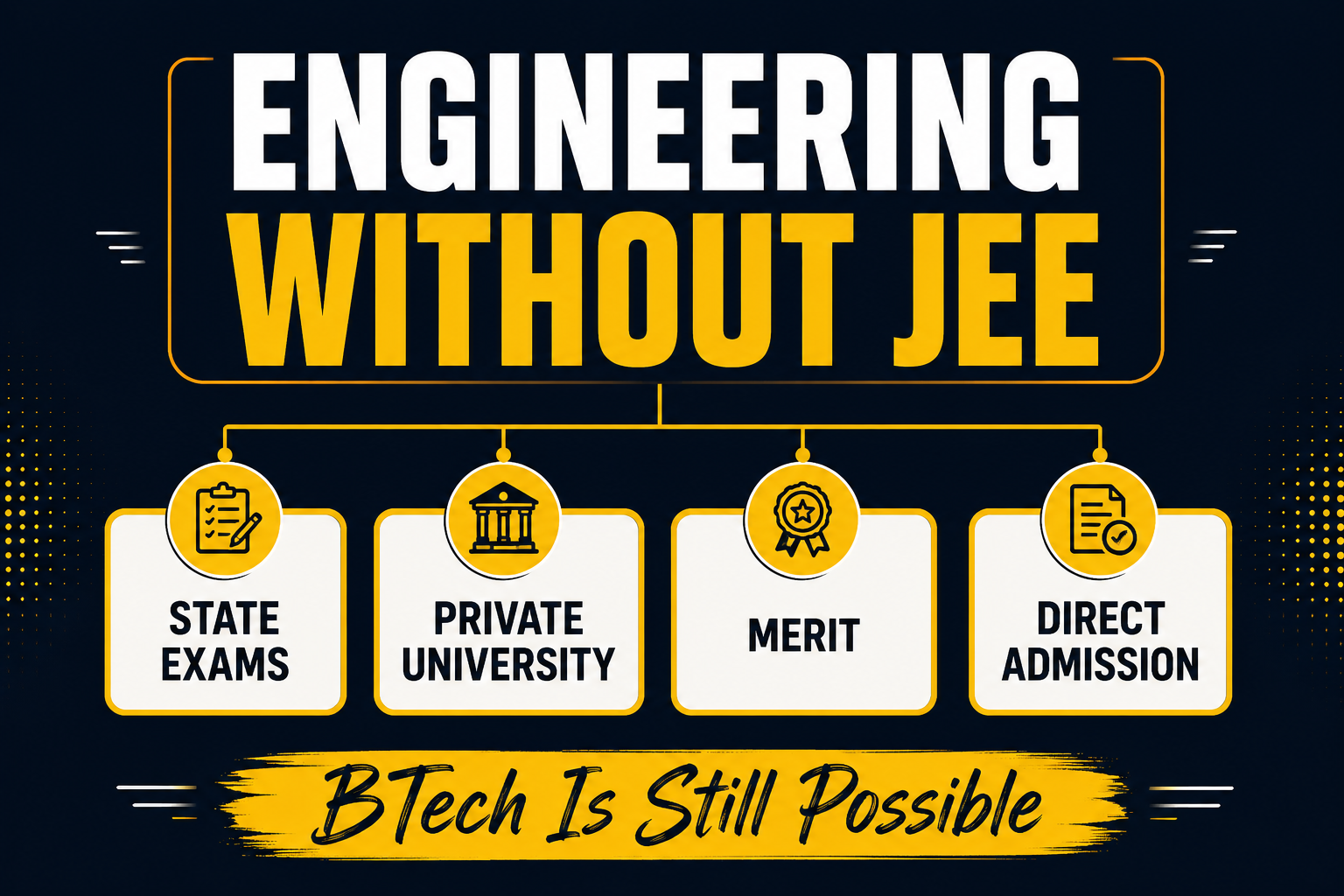
Students can explore state-level engineering entrance exams, private university entrance tests, merit-based admissions, institute-specific examinations and, in some colleges, direct admission routes.
The important thing is not to choose a college simply because admission is available without JEE.
You still need to compare:
- College reputation
- Course quality
- Fees
- Placement record
- Average package
- Infrastructure
- Faculty
- Internship opportunities
- Industry exposure
- Accreditation
- Return on investment
So, if you’re a Class 12 student wondering “Can I do engineering without JEE?”, this guide will help you understand your options, eligibility, admission routes, fees, colleges and career opportunities.
Can You Do Engineering Without JEE?
Yes, you can pursue engineering without JEE Main.
JEE Main is not mandatory for admission to every engineering college in India.
Depending on the college and state, students may get admission through:
- State-level entrance examinations
- Private university entrance examinations
- University-specific entrance tests
- Merit-based admission
- Counselling based on qualifying examination marks
- Other recognised entrance examinations
However, the admission route depends completely on the institution.
For example, some colleges may require their own entrance examination, while others may consider Class 12 marks or another recognised examination.
Therefore, students should always check the official admission criteria of the college before applying.
Why Do Students Look for Engineering Without JEE?
There are several reasons.
Some students don’t appear for JEE Main.
Others appear but don’t get the rank or percentile they expected.
Some students may not want to spend another year preparing for competitive entrance exams.
Others may simply want to explore colleges that offer a different admission pathway.
And there is nothing wrong with that.
Your engineering career is not automatically decided by your JEE rank.
Your skills, branch, college environment, internships, projects, communication skills and practical knowledge can also play an important role in your career.
The real question is:
If you’re not using JEE, which engineering admission route gives you the best combination of college quality, affordability and career opportunities?
Best Ways to Get Admission in Engineering Without JEE
Let’s look at the major options available to students.
1. State-Level Engineering Entrance Exams
Several states conduct their own engineering entrance examinations or counselling processes.
Depending on the state, admission may be based on:
- State entrance exam
- Class 12 marks
- JEE Main score
- A combination of eligibility criteria
Some state-level exams and admission systems have historically included examinations such as:
- MHT CET
- WBJEE
- KCET
- AP EAMCET / AP EAPCET
- TS EAMCET / TS EAPCET
- KEAM
- OJEE
The exact rules, participating colleges and admission criteria can change from year to year.
So if you’re specifically interested in a state, check the official examination authority before applying.
Why Consider State Entrance Exams?
They can open access to engineering colleges that you may not be able to enter through your JEE route.
For students who want to study engineering within a particular state, this can be a useful alternative.
2. Private University Entrance Exams
Many private universities conduct their own entrance examinations.
These can provide another route for students interested in BTech admission without JEE Main.
Depending on the university, admission may involve:
- University entrance test
- Class 12 marks
- Counselling
- Personal interaction
- Merit-based selection
- A combination of multiple criteria
Examples of private universities with their own admission processes may include institutions such as:
- VIT
- SRM
- Manipal
- Amity
- Shiv Nadar
- UPES
- KIIT
However, the exact examination and eligibility requirements vary by institution.
Some universities may accept multiple entrance examinations, while others may have their own tests.
Therefore, don’t assume that “private university” automatically means “direct admission.”
Always verify the current admission policy.
3. Merit-Based Engineering Admission
Another route is merit-based admission.
Some colleges and universities offer admission based partly or entirely on Class 12 performance, depending on their rules and available seats.
This can be particularly useful for students who have:
- Good PCM marks
- Not appeared for JEE
- Not achieved the desired JEE result
- A preference for private or university-level institutions
However, merit-based admission does not mean that every student will automatically get admission to every branch.
The college may have minimum eligibility requirements, subject requirements and branch-specific criteria.
4. Direct Admission in Some Private Colleges
Some private institutions may offer admission through their own eligibility and counselling process without requiring JEE Main.
This is commonly searched by students as:
“BTech direct admission without JEE.”
But students need to be careful here.
Easy admission does not automatically mean good education.
Before paying an admission fee, check:
- University recognition
- Accreditation
- Course approval where applicable
- Placement statistics
- Average package
- Recruiters
- Internship opportunities
- Total fees
- Hostel costs
- Refund policy
- Previous placement records
A college should be selected because it offers value, not simply because admission is easy.
Eligibility for Engineering Without JEE
The eligibility criteria depend on the college and admission route.
However, for many BTech programmes, students generally need to have completed Class 12 with relevant subjects.
For engineering, the common subject combination is:
Physics + Mathematics + Chemistry / relevant third subject
The exact requirements vary by programme.
Some colleges may specify:
- Minimum percentage in Class 12
- Minimum marks in Physics and Mathematics
- Specific subject combinations
- Age criteria
- Entrance test requirements
For example, Computer Science Engineering may have specific PCM requirements.
Therefore, students should always check the eligibility criteria of the particular college and course.
Also Read : JEE Main Preparation 2027: Ultimate Guide to Crack the Exam with the Best Strategy
Can PCM Students Do Engineering Without JEE?
Yes.
If you’re a Class 12 PCM student, JEE is not the only examination or admission route available to you.
You can explore:
State entrance exams
Private university entrance exams
Merit-based BTech admission
University-specific examinations
Other recognised engineering entrance routes
The important thing is to create a Plan B before the admission season becomes stressful.
Best Engineering Courses Without JEE
Not every student has to choose Computer Science.
Engineering offers several branches.
Computer Science Engineering
One of the most popular choices because of opportunities in:
- Software development
- Data analytics
- Cloud computing
- Cybersecurity
- Artificial intelligence
- Product development
Artificial Intelligence & Machine Learning
A growing specialisation focused on:
- Machine learning
- Data
- AI systems
- Automation
- Intelligent applications
Information Technology
IT programmes can lead to careers in:
- Software
- Networks
- Systems
- Cloud
- Enterprise technology
Electronics & Communication Engineering
ECE can open opportunities across:
- Electronics
- Semiconductor industry
- Embedded systems
- Communication technology
- VLSI
- Hardware
Mechanical Engineering
Career opportunities can include:
- Manufacturing
- Automotive
- Design
- Production
- Robotics
- Industrial engineering
Civil Engineering
Career paths include:
- Construction
- Infrastructure
- Structural engineering
- Transportation
- Urban development
- Government projects
The best branch depends on your interests, strengths and career goals—not simply what is currently trending.
Best Colleges for Engineering Without JEE
There is no single universal list of “best colleges without JEE.”
The right college depends on the admission route, location, budget, branch and career goals.
Students can explore different categories:
State Engineering Colleges
These may admit students through state-level examinations or state counselling.
Private Universities
Many private universities have independent admission systems.
Deemed / Private Institutions
Some institutions conduct their own entrance examinations or accept multiple admission routes.
University-Affiliated Colleges
Some colleges may follow university or state-level admission processes.
When comparing colleges, don’t focus only on rankings.
Look at the complete picture.
How Much Does Engineering Cost Without JEE?
The BTech fees without JEE can vary significantly.
There is no fixed fee simply because you are not using JEE.
Your total cost may depend on:
- College
- University
- Engineering branch
- Location
- Hostel
- Scholarships
- Admission route
- Other institutional charges
Private engineering universities can have substantially higher tuition fees than government institutions.
In addition to tuition fees, students should calculate:
Tuition + Hostel + Food + Examination Fees + Books + Laptop + Transportation + Other Charges
This gives you a more realistic estimate of the total cost.
Don’t Choose a College Only Because It Accepts Direct Admission
This is probably the most important warning for students.
Imagine two colleges.
College A
Easy admission.
Low entrance requirements.
High advertised “highest package.”
Limited placement transparency.
College B
Slightly more competitive admission.
Better academic environment.
Transparent placement data.
Stronger recruiter network.
Better internship opportunities.
Which one should you choose?
The answer should not be based only on admission difficulty.
A college is a four-year investment.
You should evaluate the ROI of engineering education.
How to Check Placement Data Before Admission
This is especially important for students choosing BTech without JEE.
Don’t look only at:
Highest Package: ₹50 LPA
That number alone tells you very little.
Instead, check:
- Total graduating students
- Number of students placed
- Placement percentage, if available
- Average package
- Median package
- Branch-wise placement data
- Recruiters
- Internship opportunities
- Higher studies
- Placement year
- Whether the data is institution-wide or branch-specific
For example, a ₹50 lakh highest package sounds impressive.
But if the average package is significantly lower, you need to understand the complete distribution.
This is why students should learn how to check college placement data before admission.
Engineering Without JEE: What About Placements?
One of the biggest misconceptions is:
“If I don’t get admission through JEE, I won’t get a good job.”
That’s not necessarily true.
Recruiters generally don’t hire students simply because they entered college through JEE.
Your career can depend on several factors, including:
- College
- Branch
- Skills
- Projects
- Internships
- Coding ability
- Communication
- Problem-solving
- Technical knowledge
- Interview performance
A student from a non-JEE admission route can build a strong career by developing relevant skills.
However, college quality still matters.
That is why you should never use “without JEE” as the only criterion for selecting an institution.
Skills Matter More Than Just the Degree
Suppose you pursue BTech CSE.
Your degree alone won’t automatically make you a software engineer.
During college, you should consider developing:
- Programming fundamentals
- Data Structures and Algorithms
- Database knowledge
- Web or application development
- Git/GitHub
- Cloud fundamentals
- Communication skills
- Problem-solving
- Industry projects
Similarly, ECE students can explore:
- Embedded systems
- VLSI
- Electronics design
- Programming
- Communication systems
Your college provides the environment.
Your skills help you take advantage of that environment.
Is Engineering Without JEE a Good Option?
Yes—if you choose the college and course carefully.
Engineering without JEE can be a practical option when:
- You don’t want to take a drop year
- Your JEE result wasn’t as expected
- You want to explore private universities
- You have access to a good state-level admission route
- You want a specific college or programme
- You have a realistic budget
- The college offers good academic and career opportunities
But it becomes risky when the only reason for choosing a college is:
“Admission is easy.”
Easy admission should never replace proper research.
Engineering Without JEE vs Engineering Through JEE
| Factor | Through JEE | Without JEE |
| Admission route | JEE-based for participating institutions | State/private/university/merit routes |
| College options | NITs, IIITs and participating institutions | State/private/university options |
| Competition | Generally high | Depends on admission route |
| Fees | Varies widely | Varies widely |
| Branch options | Depends on rank and counselling | Depends on college and seat availability |
| Preparation | JEE preparation required | Depends on admission route |
| Career potential | Depends on college, branch and skills | Depends on college, branch and skills |
The key point is:
Admission route and career outcome are not the same thing.
How to Choose the Right Engineering College Without JEE
Before taking admission, use this checklist.
1. Check Recognition
Make sure the institution and programme meet the applicable regulatory and accreditation requirements.
2. Compare Fees
Calculate the complete four-year cost.
3. Check Placement Data
Look beyond the highest package.
4. Check Branch-Wise Outcomes
Overall university placement numbers may not represent every branch.
5. Look at Recruiters
Check whether companies relevant to your target career recruit from the institution.
6. Check Internships
Internships can provide valuable industry exposure.
7. Visit or Research the Campus
Look at labs, classrooms, hostels and student facilities.
8. Talk to Current Students
Student experiences can reveal things that brochures don’t.
9. Check Curriculum
See whether the course includes relevant practical and industry-oriented subjects.
10. Calculate ROI
Compare the total cost of education with realistic career outcomes.
What Should You Do If Your JEE Score Is Low?
First, don’t panic.
A low JEE score doesn’t mean your career is over.
You have several possible options.
Option 1: Explore Other Entrance Exams
Check state and university-level engineering entrance examinations.
Option 2: Explore Private Universities
Compare colleges based on placements, fees and academic quality.
Option 3: Consider Other Courses
If engineering isn’t the right fit, explore other career options after PCM.
Option 4: Consider a Drop Year Carefully
A drop year may make sense for some students, but it should be a planned decision—not an emotional reaction to one result.
The right choice depends on your goals, preparation level and circumstances.
Is BTech Without JEE Worth It?
It can be.
But the better question is:
“Is this particular BTech college worth the investment?”
That’s the question you should ask before paying admission fees.
Evaluate:
College Quality + Course + Fees + Placements + Skills + ROI
If these factors make sense together, admission without JEE can be a perfectly valid route.
Final Takeaway
Engineering without JEE is not a shortcut. It is simply a different admission pathway.
If you didn’t appear for JEE, didn’t get the expected score, or simply want to explore alternatives, you still have options.
You can explore:
- State-level engineering entrance exams
- Private university entrance exams
- University-specific admission tests
- Merit-based BTech admission
- Direct admission routes offered by eligible institutions
But don’t make the mistake of choosing a college only because it offers admission without JEE.
Your four years of engineering can significantly influence your academic foundation, skills, internships, network and early career opportunities.
So before taking admission, compare:
Eligibility → Fees → Course → College → Placements → Internships → ROI
And remember one thing:
JEE can open certain doors, but it is not the only door to an engineering career.
What matters is what you do with the opportunity once you enter.
If you’re a Class 12 student exploring BTech admission, comparing colleges or looking for the right career options after 12th Science, don’t make the decision based on one exam result.
Research your alternatives.
Compare the numbers.
Understand the admission process.
And choose the college that makes sense for your career, budget and long-term goals.