
Important update: As of August 21, 2026, NTA’s official JEE Main website lists the 2026 Information Bulletin as the latest bulletin; I could not find an official JEE Main 2027 exam-pattern announcement yet. Therefore, this article uses the latest officially published pattern as the reference point and clearly separates confirmed information from what is yet to be announced for 2027.
JEE Main 2027 Exam Pattern at a Glance
If you’re preparing for JEE Main 2027, understanding the exam pattern is just as important as completing the syllabus.
The latest JEE Main Paper 1 pattern used for B.E./B.Tech. has three subjects:
- Mathematics
- Physics
- Chemistry
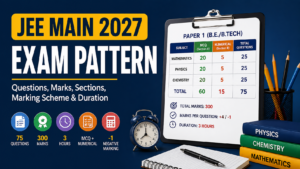
Each subject has 25 questions, making 75 questions in total. The paper carries 300 marks and is conducted for 3 hours. Each subject has 20 Multiple Choice Questions (MCQs) and 5 Numerical Value Questions.
Latest Paper 1 pattern
| Particular | Latest pattern |
| Paper | Paper 1 – B.E./B.Tech. |
| Mode | Computer-Based Test |
| Subjects | Mathematics, Physics, Chemistry |
| Total questions | 75 |
| Questions per subject | 25 |
| MCQs per subject | 20 |
| Numerical Value Questions per subject | 5 |
| Total marks | 300 |
| Marks per question | 4 |
| Negative marking | -1 for an incorrect answer |
| Unattempted question | 0 |
| Duration | 3 hours |
For JEE Main 2027: these details should be treated as the latest reference pattern, not as a confirmed 2027 notification, until NTA publishes the 2027 bulletin.
Is the JEE Main 2027 Exam Pattern Released?
Not yet, based on the official NTA information currently available.
NTA’s JEE Main website currently lists the 2026 Information Bulletin as the latest bulletin. The official site also continues to publish JEE Main 2026 documents, question papers and notices.
This distinction matters because students often search for “JEE Main 2027 exam Guide” and may come across websites presenting the previous year’s pattern as if it has already been officially confirmed for 2027.
At Aaopadhein, we recommend using the latest official pattern for preparation while checking the NTA website whenever the 2027 Information Bulletin is released.
Check the official JEE Main website
JEE Main Paper 1 Exam Pattern for B.E./B.Tech.
For students targeting B.E. or B.Tech. through JEE Main, Paper 1 is the most relevant paper.
It consists of:
- Mathematics
- Physics
- Chemistry
Each subject contributes 100 marks, giving the paper a maximum of 300 marks. The latest pattern has 25 questions in each subject.
Subject-wise breakdown
| Subject | Section A | Section B | Total Questions | Marks |
| Mathematics | 20 MCQs | 5 Numerical | 25 | 100 |
| Physics | 20 MCQs | 5 Numerical | 25 | 100 |
| Chemistry | 20 MCQs | 5 Numerical | 25 | 100 |
| Total | 60 | 15 | 75 | 300 |
This means you should not prepare only for MCQs. Numerical Value Questions also form an important part of the paper.
JEE Main Section A: Multiple Choice Questions
Section A contains 20 MCQs in each subject.
Each question has four options, with one correct answer.
For the latest pattern:
- Correct answer: +4 marks
- Incorrect answer: -1 mark
- Unattempted: 0 marks
Negative marking applies to Section A.
Why this matters
An MCQ isn’t simply worth four marks.
A wrong answer can cost you one mark.
For example, suppose you answer:
- 15 correctly = 60 marks
- 3 incorrectly = -3 marks
- 2 left unanswered = 0
Your score from those 20 questions would be:
60 – 3 = 57 marks
This is why accuracy matters almost as much as speed.
JEE Main Section B: Numerical Value Questions
Section B contains 5 Numerical Value Questions per subject in the latest pattern.
Unlike MCQs, these questions do not give you four answer options.
You solve the problem and enter the numerical answer.
The latest pattern applies:
- Correct answer: +4
- Incorrect answer: -1
- Unattempted: 0
The numerical answer is entered using the computer interface and is rounded to the nearest integer where specified by the paper instructions.
One major change students should know
Students who remember the older JEE Main pattern may remember having 10 numerical questions and choosing 5.
That is outdated for the current pattern.
NTA discontinued the optional-question arrangement in Section B beginning with JEE Main 2025, and the subsequent 2026 pattern has five compulsory numerical questions per subject.
So don’t prepare with an old pattern simply because an older coaching video or PDF still shows the previous structure.
JEE Main Marking Scheme
The marking scheme is one of the most important parts of the exam pattern.
For Paper 1
| Response | Marks |
| Correct answer | +4 |
| Incorrect answer | -1 |
| Unattempted | 0 |
The same +4/-1 principle applies to both MCQs and Numerical Value Questions in the latest Paper 1 pattern.
Example
If you attempt 75 questions and get:
- 60 correct
- 15 incorrect
Your raw score would be:
60 × 4 – 15 × 1 = 225 marks
This is your raw marks, not your percentile.
Is There Negative Marking in JEE Main?
Yes.
For the latest Paper 1 pattern, there is negative marking for incorrect answers in both:
- Section A — MCQs
- Section B — Numerical Value Questions
A wrong answer costs 1 mark. An unattempted question receives 0 marks.
This makes random guessing a poor strategy.
Instead, students should develop the ability to identify:
Attempt → Skip → Return Later
rather than trying to answer every question immediately.
How Much Time Do You Get in JEE Main?
For Paper 1, the standard examination duration is 3 hours.
That gives you:
180 minutes for 75 questions.
On average, that works out to around 2.4 minutes per question.
But don’t interpret this as:
“I should spend 2.4 minutes on every question.”
That’s not how a good JEE Main strategy works.
Some questions may take 30–60 seconds.
Others may require several minutes.
Your goal is to manage the overall paper, not maintain an identical time limit for every question.
How Should You Divide Your Time?
There is no single perfect time division for every student.
However, you can experiment with a structure such as:
| Stage | Approx. time |
| First pass | 90–100 minutes |
| Second pass | 45–55 minutes |
| Difficult questions/review | 20–30 minutes |
| Final checking | 5–10 minutes |
This is a strategy to test in mocks, not an official NTA rule.
Your ideal time division will depend on whether you are stronger in Mathematics, Physics or Chemistry.
Which Subject Should You Attempt First?
There is no official requirement that you attempt the subjects in a particular order.
You can develop your own sequence.
For example:
Strategy 1: Chemistry → Physics → Mathematics
Useful if Chemistry is your fastest subject.
Strategy 2: Physics → Chemistry → Mathematics
Useful if you are comfortable solving Physics quickly.
Strategy 3: Mathematics → Physics → Chemistry
Can work for students who are strongest in Mathematics.
The best order is the one that gives you the highest accuracy in your mock tests.
Don’t copy a topper’s subject order simply because it worked for them.

JEE Main Exam Pattern: Paper 2A and Paper 2B
JEE Main isn’t only for B.E./B.Tech.
NTA also conducts:
- Paper 2A — B.Arch
- Paper 2B — B.Planning
These have different structures from Paper 1.
Paper 2A — B.Arch
The latest pattern includes:
- Mathematics
- Aptitude Test
- Drawing Test
The paper has 77 questions and carries 400 marks. Mathematics has 25 questions, the Aptitude Test has 50 questions, and the Drawing Test has 2 questions.
Paper 2A overview
| Component | Questions | Marks |
| Mathematics | 25 | 100 |
| Aptitude Test | 50 | 200 |
| Drawing Test | 2 | 100 |
| Total | 77 | 400 |
The Drawing Test is conducted separately from the computer-based portions.
Paper 2B — B.Planning
Paper 2B is designed for students targeting B.Planning.
It consists of:
- Mathematics
- Aptitude Test
- Planning-based questions
The latest structure has 100 questions for 400 marks.
Paper 2B overview
| Component | Questions | Marks |
| Mathematics | 25 | 100 |
| Aptitude Test | 50 | 200 |
| Planning | 25 | 100 |
| Total | 100 | 400 |
If your goal is B.E./B.Tech., however, Paper 1 is the section of this article you should focus on most.
What Changed in the JEE Main Pattern?
One of the most important recent changes was the removal of optional questions from Section B.
During the COVID-era pattern, students could choose a limited number of numerical questions from a larger set.
NTA announced the discontinuation of optional questions in Section B for JEE Main 2025.
The current pattern therefore requires students to prepare more comprehensively instead of relying on the ability to skip several numerical questions.
What this means for JEE Main 2027 preparation
Don’t build your preparation around:
“I’ll skip this chapter because I can choose another numerical question.”
A safer approach is:
Complete the syllabus → practice every major topic → improve accuracy → use mocks to decide what to attempt first.
JEE Main Exam Pattern vs JEE Main Syllabus
These two things are different.
Syllabus tells you:
What to study.
For example:
- Mechanics
- Electrostatics
- Organic Chemistry
- Calculus
- Coordinate Geometry
Exam pattern tells you:
How you will be tested.
For example:
- Number of questions
- Question types
- Marks
- Negative marking
- Duration
- Sections
That’s why students should understand both before creating a preparation plan.
👉 If you haven’t checked it yet, read our JEE Main 2027 syllabus guide before building your chapter-wise study plan.

How the Exam Pattern Should Change Your Preparation
Knowing the pattern is useful only if you use it to improve your preparation.
- Practice both MCQs and numerical questions
Don’t spend months practicing only MCQs.
The latest Paper 1 structure includes both types.
Your practice should therefore include:
Concept → MCQ → Numerical → PYQ → Mock test
- Take negative marking seriously
A student who knows the concept but makes too many careless attempts can lose valuable marks.
During practice, track:
- Correct answers
- Incorrect answers
- Unattempted questions
- Time taken
Your goal isn’t simply to increase attempts.
Your goal is to increase net marks.
- Practice under a time limit
Solving a chapter without a time limit is useful during the learning stage.
But eventually you need to practice under exam conditions.
For example:
25 Physics questions → timed practice
Then:
25 Chemistry questions → timed practice
Then:
25 Mathematics questions → timed practice
Eventually move to:
75 questions → 3-hour full test
How Many Questions Should You Attempt in JEE Main?
There is no magic attempt number that guarantees a high percentile.
The current Paper 1 pattern has 75 questions, and all 75 are part of the paper.
The better question is:
How many questions can you attempt accurately?
For example, attempting 70 questions with many incorrect answers isn’t automatically better than attempting fewer questions with high accuracy.
Because of negative marking, your strategy should focus on accuracy + speed + question selection.
Should You Attempt Every Question?
Not necessarily.
Although the latest Paper 1 structure contains 75 questions, you should not blindly attempt a question simply because it is available.
A practical approach is:
Round 1
Attempt questions you can solve confidently.
Round 2
Return to questions that require moderate calculation.
Round 3
Try difficult questions only if you have enough time and a reasonable chance of getting them correct.
This reduces unnecessary negative marking.
JEE Main Mock Test Strategy
Your mock tests should eventually reproduce the real examination environment.
That means:
- 3-hour duration
- 75 questions
- Physics + Chemistry + Mathematics
- No unnecessary breaks
- Proper time management
- Analysis after the test
But taking a mock test is only half the job.
The real improvement comes from analysing it.
After every test, create four categories:
| Category | What it tells you |
| Correct + confident | Strength |
| Correct + guessed | Risk |
| Incorrect | Weakness/carelessness |
| Unattempted | Concept or time issue |
This gives you a much better preparation roadmap than simply looking at your final score.
Common Mistakes Students Make With the JEE Main Exam Pattern
Mistake 1: Preparing from an old pattern
JEE Main has changed over the years.
Old videos and PDFs can contain outdated rules.
Fix: Always verify the latest pattern using NTA’s official information.
Mistake 2: Ignoring numerical questions
Some students focus almost entirely on MCQs.
Fix: Include numerical-value practice from the beginning.
Mistake 3: Treating every question equally
A difficult question can consume several minutes.
Fix: Learn question selection and move on when necessary.
Mistake 4: Taking too many mocks without analysing them
Ten unanalysed mocks can be less useful than a smaller number of properly analysed tests.
Fix: Spend time reviewing mistakes after every mock.
Mistake 5: Chasing attempts instead of marks
More attempts don’t automatically mean a better score.
Fix: Track accuracy and net marks.
JEE Main 2027 Exam Pattern Preparation Checklist
Before your preparation gets serious, make sure you understand:
- Paper 1 is for B.E./B.Tech.
- Mathematics, Physics and Chemistry are included.
- Latest Paper 1 pattern has 75 questions.
- Each subject has 25 questions.
- Each subject has 20 MCQs and 5 numerical questions.
- Total marks are 300.
- Correct answers receive +4.
- Incorrect answers receive -1.
- Unattempted questions receive 0.
- Standard Paper 1 duration is 3 hours.
- Section B no longer follows the old “choose 5 out of 10” format.
- The official 2027 pattern should be checked once NTA releases the 2027 bulletin.
The first ten points reflect the latest published pattern; the final point is particularly important because JEE Main 2027 has not yet received its official bulletin on the NTA site as of August 21, 2026.
Frequently Asked Questions
How many questions are there in JEE Main?
For the latest Paper 1 pattern for B.E./B.Tech., there are 75 questions: 25 each from Mathematics, Physics and Chemistry.
How many marks is JEE Main Paper 1?
Paper 1 carries 300 marks under the latest pattern.
Is there negative marking in JEE Main?
Yes. In the latest Paper 1 pattern, an incorrect answer carries -1 mark, while a correct answer carries +4.
How many numerical questions are there in JEE Main?
There are 5 Numerical Value Questions per subject in the latest Paper 1 pattern.
Are Section B questions optional?
No. The old option of choosing 5 questions from 10 in Section B was discontinued. The current pattern has 5 numerical questions per subject, with all five included in the paper.
How long is the JEE Main exam?
The standard duration for Paper 1 is 3 hours.
Is the JEE Main 2027 exam pattern officially released?
Not as of August 21, 2026. NTA’s official JEE Main website currently lists the 2026 Information Bulletin as the latest bulletin.
Is JEE Main conducted for B.Arch and B.Planning too?
Yes. JEE Main also includes Paper 2A for B.Arch and Paper 2B for B.Planning, which have different structures from Paper 1.
Final Takeaway
Understanding the JEE Main exam pattern is not just about memorising the number of questions.
It tells you how you need to prepare.
For the latest Paper 1 pattern, you need to be ready for:
75 questions → 300 marks → 3 hours → 20 MCQs + 5 numerical questions per subject → +4 for correct → -1 for incorrect.
But remember one important point: the 2027 pattern has not yet been officially announced by NTA. Use the latest published pattern as your preparation reference, and verify the official 2027 Information Bulletin when NTA releases it.
The best way to use the pattern is to combine it with your syllabus:
Know the syllabus → understand the pattern → practise PYQs → take timed mocks → analyse mistakes → improve accuracy.
Continue your JEE Main preparation
After understanding the pattern, the next useful step is to see how to turn the syllabus into a realistic preparation plan.
👉 JEE Main 2027 Syllabus
👉 JEE Main 2027 Preparation Strategy
👉 JEE Main 2027 Complete Guide