
If you are preparing for CLAT 2027, understanding the syllabus and exam pattern should be one of your first steps.
Before choosing books, joining a coaching programme or starting full-length mocks, you need to know what CLAT actually tests, how the 120 questions are distributed, which sections carry more weight and what kind of skills each section requires.
The official CLAT 2027 syllabus makes one thing particularly clear: the UG examination is designed to test the comprehension, reasoning and aptitude skills required for legal education, rather than simply testing prior knowledge of law. (Consortium of NLUs)
If you haven’t yet read our broader CLAT guide, start there first:
CLAT 2027: Ultimate Guide to Exam Date, Eligibility, Syllabus, Pattern & Preparation →
This article then goes one level deeper into the CLAT 2027 syllabus and exam pattern.
Quick answer: CLAT 2027 UG is a 2-hour offline exam with 120 multiple-choice questions carrying 120 marks. There are five sections: English Language, Current Affairs including General Knowledge, Legal Reasoning, Logical Reasoning and Quantitative Techniques. Each incorrect answer attracts a 0.25-mark penalty. (Consortium of NLUs)
CLAT 2027 Exam Pattern at a Glance
| Particular | CLAT 2027 UG |
| Exam mode | Offline |
| Duration | 2 hours |
| Total questions | 120 |
| Maximum marks | 120 |
| Question type | Multiple-choice questions |
| Marks per correct answer | +1 |
| Negative marking | -0.25 |
| Total sections | 5 |
| English Language | 22–26 questions |
| Current Affairs + GK | 28–32 questions |
| Legal Reasoning | 28–32 questions |
| Logical Reasoning | 22–26 questions |
| Quantitative Techniques | 10–14 questions |
The section-wise question counts are approximate ranges specified by the Consortium of NLUs. (Consortium of NLUs)
What Is the CLAT 2027 Exam Pattern?
The CLAT 2027 UG question paper contains 120 multiple-choice questions.
Each correct answer gives you 1 mark, while every incorrect answer results in a deduction of 0.25 marks. The total duration is two hours.
The five sections are:
- English Language
- Current Affairs, including General Knowledge
- Legal Reasoning
- Logical Reasoning
- Quantitative Techniques
The examination is scheduled to be conducted in offline mode.
This pattern tells us something important about CLAT preparation.
It isn’t enough to memorise information.
You also need to develop:
- Reading speed
- Passage comprehension
- Critical thinking
- Logical reasoning
- Application skills
- Calculation ability
- Accuracy
- Time management
CLAT 2027 Section-Wise Weightage
According to the official question-paper format, the approximate distribution is:
| Section | Questions | Approx. Weightage |
| English Language | 22–26 | 20% |
| Current Affairs, including General Knowledge | 28–32 | 25% |
| Legal Reasoning | 28–32 | 25% |
| Logical Reasoning | 22–26 | 20% |
| Quantitative Techniques | 10–14 | 10% |
| Total | 120 | 100% |
Current Affairs including General Knowledge and Legal Reasoning have the highest approximate weightage at 25% each.
But don’t make the mistake of thinking that the 10% Quantitative Techniques section doesn’t matter.
In a competitive examination, even a relatively small section can make a meaningful difference to your final score.
CLAT 2027 Syllabus: What Are the Five Sections?
The official syllabus divides CLAT 2027 UG into five subject areas:
- English Language
- Current Affairs Including General Knowledge
- Legal Reasoning
- Logical Reasoning
- Quantitative Techniques
The Consortium describes CLAT as an aptitude and skills-based examination rather than an examination requiring extensive prior knowledge of law.
Let’s understand each section.
- CLAT 2027 English Language Syllabus
The English Language section uses passages of approximately 450 words.
These passages may be taken from contemporary or historically significant fiction and non-fiction. The official syllabus indicates that the passages are intended to be at a level that a Class 12 student can read in approximately 5–7 minutes. (Consortium of NLUs)
Questions can test your ability to:
- Understand the main idea
- Identify arguments and viewpoints
- Draw inferences
- Draw conclusions
- Summarise a passage
- Compare and contrast viewpoints
- Understand words and phrases in context
What does this mean for students?
CLAT English is not simply about memorising vocabulary.
Imagine you receive a passage discussing technology and education.
You might be asked:
- What is the author’s central argument?
- Which statement can be inferred?
- What does a particular phrase mean in the passage?
- Which option best summarises the author’s position?
- How do two viewpoints differ?
So, reading comprehension is the foundation of this section.
How to Prepare for CLAT English
Develop a regular reading habit.
You can read:
- Newspaper editorials
- Essays
- Long-form articles
- Non-fiction
- Quality magazines
- Books
But don’t read passively.
After finishing an article, ask yourself:
What is the central idea?
What is the author’s position?
What evidence does the author provide?
What conclusion can I draw?
This turns ordinary reading into CLAT preparation.
- CLAT 2027 Current Affairs Including General Knowledge
Current Affairs including General Knowledge is one of the two largest sections of the CLAT paper, with approximately 28–32 questions. (Consortium of NLUs)
The official syllabus says the passages may come from news, journalistic sources and other non-fiction writing.
The section can cover areas including:
- Important events in India
- Important international events
- Arts and culture
- International affairs
- Historical events of continuing significance
The questions may involve information or legal knowledge discussed in the passage, but candidates are not expected to have additional knowledge of law beyond what the passage provides.
How Should You Prepare for Current Affairs?
Don’t try to memorise every headline you see.
Instead, build context around important events.
For every major event, ask:
What happened?
Who is involved?
Where did it happen?
Why is it important?
What is the background?
What could be its broader significance?
For revision, make short notes rather than copying entire articles.
A useful current-affairs note can contain:
Topic:
Important event
What happened:
2–3 line summary
Key people/institutions:
Names you need to remember
Background:
Why the event matters
Important facts:
Dates, agreements, organisations etc.
Why it matters:
One short explanation
This makes revision significantly easier.
- CLAT 2027 Legal Reasoning Syllabus
Legal Reasoning carries approximately 28–32 questions, making it one of the highest-weighted sections. (Consortium of NLUs)
But there is a misconception that often scares beginners:
You do not need prior knowledge of law to attempt CLAT Legal Reasoning.
The official syllabus explicitly says that prior knowledge of law is not required for this section. (Consortium of NLUs)
The section can contain passages involving:
- Legal matters
- Public policy
- Moral questions
- Philosophical enquiries
- Fact situations
- Scenarios
You are then expected to identify principles and apply them to the given situation. (Consortium of NLUs)
What Does Legal Reasoning Test?
You may need to:
- Identify a rule or principle
- Infer a principle from the passage
- Apply a principle to a fact situation
- Understand how changing a rule changes its application
Think of the process as:
Read → Identify the principle → Understand the facts → Apply the principle → Choose the answer
That’s very different from simply memorising legal definitions.
How to Prepare for Legal Reasoning
Start with passage-based practice.
Whenever you encounter a principle, ask:
What exactly is the rule?
What facts have been provided?
Does the rule apply to those facts?
Which answer follows from the principle?
A general awareness of contemporary legal and moral issues can also be useful when applying principles to situations, according to the official syllabus.
- CLAT 2027 Logical Reasoning Syllabus
Logical Reasoning accounts for approximately 20% of the paper, with around 22–26 questions.
The official syllabus describes a series of passages of approximately 450 words followed by questions. (Consortium of NLUs)
The questions can require you to:
- Identify arguments
- Identify premises and conclusions
- Analyse reasoning
- Evaluate evidence
- Understand how conclusions depend on premises
- Determine how changing evidence affects conclusions
- Draw inferences
- Apply inferences to new situations
- Identify relationships and analogies
- Identify contradictions
- Identify equivalence
- Evaluate arguments
How to Prepare for Logical Reasoning
Logical Reasoning improves through practice and analysis.
A useful cycle is:
Learn → Practise → Make mistakes → Analyse → Practise again
Don’t just check whether your answer was right or wrong.
Find out why.
For example, did you:
- Misread the passage?
- Miss an assumption?
- Confuse a premise with a conclusion?
- Choose an option that sounded reasonable but wasn’t supported?
- Run out of time?
Understanding your mistakes is where much of the improvement happens.
- CLAT 2027 Quantitative Techniques Syllabus
Quantitative Techniques is the smallest section by weightage, accounting for approximately 10% of the paper, with around 10–14 questions.
The official syllabus describes questions based on numerical information presented through short sets of facts, propositions or other textual representations.
Students may need to:
- Derive numerical information
- Manipulate numerical information
- Apply mathematical operations
- Interpret information from the question
The syllabus includes areas such as:
- Ratios and proportions
- Basic algebra
- Mensuration
- Statistical estimation
The mathematical level is approximately Class 10. (Consortium of NLUs)
How to Prepare for Quantitative Techniques
If maths isn’t your strongest subject, don’t panic.
You don’t need to approach CLAT Quantitative Techniques like an advanced mathematics examination.
Start with the basics.
Step 1: Strengthen concepts
Understand what the formula actually means.
Step 2: Practise basic questions
Build confidence.
Step 3: Move to CLAT-style questions
Learn to extract information from the passage.
Step 4: Improve calculation speed
Practise regularly.
Step 5: Work on accuracy
Negative marking means careless calculation can cost you marks.
CLAT 2027 Negative Marking Explained
CLAT 2027 follows this marking system:
| Response | Marks |
| Correct answer | +1 |
| Incorrect answer | -0.25 |
| Unattempted | 0 |
The official question-paper format confirms the 0.25-mark deduction for every wrong answer. (Consortium of NLUs)
Example
Suppose you attempt 100 questions.
You get:
- 80 correct
- 20 incorrect
Your score would be:
80 − (20 × 0.25)
= 80 − 5
= 75 marks
This is why accuracy matters.
Your goal shouldn’t be:
“I need to attempt everything.”
Your goal should be:
“I need to maximise my accurate score within two hours.”
Try Solving PYQs and Mock Tests.
How Much Time Do You Get in CLAT 2027?
The CLAT 2027 UG examination is two hours long. (Consortium of NLUs)
With 120 questions in 120 minutes, the mathematical average is approximately one minute per question.
But don’t treat that as a fixed rule.
A passage might take several minutes to read, followed by multiple questions that can be answered relatively quickly.
Another question might require additional calculation or reasoning.
Therefore, effective CLAT time management is about managing passages and questions, not mechanically spending one minute on every question.
Is There One Perfect Time Strategy for CLAT?
No.
Your ideal strategy will depend on your strengths.
A student who reads quickly may be comfortable moving through English and Logical Reasoning faster.
Another student may need additional time for Quantitative Techniques.
The best way to find your strategy is through timed sectional tests and mocks.
Track:
- Time taken
- Questions attempted
- Correct answers
- Incorrect answers
- Questions left
- Reasons for mistakes
After several tests, you’ll start seeing a pattern.
CLAT 2027 Syllabus: What Should You Study First?
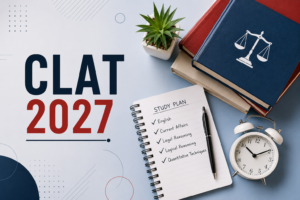
If you are a beginner, don’t try to master all five sections simultaneously.
Build your preparation step by step.
Start with Reading
English, Legal Reasoning and Logical Reasoning all require strong comprehension skills.
Build Current Affairs Consistency
Don’t leave current affairs for the final few months.
Practise Reasoning
Legal and Logical Reasoning need regular passage practice.
Strengthen Maths
Build your Class 10-level fundamentals for Quantitative Techniques.
Introduce Timed Practice
Once your basic skills improve, begin sectional tests.
Move to Full Mocks
Use full-length mocks to develop your final exam strategy.
How Class 11 Students Can Use the CLAT 2027 Syllabus
If you’re currently in Class 11, your biggest advantage is time.
You don’t need to rush into intensive mock-test preparation immediately.
Instead, focus on developing the skills that take time to build.
Your priorities can be:
- Regular reading
- Vocabulary through context
- Current-affairs awareness
- Logical reasoning practice
- Legal reasoning fundamentals
- Basic quantitative skills
- Gradual exposure to CLAT-style passages
The objective at this stage is not to finish everything quickly.
It’s to build a strong foundation.
How Class 12 Students Can Prepare
Class 12 students have another responsibility: board examinations.
Your CLAT preparation should therefore be realistic.
Don’t create a timetable that looks impressive on paper but becomes impossible to follow.
Instead:
- Maintain regular CLAT practice
- Keep current affairs consistent
- Practise reasoning every week
- Use weekends for longer tests
- Increase mock frequency as the examination approaches
- Keep your board preparation protected
Consistency is more useful than an unrealistic schedule.
Do You Need to Study Law Before CLAT?
No.
This is worth repeating because it is one of the most common misconceptions among beginners.
The official CLAT 2027 syllabus states that candidates do not require prior knowledge of law to attempt Legal Reasoning. (Consortium of NLUs)
So don’t spend your preparation trying to memorise an entire law curriculum.
Instead, learn to:
Understand a principle → Apply it to facts → Reach a logical conclusion.
That’s much closer to the skill being tested.
CLAT 2027 Preparation Strategy Based on the Weightage
The official distribution gives us:
- English Language: approximately 20%
- Current Affairs + GK: approximately 25%
- Legal Reasoning: approximately 25%
- Logical Reasoning: approximately 20%
- Quantitative Techniques: approximately 10% (Consortium of NLUs)
But don’t simply divide your study hours using those percentages.
Your personal strengths and weaknesses matter.
For example, suppose you are already excellent at English but struggle with Quantitative Techniques.
Even though English has twice the approximate weightage of Quantitative Techniques, spending additional time improving your weakest area could produce a bigger improvement in your overall score.
A better formula is:
Section weightage + personal weakness + personal strength = study priority
A Practical Weekly CLAT 2027 Study Plan
Here’s a simple example for students who are building their preparation:
| Day | Focus |
| Monday | English + Current Affairs |
| Tuesday | Legal Reasoning + Quantitative Techniques |
| Wednesday | Logical Reasoning + Current Affairs |
| Thursday | English + Legal Reasoning |
| Friday | Logical Reasoning + Quantitative Techniques |
| Saturday | Current Affairs revision + mixed practice |
| Sunday | Timed test + mistake analysis |
This is not an official timetable.
It is simply a practical structure you can adapt around school, coaching and other commitments.
How to Find Your Weakest CLAT Section
Don’t decide based only on how difficult a subject feels.
Use your test results.
For example:
| Section | Attempted | Correct | Incorrect | Accuracy |
| English | 24 | 20 | 4 | 83% |
| Current Affairs | 30 | 21 | 9 | 70% |
| Legal Reasoning | 30 | 25 | 5 | 83% |
| Logical Reasoning | 24 | 18 | 6 | 75% |
| Quantitative Techniques | 12 | 7 | 5 | 58% |
In this example, Quantitative Techniques deserves additional attention.
This data-driven approach is much better than simply saying:
“I’m weak in maths.”
Find the exact problem.
Is it concepts?
Calculation?
Time?
Question interpretation?
Or accuracy?
Common CLAT 2027 Preparation Mistakes
- Treating CLAT Like a Memorisation Exam
CLAT tests comprehension, reasoning and aptitude. (Consortium of NLUs)
Memorisation alone won’t build those skills.
- Ignoring Reading
Reading is central to several sections.
- Treating Legal Reasoning Like a Law Degree
Prior legal knowledge isn’t required for the Legal Reasoning section. (Consortium of NLUs)
- Ignoring Quantitative Techniques
It has fewer questions, but those marks still count.
- Taking Mocks Without Analysing Them
Your mock score tells you where you are.
Your mock analysis tells you how to improve.
- Chasing Speed at the Cost of Accuracy
Remember: wrong answers attract negative marking.
- Following Outdated Information
CLAT information can change.
Always verify important examination details against the latest official Consortium information.
CLAT 2027 Syllabus vs What You Actually Need to Practise
| Section | Approx. Weightage | Main Skill |
| English Language | 20% | Reading + comprehension |
| Current Affairs + GK | 25% | Awareness + contextual understanding |
| Legal Reasoning | 25% | Principle application |
| Logical Reasoning | 20% | Critical analysis |
| Quantitative Techniques | 10% | Numerical reasoning + accuracy |
This is one of the most useful ways to look at the CLAT syllabus.
Don’t just ask:
“What chapters do I have to complete?”
Ask:
“What skill does this section require me to develop?”
That shift can completely change how you prepare.
What Should You Do After Understanding the CLAT 2027 Syllabus?
Once you understand the pattern, don’t immediately buy every book or course you find.
Follow a simple progression:
Step 1: Understand the five sections
Know what each section tests.
Step 2: Take a diagnostic test
Find your current level.
Step 3: Identify your weaknesses
Use actual performance data.
Step 4: Build your reading habit
Make reading part of your daily routine.
Step 5: Start reasoning practice
Work on Legal and Logical Reasoning consistently.
Step 6: Build current-affairs knowledge
Revise regularly rather than postponing everything.
Step 7: Strengthen Quantitative Techniques
Start with the basics.
Step 8: Practise previous-year questions
Understand how questions are framed.
Step 9: Take sectional tests
Improve section-specific speed and accuracy.
Step 10: Start full-length mocks
Eventually practise the complete two-hour experience.
CLAT 2027 Exam Pattern: Quick Revision
Before you leave, remember these key numbers:
120 questions
120 marks
2 hours
5 sections
0.25 negative marking
22–26 English questions
28–32 Current Affairs + GK questions
28–32 Legal Reasoning questions
22–26 Logical Reasoning questions
10–14 Quantitative Techniques questions (Consortium of NLUs)
And remember the bigger picture:
CLAT is designed to assess comprehension, reasoning and aptitude skills needed for legal education—not simply prior knowledge of law. (Consortium of NLUs)
Frequently Asked Questions About CLAT 2027 Syllabus & Exam Pattern
How many questions are there in CLAT 2027?
The CLAT 2027 UG paper contains 120 multiple-choice questions. (Consortium of NLUs)
How many marks is CLAT 2027 worth?
The paper carries a maximum of 120 marks, with one mark for each correct answer. (Consortium of NLUs)
What is the duration of CLAT 2027?
The UG examination is two hours long. (Consortium of NLUs)
Is there negative marking in CLAT 2027?
Yes. 0.25 marks are deducted for every incorrect answer. (Consortium of NLUs)
How many sections are there in CLAT 2027?
There are five sections:
- English Language
- Current Affairs including General Knowledge
- Legal Reasoning
- Logical Reasoning
- Quantitative Techniques (Consortium of NLUs)
Which sections have the highest weightage?
Current Affairs including General Knowledge and Legal Reasoning each account for approximately 25% of the paper. (Consortium of NLUs)
How many questions are asked from Quantitative Techniques?
Approximately 10–14 questions are allocated to Quantitative Techniques. (Consortium of NLUs)
What level of mathematics is required for CLAT 2027?
The official syllabus places the mathematical concepts at approximately the Class 10 level. (Consortium of NLUs)
Do I need prior knowledge of law for CLAT Legal Reasoning?
No. The official syllabus says prior knowledge of law is not required for attempting the Legal Reasoning section. (Consortium of NLUs)
Is CLAT 2027 conducted offline?
Yes. The official instructions state that CLAT 2027 will be conducted in offline mode. (Consortium of NLUs)
Final Takeaway
The CLAT 2027 syllabus can initially look overwhelming because it covers five different sections.
But when you break it down, the examination is built around a few core abilities:
Read.
Understand.
Reason.
Apply.
Calculate.
Choose accurately.
The official CLAT 2027 pattern consists of 120 questions carrying 120 marks, to be completed in two hours, with five sections and 0.25-mark negative marking for an incorrect answer. (Consortium of NLUs)
So your preparation shouldn’t be about completing the maximum number of books.
It should be about becoming better at the skills the examination actually tests.
And if you’re starting in Class 11 or Class 12, building these skills consistently can give you a much stronger foundation than trying to complete everything in the final months.
Official CLAT 2027 Sources
For examination information, always verify the latest updates from the Consortium of NLUs:
CLAT 2027 Official Question Paper Format
CLAT 2027 Official Instructions