

Thinking about doing an MBA but worried because you don’t want to take the CAT?
Don’t worry—CAT is not the only route to an MBA in India.
While the Common Admission Test is one of the most important management entrance exams in the country, several business schools use other national-level exams, institute-level tests, or alternative admission routes for their MBA/PGDM programmes.
You can explore options through exams such as XAT, NMAT, SNAP, CMAT, MAT, GMAT and other institute-specific entrance tests. Some universities may also have their own admission tests or alternative pathways. However, the exact eligibility and selection process varies from college to college.
For example, SNAP is mandatory for the MBA programmes offered through the Symbiosis admission process, while CMAT is a national-level management entrance examination whose scores are accepted by AICTE-approved institutions and participating management institutes. (SNAP 2026)
So, if CAT isn’t your plan, that doesn’t mean your MBA journey has to stop.
In this guide, we’ll explain how to do an MBA without CAT, which entrance exams you can consider, what types of colleges accept alternative scores, eligibility requirements, admission procedures, and how to choose the right route for you.
Important: MBA admission rules, accepted exams, fees and eligibility can change every admission cycle. Always verify the current requirements directly on the official website of the college before applying.
MBA Without CAT: Quick Overview
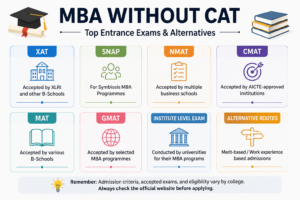
| Route | Entrance Exam / Method | Examples of Where It Can Be Used |
|---|---|---|
| XAT | Xavier Aptitude Test | XLRI and participating B-schools |
| SNAP | Symbiosis National Aptitude Test | Symbiosis MBA programmes |
| NMAT | NMAT by GMAC | Participating B-schools |
| CMAT | Common Management Admission Test | AICTE-approved/participating institutes |
| MAT | Management Aptitude Test | Participating B-schools |
| GMAT | GMAT | Selected MBA programmes |
| Institute-level exam | College/university’s own test | Certain universities |
| Alternative admission route | Depends on institute | Selected programmes |
The important point is that “MBA without CAT” does not mean “MBA without an entrance exam.”
In many cases, you simply replace CAT with another accepted examination.
Can You Do an MBA Without CAT?
Yes.
CAT is not a universal requirement for every MBA programme in India.
Different business schools establish their own admission criteria. Some accept XAT, some use SNAP, some accept NMAT or CMAT, and some universities conduct their own entrance tests.
For example, Symbiosis International University’s MBA admission process requires candidates to take SNAP for the MBA programmes covered under its SNAP process. The official SNAP website currently lists 17 Symbiosis institutes and 29 MBA programmes associated with the 2026 test. (SNAP 2026)
Similarly, CMAT is conducted by the National Testing Agency and is a national-level entrance examination for management programmes. NTA states that CMAT scores are accepted by AICTE-approved institutions, university departments, constituent colleges and affiliated colleges. (CMAT)
So the better question isn’t:
“Can I get an MBA without CAT?”
It is:
“Which MBA colleges fit my profile and accept an entrance exam I can take?”
That change in thinking can open up many more possibilities.
Why Do Students Look for MBA Without CAT?
There can be several reasons.
1. You don’t want to take CAT
Some students simply don’t want to prepare specifically for CAT.
That’s a valid decision, provided you understand which alternative exams your target colleges accept.
2. You want to diversify your applications
Even students who take CAT often apply through other exams.
Having multiple exams can give you access to different institutes and admission cycles.
3. You prefer a different exam pattern
Different MBA entrance exams have different structures.
For example, SNAP, XAT and CMAT don’t test candidates in exactly the same way.
Understanding the exam pattern before choosing your target schools can help you decide where to focus your preparation.
4. You want to target a specific business school
If your primary target is a college that accepts XAT or SNAP rather than CAT, preparing for that exam can make more sense than preparing for CAT simply because it is popular.
Best Entrance Exams for MBA Without CAT
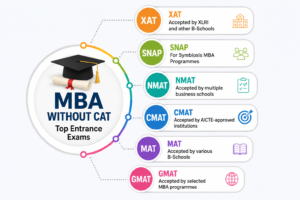
Let’s look at the major alternatives.
1. XAT
The Xavier Aptitude Test (XAT) is conducted by XLRI Jamshedpur on behalf of XAMI members.
XLRI describes XAT as an entrance examination conducted in January every year and notes that it is conducted across more than 100 test cities. (XLRI)
XAT is particularly important if you are interested in XLRI.
It can also be used by candidates applying to other participating management institutes.
Why consider XAT?
- Strong alternative to CAT
- Important route for XLRI
- Accepted by several management institutes
- Tests aptitude and decision-making skills
- Useful for students targeting multiple B-schools
If you’re preparing for management entrances and don’t want CAT, XAT should be one of the first exams you investigate.
Also Read : XAT complete guide
2. SNAP
SNAP is the entrance examination associated with MBA programmes offered by Symbiosis International (Deemed University).
The official SNAP website states that candidates aspiring to join an MBA programme offered by an SIU institute need to appear for SNAP for the relevant programmes. Shortlisted candidates then participate in the further admission process conducted by the respective institute. (SNAP 2026)
The current SNAP 2026 process includes three test attempts, with the higher score considered for the final percentile calculation. (SNAP 2026)
This makes SNAP an interesting option if Symbiosis is one of your target groups.
Important:
Taking SNAP alone doesn’t automatically apply you to every Symbiosis MBA programme.
The official website states that candidates need to select the programme they want and pay the applicable programme registration fee separately. (SNAP 2026)
3. NMAT
NMAT by GMAC is another major management entrance examination that can be used for admission to participating business schools.
One advantage of researching NMAT is that it can provide access to multiple institutions through a common test.
However, you should never assume that every college accepts NMAT.
Before applying, check:
- Whether your target college accepts NMAT
- The required score/percentile
- Eligibility criteria
- Application deadline
- Selection process
- Whether the college requires a separate application
This is an important rule for all alternative MBA entrance exams:
The exam score and the college application are often two separate things.
4. CMAT
The Common Management Admission Test (CMAT) is conducted by the National Testing Agency.
NTA describes CMAT as a national-level entrance examination for admission to management programmes. Its score is accepted by AICTE-approved institutions, university departments, constituent colleges and affiliated colleges. (CMAT)
CMAT covers areas such as:
- Quantitative Techniques and Data Interpretation
- Logical Reasoning
- Language Comprehension
- General Awareness
- Innovation and Entrepreneurship
according to the current official CMAT information. (CMAT)
One thing students should understand is that taking CMAT doesn’t automatically guarantee admission to an MBA college.
NTA states that candidates must apply separately to desired participating institutions, after which each institution determines its own cutoff and selection process. (CMAT)
That means your process may look like:
CMAT → College application → Cutoff → Shortlisting → GD/PI or other selection stages → Final admission
5. MAT
The Management Aptitude Test (MAT) is another management entrance exam used by various business schools.
If you are considering MAT, don’t simply search for “best colleges accepting MAT.”
Instead, create a shortlist based on:
- College accreditation
- MBA/PGDM programme
- Fees
- Placement record
- Location
- Specialisation
- Alumni network
- Average salary
- Admission criteria
- Whether the programme is AICTE/UGC approved as applicable
The exam you take matters, but the institution you eventually join matters even more.
6. GMAT
GMAT can also be relevant for certain MBA admissions.
It is particularly useful for candidates considering programmes that accept GMAT scores or for applicants who may want a test with broader international recognition.
Some Indian universities explicitly accept GMAT alongside other exams.
For example, Mahindra University currently lists GMAT, GRE, CAT, XAT and NMAT among accepted standardized test scores for its MBA programme and also provides its own MUMET route for applicants without those scores. (Mahindra University)
This illustrates why checking the individual college’s admission policy is so important.
MBA Without CAT: What About Colleges?
This is where students need to be careful.
There isn’t one universal list of “MBA colleges without CAT.”
Instead, there are different categories.
Category 1: Colleges accepting XAT
If you’re targeting an institution that accepts XAT, you can apply through XAT instead of CAT where the programme permits it.
Category 2: Colleges accepting SNAP
These include the MBA programmes within the Symbiosis admission ecosystem for which SNAP is mandatory. (SNAP 2026)
Category 3: Colleges accepting CMAT
CMAT scores are accepted by AICTE-approved institutions and other participating institutions, subject to their individual admission rules. (CMAT)
Category 4: Colleges accepting NMAT
Several participating institutions use NMAT scores as part of their admission process.
Category 5: Colleges with their own entrance tests
Some universities conduct their own management entrance examinations.
For example, XIM University has its own XGMT route for certain programmes. Its official FAQ also describes specific circumstances in which university/college/institute rank holders may apply without an admission test for certain MBA programmes, subject to eligibility. (XIM University)
Category 6: Alternative/Direct Admission Routes
Some institutions may have alternative admission pathways.
But direct admission does not automatically mean a college is good or bad.
You need to investigate the institution carefully before paying an admission fee.
ALSO READ : XAT 2027 complete guide
MBA Without CAT: Eligibility Criteria
The eligibility requirement depends on the college.
However, a typical full-time MBA generally requires a bachelor’s degree from a recognized university.
For example, the current SNAP eligibility page states that applicants for SIBM Pune’s MBA must be graduates from a recognized university/institution with at least 50% marks, with a 45% requirement for SC/ST candidates. (SNAP 2026)
But don’t assume this percentage applies everywhere.
Some programmes may have:
- Different minimum percentages
- Different final-year rules
- Subject-specific requirements
- Work-experience requirements
- Programme-specific criteria
Therefore, always check the exact programme you’re applying to.
Can Final-Year Students Do an MBA Without CAT?
Yes, many MBA programmes allow final-year students to apply, subject to their individual eligibility and documentation requirements.
For example, Mahindra University currently states that final-year undergraduate students can apply, subject to submitting the required final transcript and degree before classes begin. (Mahindra University)
However, the rules vary.
Before applying, check:
“Are final-year students eligible?”
and
“By what date must graduation be completed?”
These two questions can prevent an eligibility problem later.
MBA Without CAT: Admission Process
The admission process usually follows several stages.
Step 1: Choose Your Target Colleges
Don’t begin with the exam.
Begin with the college.
Make a list of 10–15 realistic MBA programmes.
Then check which entrance exams they accept.
Step 2: Identify the Common Exams
Suppose your list contains colleges accepting:
- XAT
- NMAT
- SNAP
- CMAT
Instead of preparing for four completely different exams blindly, compare their syllabus and overlap.
You may find that one preparation strategy covers multiple exams.
Step 3: Register for the Relevant Exam
Register through the official website of the exam.
Don’t rely on coaching websites for the actual application.
Use official sources for:
- Registration dates
- Fees
- Eligibility
- Exam pattern
- Admit card
- Results
Step 4: Apply to Individual Colleges
This is an important step.
Exam registration ≠ college application.
CMAT’s official information explicitly says candidates must apply separately to desired participating institutions. (CMAT)
Similarly, SNAP candidates must select and register for their desired Symbiosis programmes separately. (SNAP 2026)
Never assume your exam score automatically enters you into every college’s admission process.
Step 5: Take the Exam
Prepare according to the exam you selected.
Don’t use exactly the same strategy for every exam.
For example:
XAT preparation should account for its specific sections and decision-making component.
SNAP preparation should reflect its own speed-oriented structure.
CMAT preparation needs attention to its current section structure, including General Awareness and Innovation & Entrepreneurship. (CMAT)
Step 6: Clear the College’s Shortlisting Criteria
After the result, colleges may use:
- Entrance-test score
- Academic record
- Work experience
- Personal interview
- Group exercise/discussion
- Written ability assessment
- Other institute-specific factors
The exact process varies.
For example, SNAP’s official information states that shortlisted candidates participate in the institute’s further selection process, including Group Exercise and Personal Interaction. (SNAP 2026)
MBA Without CAT: Is It a Good Idea?
Yes—but only if you’re strategic.
Skipping CAT should not mean lowering your standards.
Instead, think of it as changing your route.
For example:
Weak approach
“I don’t want CAT, so I’ll join any college that offers an MBA.”
Better approach
“I don’t want CAT, so I’ll identify strong colleges accepting XAT, SNAP, NMAT, CMAT or other valid routes and compare them carefully.”
The second approach protects your career and your investment.
How to Choose an MBA College Without CAT
Don’t choose a college simply because its advertisement says:
“MBA admissions open.”
Check the following.
1. Accreditation and recognition
Verify the relevant university/institution status and applicable approvals.
2. Placement transparency
Look for:
- Placement reports
- Batch size
- Median/average salary
- Recruiter information
- Internship data
Don’t judge a college only by its highest package.
3. Total cost
Calculate:
Tuition + hostel + living expenses + other charges
Then compare this with realistic placement outcomes.
4. Programme quality
An MBA in:
- Finance
- Marketing
- HR
- Business Analytics
- Operations
- International Business
can have very different career outcomes.
Choose based on your interests and career plans.
5. Alumni network
A strong alumni network can provide valuable long-term career connections.
MBA Without CAT vs MBA Through CAT
| Factor | Through CAT | Without CAT |
|---|---|---|
| Main exam | CAT | XAT/NMAT/SNAP/CMAT/MAT/other routes |
| College options | Large | Large, but depends on exam |
| IIM route | Available | Generally not through alternative exams |
| Exam choice | Primarily CAT | Multiple options |
| Preparation | CAT-specific | Depends on chosen exam |
| Application strategy | College-specific | College + exam-specific |
| Flexibility | Moderate | Can be high |
| Best for | CAT-targeting aspirants | Students targeting alternative B-schools |
The important takeaway:
Without CAT doesn’t mean without competition.
Good MBA programmes can still be highly competitive.
A Smart Strategy for Students Who Don’t Want CAT
If you have decided not to take CAT, don’t immediately register for every management entrance exam available.
Instead, follow this process.
Step 1: Create your college list
Choose around 10–15 target institutions.
Step 2: Check accepted exams
Make a table:
| College | Exam Accepted | Minimum Eligibility | Fees | Selection Process |
|---|---|---|---|---|
| College A | XAT | Check official site | Check | PI/GD etc. |
| College B | SNAP | Check official site | Check | GE-PI |
| College C | CMAT | Check official site | Check | Institute-specific |
| College D | NMAT | Check official site | Check | Institute-specific |
Step 3: Find exam overlap
If most of your colleges accept XAT and CMAT, you may not need to prepare for five different exams.
Step 4: Apply early
Keep track of separate college application deadlines.
Step 5: Compare final options
Don’t accept an offer simply because you got one.
Compare:
fees + placements + curriculum + location + specialization + alumni + career opportunities.
What If You Don’t Want Any Entrance Exam?
This is where you need to be especially careful.
Some universities and institutions may offer admission through their own entrance tests or alternative pathways.
But “no CAT required” and “no entrance exam required” are not the same thing.
For example, some universities may conduct their own test.
Others may consider scores from different exams.
A few may have special eligibility-based routes.
XIM University’s official FAQ, for instance, describes a specific exception for certain university/college/institute rank holders applying to selected programmes without an admission test, subject to its eligibility requirements. (XIM University)
So don’t search only for:
“MBA without entrance exam.”
Search for the specific institution and its official admission criteria.
Common Mistakes Students Make
Mistake 1: Assuming CAT is mandatory for every MBA
It isn’t.
But some of the most selective programmes do have specific exam requirements, so always check the target institution.
Mistake 2: Choosing a college only because CAT isn’t required
This is one of the biggest mistakes.
The quality of the MBA matters more than the convenience of admission.
Mistake 3: Ignoring placement data
A low entrance barrier doesn’t necessarily mean good ROI.
Mistake 4: Confusing exam registration with college registration
Many exams and institutions have separate applications. (CMAT)
Mistake 5: Applying everywhere
More applications don’t automatically mean better outcomes.
Mistake 6: Waiting until the last minute
Alternative exams have their own registration windows.
Track them separately.
MBA Without CAT: Frequently Asked Questions
Can I do an MBA without CAT?
Yes. Many MBA programmes accept alternative entrance exams such as XAT, SNAP, NMAT, CMAT, MAT or GMAT, while some institutions conduct their own admission tests or offer specific alternative pathways.
Which exam is best for MBA without CAT?
There isn’t one universally best exam.
Choose based on your target colleges.
If XLRI is your target, investigate XAT. If you want Symbiosis MBA programmes, SNAP is central to that admission process. For many AICTE-approved and participating institutions, CMAT can be relevant. (XLRI)
Can I get into XLRI without CAT?
For the standard XAT route, XLRI uses XAT rather than CAT for the relevant admissions process. Always check the current programme-specific admission requirements before applying. (XLRI)
Can I get into Symbiosis without CAT?
Yes. SNAP is the relevant entrance test for the MBA programmes covered by the Symbiosis admission process. (SNAP 2026)
Can I do an MBA through CMAT without CAT?
Yes. CMAT is itself a national-level management entrance examination used by participating institutions, subject to each institution’s admission criteria. (CMAT)
Is an MBA without CAT worth it?
It can be, provided you choose a good institution and programme. Don’t evaluate an MBA solely by the entrance exam required.
Can freshers do an MBA without CAT?
Yes. Many MBA programmes accept fresh graduates or final-year students, subject to their specific eligibility criteria.
Can I do an MBA without CAT and without work experience?
Yes, depending on the programme. Work experience is not universally mandatory for MBA admission.
Is direct admission to an MBA college safe?
It depends entirely on the institution and programme. Verify recognition, accreditation, curriculum, faculty, placement data, fees and official admission rules before paying.
Final Verdict: Should You Do an MBA Without CAT?
Absolutely—if you have a clear plan.
CAT is one route into management education, not the definition of an MBA career.
If you don’t want to take CAT, you can explore XAT, SNAP, NMAT, CMAT, MAT, GMAT and institute-specific admission tests depending on your target colleges.
But here’s the most important advice:
Don’t choose the exam first. Choose the college first.
Find the MBA programmes you actually want.
Then check:
Which exam do they accept?
Then prepare for that exam.
This simple change can make your preparation much more focused.
And remember that an MBA is a major investment of time, money and two years of your career. Avoid choosing a college simply because it offers admission without CAT.
Look beyond the entrance requirement.
Compare the curriculum, faculty, placements, fees, ROI, alumni network, specialization and career opportunities.
Your goal isn’t simply to get into an MBA programme.
Your goal is to get into an MBA programme that moves your career forward.
Your MBA Without CAT Roadmap
1. Shortlist colleges
↓
2. Check accepted entrance exams
↓
3. Compare eligibility & fees
↓
4. Register for the right exam(s)
↓
5. Prepare strategically
↓
6. Apply separately to colleges
↓
7. Take the entrance exam
↓
8. Attend PI/GD/GE if required
↓
9. Compare offers
↓
10. Choose based on ROI & career goals
CAT is one door. It isn’t the entire building.
For students who plan carefully, there are multiple ways to reach a good MBA programme without making CAT the centre of their admission strategy.