
JEE Main preparation without coaching institute may sound difficult, especially when students around you are attending coaching classes, solving institute modules and following schedules prepared by teachers.
But coaching itself does not determine your JEE Main result.
Your preparation ultimately depends on how clearly you understand concepts, how many relevant questions you solve, how regularly you revise and how effectively you analyse your mistakes.
A student studying independently can build all four of these habits.
The difference is that without coaching, you have to create your own preparation system.
Instead of studying randomly for long hours, you need a clear syllabus, limited study resources, a realistic timetable, regular previous-year question practice and mock-test analysis.
This guide explains how to prepare for JEE Main without coaching, including subject-wise preparation strategies, recommended study resources, daily routines, revision techniques, PYQ practice and common mistakes to avoid.
Can You Crack JEE Main Without Coaching?
Yes, JEE Main can be prepared for through self-study.
However, preparing without coaching does not mean preparing without guidance or structure.
Coaching institutes generally provide students with four things:
- a syllabus schedule,
- study material,
- regular tests,
- and doubt support.
If you are studying independently, you need to recreate these elements yourself.
Fortunately, students today have access to NCERT textbooks, official JEE Main resources, previous-year questions, online lectures, mock tests and other learning resources.
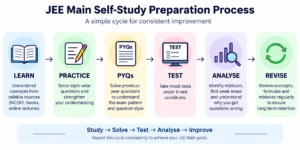
Your self-study system should therefore revolve around a simple cycle:
Learn → Practise → Test → Analyse → Revise
For example, after studying Newton’s Laws of Motion, don’t immediately move to another chapter.
First understand the theory and formulas, then solve basic questions, attempt JEE Main-level questions, practise previous-year questions and finally test yourself.
The effectiveness of self-study comes from repeating this process consistently.

Step 1: How to Prepare for JEE Main Without Coaching
One of the biggest mistakes students make is beginning preparation without properly understanding what they actually have to study.
Before creating a timetable, download the latest official JEE Main syllabus released by the National Testing Agency.
The syllabus for Paper 1 covers three major subjects:
Physics
Chemistry
Mathematics
Each subject contains topics largely based on concepts studied in Classes 11 and 12.
You can check the latest official syllabus directly from the JEE Main official syllabus page.
Once you have the syllabus, create three categories.
Category 1: Strong Chapters
These are chapters where your concepts are already reasonably clear and you can solve questions confidently.
Category 2: Average Chapters
You understand the basic concepts but struggle with difficult or mixed questions.
Category 3: Weak Chapters
These are chapters where your concepts are incomplete or where you consistently make mistakes.
This classification is important because your preparation should not give equal time to every chapter.
Weak chapters require concept-building.
Average chapters require more problem-solving.
Strong chapters mainly require revision and testing.
Internal link opportunity: Link here to your future article on JEE Main Syllabus and Chapter-Wise Preparation.
Step 2: Choose Limited Resources for JEE Main Preparation
Students preparing without coaching often make one major mistake: collecting too many books, PDFs, courses and YouTube playlists.
More resources do not automatically mean better preparation.
A better approach is:
One source for concepts + one source for practice + PYQs + mock tests
Start with NCERT, especially for building your Class 11 and Class 12 foundation. Official digital textbooks can be accessed through the NCERT textbook portal.
Once the basics are clear, move toward JEE Main-oriented questions.
Your study material should ideally contain:
- Concept explanations
- Solved examples
- Topic-wise practice questions
- JEE Main previous-year questions
- Full-length mock tests
Avoid changing your main book or learning source every few weeks.
If one resource explains a chapter clearly enough for you to solve questions, continue using it.
Step 3: Create a Realistic JEE Main Study Plan
A timetable should help you study consistently rather than look impressive on paper.
Writing a schedule that says:
Physics – 4 hours
Chemistry – 4 hours
Mathematics – 4 hours
may look productive, but maintaining such a timetable alongside school can be unrealistic for many students.
Instead, plan according to tasks.
For example:
Physics: Complete Work, Energy and Power concepts + 25 questions
Chemistry: Revise Chemical Bonding + NCERT reading
Mathematics: Quadratic Equations + 20 PYQs
This gives you a measurable target.
At the end of the day, you know whether the target was completed.
Sample Daily Timetable for JEE Main Self-Study
The exact number of study hours will depend on whether you are attending school, preparing during a drop year or studying during holidays.
A school-going student could use a structure such as:
| Time | Task |
|---|---|
| Morning | Formula/reaction revision |
| After school | Rest + schoolwork |
| Study Session 1 | Physics concepts/questions |
| Short break | Rest |
| Study Session 2 | Mathematics problem-solving |
| Short break | Rest |
| Study Session 3 | Chemistry |
| Final 20–30 minutes | Revision/error notebook |
The exact clock timings are less important than consistency.
A student studying effectively for a few focused hours can achieve more than someone sitting at a desk all day while constantly checking their phone.
Use focused study blocks and take short breaks between them.
Step 4: How to Prepare Physics for JEE Main Without Coaching
Physics becomes much easier when you stop treating it as a subject where formulas simply have to be memorised.
For every Physics chapter, follow this sequence:
Concept → Formula → Application → Questions → PYQs
Suppose you are studying Current Electricity.
First understand concepts such as current, resistance and potential difference.
Then understand the relevant equations.
Next, study solved examples showing where those equations are applied.
After that, solve questions yourself.
Finally, attempt JEE Main previous-year questions.
If you directly memorise formulas without understanding when they apply, unfamiliar questions can become difficult.
Create a Physics Formula Notebook
Maintain a small notebook containing:
- important formulas,
- important graphs,
- common relationships,
- special conditions,
- frequently forgotten concepts.
Keep it concise.
The purpose is not to rewrite the entire textbook. It should become a rapid revision tool before tests.
Analyse Incorrect Physics Questions
Whenever you get a question wrong, determine why.
Was it because:
- the concept was unclear?
- you selected the wrong formula?
- you made a calculation error?
- you misunderstood the question?
- you forgot a condition?
Knowing the reason behind mistakes is much more useful than simply checking the correct answer.
Step 5: How to Prepare Chemistry for JEE Main Without Coaching
Chemistry preparation should not be identical across Physical, Organic and Inorganic Chemistry because each requires a different approach.
Physical Chemistry
Physical Chemistry requires conceptual understanding combined with numerical practice.
Your approach should be:
Understand theory → Learn formulas → Solve examples → Practise numericals → Attempt PYQs
Do not simply read solved numerical problems.
Close the solution and solve them yourself.
Organic Chemistry
Organic Chemistry becomes easier when concepts are connected rather than memorised as unrelated reactions.
Focus on understanding:
- reaction mechanisms,
- electronic effects,
- important reagents,
- conversions,
- reaction conditions.
Build your fundamentals properly before moving toward complicated reaction sequences.
Maintain a reaction notebook where related reactions and reagents are organised together.
Inorganic Chemistry
NCERT deserves particular attention here.
Read important chapters carefully and revise them repeatedly instead of trying to memorise everything in one sitting.
Create short notes containing:
- trends,
- exceptions,
- important compounds,
- reactions,
- key facts.
Frequent revision is especially important because factual information can be forgotten quickly.
Internal link opportunity: Add a link here later to How to Study Chemistry for JEE Main.
Step 6: How to Prepare Mathematics for JEE Main Without Coaching
Mathematics requires active problem-solving.
Watching someone else solve 50 questions will not give you the same benefit as solving those questions yourself.
For each Mathematics chapter:
- Understand the concept.
- Learn the important formulas.
- Solve basic examples.
- Move to standard JEE Main-level questions.
- Solve PYQs.
- Attempt timed chapter tests.
Suppose you study Definite Integration.
Understanding the formulas is only the beginning.
You must practise enough questions to recognise which method is appropriate for different situations.
Maintain a Mathematics Mistake Notebook
Write down questions where you:
- used an unnecessarily long method,
- forgot a formula,
- made an algebraic mistake,
- misunderstood the question,
- or could not identify the approach.
Review this notebook every week.
Over time, it becomes a personalised revision resource containing exactly the mistakes you are most likely to repeat.
Step 7: Make Previous-Year Questions a Core Part of Preparation
Previous-year questions, commonly called PYQs, should not be something you start only a few weeks before JEE Main.
They should be integrated into your chapter preparation.
After completing a chapter, attempt relevant previous-year questions.
This helps you understand:
- how concepts are tested,
- what kind of calculations appear,
- how multiple concepts can be combined,
- and whether you can actually apply what you studied.
The official JEE Main website also provides examination resources and question-paper information. Students should use the official JEE Main website for current exam-related information rather than depending entirely on social-media posts or unofficial updates.
When solving PYQs, don’t immediately check the solution when you get stuck.
Spend some time attempting the problem independently.
That struggle is part of learning.
Step 8: Build an Error Notebook
An error notebook is one of the most valuable tools for self-study students.
Every mock test and practice session will expose mistakes.
Instead of forgetting them, record them.
Divide your mistakes into categories:
Conceptual Error
You didn’t understand the concept properly.
Action: Study the concept again.
Formula Error
You forgot or incorrectly applied a formula.
Action: Add it to your revision sheet.
Calculation Error
You understood the question but made an arithmetic or algebraic mistake.
Action: Slow down during calculations and practise similar problems.
Reading Error
You overlooked words such as incorrect, maximum, minimum or a unit.
Action: Practise reading questions carefully.
Time-Management Error
You spent too much time on one question.
Action: Learn when to skip and return later.
If you analyse mistakes consistently, every test becomes part of your preparation rather than merely a score.
Step 9: Start Mock Tests Before Completing 100% of the Syllabus
Many students think:
“I will start mock tests after finishing the entire syllabus.”
That can delay one of the most important parts of JEE Main preparation.
You can begin with chapter tests.
Then move to unit tests.
Then subject tests.
Finally, attempt full-length mock papers under exam-like conditions.
Mock tests help you develop:
- speed,
- question selection,
- time management,
- accuracy,
- concentration,
- and familiarity with exam pressure.
But simply taking tests is not enough.
How to Analyse a JEE Main Mock Test
After every test, divide the questions into four groups:
Correct + confident
These usually require little attention.
Correct + guessed/uncertain
Review these because the answer may have been correct by chance.
Incorrect
Understand exactly why the mistake happened.
Not attempted
Check whether you skipped the question because of lack of knowledge, lack of time or difficulty identifying the method.
Suppose you take a three-hour mock test.
Do not hesitate to spend substantial additional time reviewing it.
The analysis can sometimes teach you more than the test itself.
Step 10: Revision Should Be Built Into Your Schedule
JEE Main covers a large syllabus, which makes forgetting inevitable if chapters are studied once and then abandoned.
Revision should therefore be planned from the beginning.
A simple revision structure could be:
Daily: formulas, reactions and mistakes from recent study.
Weekly: chapters studied during the week.
Periodic: older chapters and mixed-topic questions.
Your revision frequency can change depending on how well you remember a chapter.
Weak chapters may need frequent revision, while strong chapters can be revised at wider intervals.
Use Active Recall
Instead of simply rereading notes, close the book and ask yourself:
- What are the important formulas?
- What assumptions apply?
- What are the common exceptions?
- Can I explain this concept without looking at the book?
Trying to retrieve information from memory makes revision more active.
Step 11: Balance Class 11 and Class 12 Topics
Students often realise during Class 12 that several Class 11 chapters are weak.
Ignoring those chapters completely can create problems because concepts across the two years can be connected.
Instead of abandoning your current Class 12 preparation, create separate weekly slots for Class 11 revision.
For example:
Monday–Friday: Current syllabus + regular preparation
Saturday: Class 11 weak chapters
Sunday: PYQs + test + weekly revision
The exact structure can change, but the principle remains the same:
Don’t allow old chapters to disappear from your preparation.
Step 12: Avoid the “Too Many Books” Problem
A common self-study pattern looks like this:
A student buys one book.
Then sees another book recommended online.
Then downloads a PDF.
Then finds a new video series.
Then switches teachers.
Eventually, the student has plenty of material but has completed very little of it.
Resource hopping creates the feeling of preparation without necessarily producing progress.
Instead, choose limited resources and complete them.
For most chapters, your objective should be:
Concept source → Practice source → PYQs → Test
Only look for another explanation when your existing resource genuinely fails to clarify a topic.
Step 13: Use Online Lectures Strategically
Online learning can be extremely helpful for students preparing without coaching, but it can also become a major distraction.
Use video lectures mainly when:
- a concept is difficult to understand,
- your school explanation was insufficient,
- you need a structured chapter explanation,
- or you need help understanding a specific problem-solving technique.
Avoid spending the entire day watching lectures.
JEE Main requires you to solve questions yourself.
A useful rule is:
Learn something → immediately apply it.
After a lecture, solve relevant questions without looking at the solution.
If you cannot solve them, revisit the concept.
Step 14: Track Your Preparation Every Week
Without coaching, there is no teacher automatically monitoring your progress.
You therefore need a simple tracking system.
At the end of every week, record:
| Metric | Weekly Check |
|---|---|
| Chapters completed | ___ |
| Chapters revised | ___ |
| PYQs solved | ___ |
| Tests attempted | ___ |
| Average accuracy | ___ |
| Weak chapters identified | ___ |
| Chapters to revise next week | ___ |
Don’t judge progress only by study hours.
Someone can study for seven hours and accomplish very little.
Instead, track output.
Questions solved, chapters revised, tests attempted and mistakes corrected are better indicators of preparation quality.
Step 15: Don’t Ignore Board Exam Preparation
If you are appearing for Class 12 board examinations alongside JEE Main, don’t treat board preparation and JEE preparation as completely unrelated.
There is considerable overlap in the underlying Physics, Chemistry and Mathematics concepts.
The difference is often in the style and depth of questions.
NCERT-based study can therefore contribute to both.
Create a schedule that allows you to strengthen concepts while also practising the type of written answers required for board examinations.
During periods closer to board exams, your time distribution may need to shift temporarily.
Common Mistakes While Preparing for JEE Main Without Coaching
1. Studying Without a Plan
Opening whichever chapter you feel like studying can create syllabus gaps.
Maintain weekly targets.
2. Watching Too Many Lectures
Watching a solution is not the same as solving a problem.
Increase active question practice.
3. Ignoring PYQs
PYQs help connect theoretical preparation with actual examination-style questions.
4. Avoiding Mock Tests Because Scores Are Low
A low mock-test score is information.
Analyse it and identify what needs improvement.
5. Constantly Changing Resources
Complete a good resource before looking for another one.
6. Ignoring Weak Chapters
Weak chapters usually don’t improve automatically.
Schedule specific time for them.
7. Comparing Study Hours With Other Students
Your target should be improving your preparation quality, not matching somebody else’s daily study-hour claim.
A Simple 90-Day JEE Main Self-Study Framework
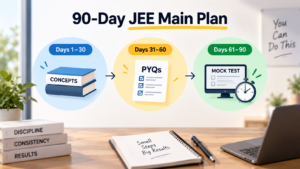
If you have roughly three months available, you can divide your preparation into three broad phases.
Days 1–30: Concept Strengthening
Focus on:
- weak chapters,
- important concepts,
- NCERT,
- formula notes,
- basic-to-moderate questions.
Your objective is to repair major conceptual gaps.
Days 31–60: PYQs and Problem-Solving
Increase the percentage of time spent solving questions.
Focus on:
- chapter-wise PYQs,
- mixed-topic questions,
- timed practice,
- weak-topic revision,
- chapter and subject tests.
Days 61–90: Tests, Analysis and Revision
Shift toward:
- full-length mock tests,
- PYQ papers,
- error analysis,
- formula revision,
- reaction revision,
- weak-chapter repair.
Avoid trying to learn a huge number of completely new resources during the final phase.
Consolidation becomes increasingly important.
Internal link opportunity: Link this section to your JEE Main 3-Month Preparation Strategy article.
Also Read : JEE Main 2027 Syllabus
What Should You Do If Your Mock Scores Are Not Improving?
First, don’t respond by simply increasing your study hours.
Find the reason.
Suppose your Mathematics score is consistently weak.
Look deeper.
Are you:
- attempting too few questions?
- making calculation errors?
- unable to remember formulas?
- spending too much time on difficult problems?
- weak in specific chapters?
The solution depends on the problem.
For example, if you know concepts but cannot complete the paper, your problem may be speed and question selection rather than knowledge.
If you attempt many questions but accuracy is poor, your focus should shift toward error reduction.
Measure the problem before changing your strategy.
How to Stay Consistent Without Coaching
Self-study gives you freedom, but freedom also makes procrastination easier.
Create a routine where studying does not depend entirely on motivation.
Set three daily targets such as:
Target 1: Complete one concept/topic.
Target 2: Solve a fixed set of questions.
Target 3: Revise yesterday’s material.
Even on difficult days, try to maintain minimum progress.
You don’t need every study session to be perfect.
You need enough productive days accumulated over several months.
Official Sources Every JEE Main Aspirant Should Follow
Exam dates, application instructions, syllabus changes and official notices should always be verified through authoritative sources.
The most important source is the official JEE Main website maintained for the examination. The site provides official notices, candidate information and examination resources.
Students can also refer to the JEE Main Information Bulletin for official examination rules and related information.
For school-level textbooks, use the official NCERT textbook portal rather than relying on unknown PDF websites.
Always verify important examination information from official sources because dates, eligibility conditions, procedures and examination rules can change.
Final Preparation Checklist
Before considering your JEE Main preparation complete, check whether you have:
- reviewed the complete official syllabus,
- built clear concepts in Physics, Chemistry and Mathematics,
- completed sufficient chapter-wise practice,
- solved previous-year questions,
- maintained formula and revision notes,
- created an error notebook,
- attempted timed tests,
- analysed your mock tests,
- revised weak chapters,
- and regularly revisited older topics.
If several of these are missing, improving them may be more useful than searching for another book or another study timetable.
Final Thoughts
JEE Main preparation without coaching is not about proving that coaching is unnecessary.
It is about building a preparation system that gives you the same essential ingredients: direction, learning, practice, testing and feedback.
Start with the official syllabus.
Build concepts using reliable resources.
Keep your books and learning sources limited.
Solve questions every day.
Use previous-year questions to understand the examination.
Take mock tests before you feel completely ready.
Most importantly, analyse your mistakes.
A productive JEE Main preparation cycle can be summarised in five words:
Study → Solve → Test → Analyse → Improve
Repeat that cycle consistently.
You may not control how many hours another student studies or which coaching institute they attend, but you can control whether today’s concepts are clearer than yesterday’s, whether your mistakes are decreasing and whether your test performance is gradually improving.
That is what effective self-study should achieve.
Frequently Asked Questions
Can I prepare for JEE Main without coaching?
Yes. Students can prepare independently by following the official syllabus, building concepts through reliable resources, practising questions, solving PYQs and regularly taking mock tests. The important factor is having a structured preparation system.
Is NCERT enough for JEE Main?
NCERT is an important foundation, but relying only on textbook reading may not provide enough problem-solving practice for every subject and chapter. Students should combine conceptual study with JEE Main-level questions, PYQs and mock tests.
How many hours should I study for JEE Main without coaching?
There is no universal number of hours that guarantees a particular result. School schedule, current preparation level and learning speed differ between students. Focus on consistent, distraction-free study sessions with measurable daily targets.
When should I start solving JEE Main PYQs?
Start chapter-wise PYQs after you have understood the core concepts and completed basic practice for that chapter. Don’t wait until the entire syllabus is finished.
When should I start taking mock tests?
You can start with chapter and unit tests during syllabus preparation and gradually progress to full-length mock tests. Full-syllabus tests become increasingly important as the exam approaches.
How can I know whether my JEE preparation is improving?
Track your test scores, accuracy, question-solving speed, syllabus coverage and recurring mistakes. Improvement should gradually appear through better accuracy and fewer repeated errors.
Which subject should I study first every day?
There is no compulsory order. Many students prefer tackling the subject requiring the most concentration when their energy is highest. Experiment with your routine and use the sequence that produces the best focus and consistency.
What should I do if I have weak Class 11 concepts?
Don’t restart the entire Class 11 syllabus blindly. Identify the chapters where your fundamentals are weak and schedule dedicated revision slots alongside your current preparation.
Read Our Article on : JEE Main 2027 Exam pattern