
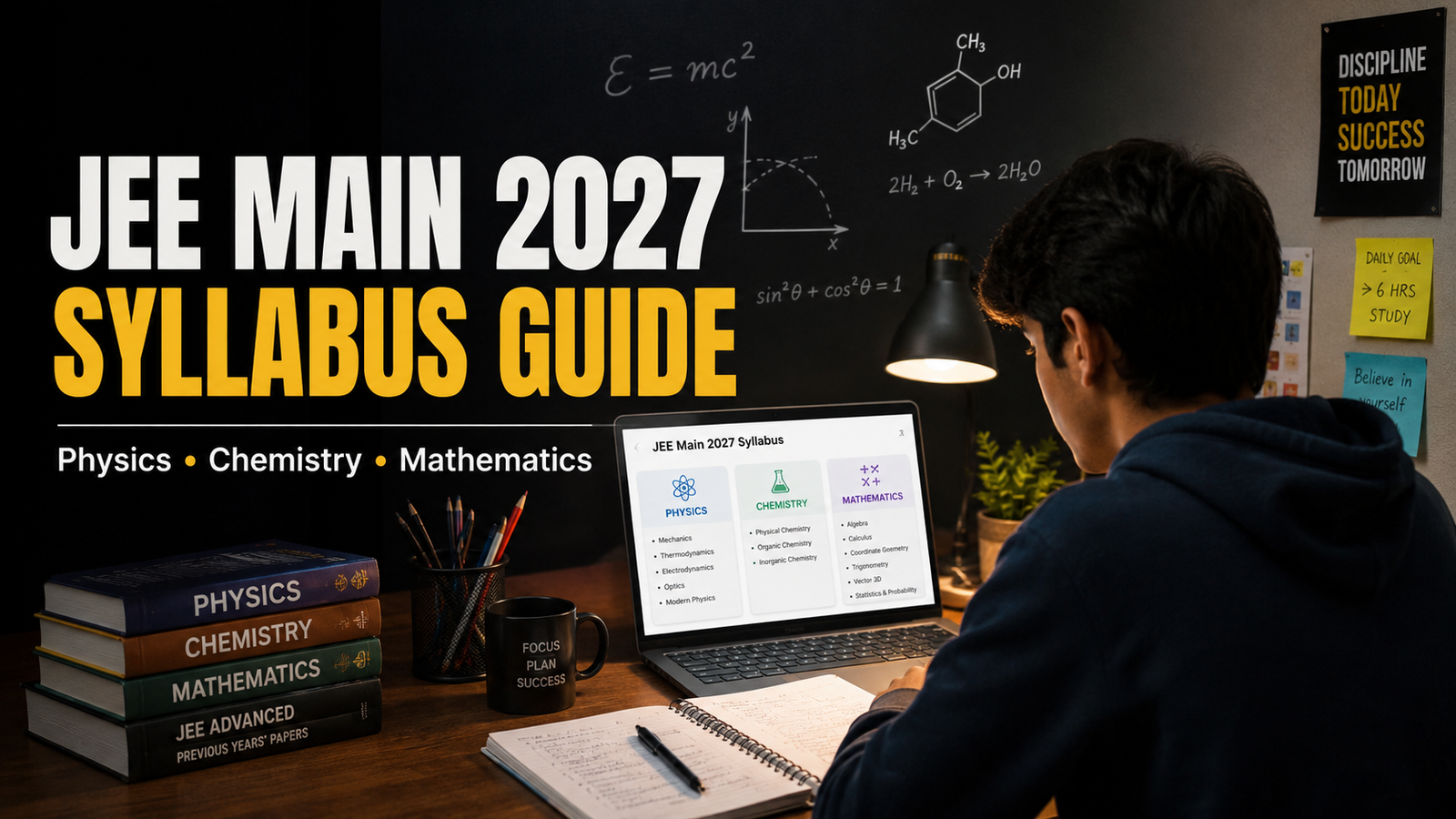
If you’re preparing for JEE Main 2027, one of the first things you should do is understand the syllabus properly.
The syllabus tells you what you need to study, what you don’t need to spend time on, and how you should divide your preparation across Physics, Chemistry and Mathematics.
But there is an important update for JEE Main 2027:
NTA has not released the official JEE Main 2027 syllabus yet. The latest syllabus currently available on the official JEE Main website is the JEE Main 2026 syllabus. Until NTA publishes the 2027 syllabus, students can use the latest official syllabus as their working reference and should check the official website for any changes.
This guide explains the latest available syllabus, subject-wise topics, how to use it as a preparation checklist, and how Class 11 and Class 12 students can plan their study around it.
JEE Main 2027 Syllabus at a Glance
| Subject | What you need to prepare |
| Physics | Mechanics, Electricity, Magnetism, Optics, Modern Physics, Experimental Physics and other prescribed topics |
| Chemistry | Physical Chemistry, Inorganic Chemistry and Organic Chemistry |
| Mathematics | Algebra, Calculus, Coordinate Geometry, Vector & 3D Geometry, Statistics, Probability and other prescribed topics |
| Latest official syllabus available | JEE Main 2026 |
| JEE Main 2027 syllabus | Not released yet |
| For B.E./B.Tech | Mathematics + Physics + Chemistry |
The official JEE Main website currently provides the syllabus through its Information section and lists the 2026 syllabus.
Is the JEE Main 2027 Syllabus Released?
No.
As of August 21, 2026, NTA has not published a JEE Main 2027 syllabus on the official JEE Main website.
The latest official syllabus available is for JEE Main 2026.
That means students should be careful with websites claiming to have an “official JEE Main 2027 syllabus PDF” unless the document can be traced back to NTA.
What should you do right now?
If you’re preparing for JEE Main 2027:
- Use the latest official JEE Main syllabus available.
- start your preparation according to that syllabus.
- Keep checking NTA for the 2027 notification.
- Compare the 2027 syllabus with the previous official version when it is released.
- Adjust your preparation only if NTA announces a change.
This is especially important because syllabus pages on coaching and education websites can remain online for years even after the official syllabus changes.
Always treat NTA as the final authority.
Official JEE Main syllabus — NTA
JEE Main 2027 Syllabus for Paper 1
For students targeting B.E./B.Tech, JEE Main Paper 1 covers:
- Physics
- Chemistry
- Mathematics
The latest available syllabus contains detailed units and topics for all three subjects.
A useful way to think about the syllabus is:
Class 11 + Class 12 concepts → JEE-level application → Previous-year questions → Mock tests
The syllabus is not simply a list of chapters to finish.
It should become your master preparation checklist.
JEE Main Physics Syllabus 2027
The Physics syllabus covers major areas of physics from mechanics through electricity, magnetism, optics and modern physics.
Since the 2027 syllabus has not been released yet, the following is based on the latest official syllabus available for JEE Main 2026.
Major Physics Areas
- Physics and Measurement
Students should understand:
- Units and dimensions
- Measurements
- Significant figures
- Errors in measurement
- Dimensional analysis
This may look like a small part of the syllabus, but measurement concepts are useful throughout Physics.
- Kinematics
Important concepts include:
- Motion in a straight line
- Motion in a plane
- Position and displacement
- Velocity
- Acceleration
- Graphical representation of motion
- Laws of Motion
Prepare concepts related to:
- Newton’s laws
- Force
- Momentum
- Friction
- Circular motion
- Equilibrium
The important thing is not simply memorising Newton’s laws but learning how to apply them to different situations.
- Work, Energy and Power
Focus on:
- Work done by a force
- Kinetic energy
- Potential energy
- Work-energy theorem
- Conservation of mechanical energy
- Power
- Rotational Motion
This is an important conceptual area involving:
- Centre of mass
- Moment of inertia
- Torque
- Angular momentum
- Rotational equilibrium
- Rolling motion
Students often find this chapter difficult because several concepts interact with each other.
- Gravitation
Prepare:
- Universal law of gravitation
- Gravitational potential
- Gravitational field
- Escape velocity
- Satellites
- Orbital velocity
- Properties of Solids and Liquids
Topics include areas such as:
- Elasticity
- Fluid pressure
- Viscosity
- Surface tension
- Fluid flow
- Bernoulli’s principle
- Thermodynamics
Understand:
- Heat
- Work
- Internal energy
- First law of thermodynamics
- Thermodynamic processes
- Second law concepts
- Kinetic Theory of Gases
Important concepts include:
- Gas laws
- Molecular motion
- Pressure
- Temperature
- Mean kinetic energy
- Degrees of freedom
- Oscillations and Waves
Prepare:
- Simple harmonic motion
- Period and frequency
- Wave motion
- Progressive waves
- Standing waves
- Sound waves
Electricity and Magnetism
A significant part of Physics preparation comes from electricity and magnetism.
Electrostatics
Study:
- Electric charges
- Coulomb’s law
- Electric field
- Electric potential
- Capacitance
- Capacitors
Current Electricity
Important topics include:
- Electric current
- Resistance
- Ohm’s law
- Resistivity
- Series and parallel combinations
- Kirchhoff’s laws
- Electrical energy and power
Magnetic Effects of Current
Prepare:
- Magnetic field
- Biot-Savart law
- Ampere’s law
- Force on a moving charge
- Force on a current-carrying conductor
Electromagnetic Induction
Focus on:
- Faraday’s laws
- Lenz’s law
- Magnetic flux
- Induced emf
- Inductance
Alternating Current
Understand:
- AC voltage/current
- RMS values
- Reactance
- Impedance
- Resonance
- Transformers
Optics
Optics should be divided into two broad areas.
Ray Optics
Study:
- Reflection
- Refraction
- Mirrors
- Lenses
- Optical instruments
Wave Optics
Study:
- Wavefronts
- Interference
- Diffraction
- Polarisation
Modern Physics
Modern Physics includes several important areas.
Students should prepare concepts related to:
- Dual nature of matter and radiation
- Photoelectric effect
- Atoms
- Nuclei
- Radioactivity
- Nuclear reactions
- Electronic devices
- Semiconductor-related concepts
Experimental Physics
Don’t completely ignore experimental concepts.
The syllabus also includes experimental and measurement-related areas, so students should understand basic experimental principles and the interpretation of measurements.
JEE Main Chemistry Syllabus 2027
Chemistry is generally organised into three broad areas:
Physical Chemistry
Concepts + formulas + numerical problem-solving.
Inorganic Chemistry
Concepts + periodic trends + reactions + systematic revision.
Organic Chemistry
Concepts + mechanisms + reactions + application.
The latest available JEE Main syllabus covers topics across these three areas.
Physical Chemistry
Important areas in the latest available syllabus include:
Some Basic Concepts in Chemistry
- Mole concept
- Molar mass
- Percentage composition
- Empirical and molecular formulae
- Chemical equations
- Stoichiometry
Atomic Structure
- Electromagnetic radiation
- Photoelectric effect
- Bohr model
- Dual nature of matter
- de Broglie relationship
- Heisenberg uncertainty principle
- Quantum numbers
- Electronic configuration
Chemical Bonding and Molecular Structure
- Ionic and covalent bonding
- Electronegativity
- VSEPR theory
- Hybridisation
- Molecular orbital theory
- Hydrogen bonding
Chemical Thermodynamics
- Thermodynamic systems
- Internal energy
- Enthalpy
- Entropy
- Gibbs energy
- Spontaneity
Solutions
- Concentration terms
- Molarity
- Molality
- Colligative properties
- Raoult’s law
- Abnormal molar mass
Equilibrium
Prepare:
- Chemical equilibrium
- Ionic equilibrium
- Equilibrium constants
- Le Chatelier’s principle
- Acids and bases
- pH
- Buffer solutions
- Solubility product
Redox Reactions and Electrochemistry
Important concepts include:
- Oxidation and reduction
- Oxidation number
- Electrochemical cells
- Electrode potential
- Nernst equation
- Faraday’s laws
Chemical Kinetics
Focus on:
- Rate of reaction
- Factors affecting reaction rate
- Rate laws
- Order of reaction
- Activation energy
- Arrhenius equation
Inorganic Chemistry
The latest syllabus includes areas such as:
- Classification of elements and periodicity
- p-block elements
- d- and f-block elements
- Coordination compounds
- Principles related to inorganic chemistry
The exact topic list should always be checked against the official syllabus PDF because individual subtopics can change between examination years.
Organic Chemistry
Important areas include:
Basic Principles of Organic Chemistry
- Nomenclature
- Isomerism
- Electronic effects
- Reaction mechanisms
Hydrocarbons
- Alkanes
- Alkenes
- Alkynes
- Aromatic hydrocarbons
Organic Compounds Containing Halogens
- Haloalkanes
- Haloarenes
- Relevant reactions
Organic Compounds Containing Oxygen
- Alcohols
- Phenols
- Ethers
- Aldehydes
- Ketones
- Carboxylic acids
Organic Compounds Containing Nitrogen
- Amines
- Other prescribed nitrogen-containing compounds
Biomolecules
- Carbohydrates
- Proteins
- Nucleic acids
- Related biological molecules
The latest published syllabus should be treated as the reference point until NTA releases the 2027 version.
Also read : HOW TO IMPROVE EXAM SCORE
JEE Main Mathematics Syllabus 2027
Mathematics requires a different preparation approach because students need both conceptual understanding and speed.
The latest available syllabus covers areas from algebra and calculus to coordinate geometry, vectors, three-dimensional geometry, statistics and probability.
- Sets, Relations and Functions
Topics include:
- Sets and their representation
- Union and intersection
- Complement
- Power set
- Relations
- Equivalence relations
- Functions
- One-one, into and onto functions
- Composition of functions
- Complex Numbers and Quadratic Equations
Prepare:
- Complex numbers
- Algebra of complex numbers
- Argand diagram
- Modulus and argument
- Quadratic equations
- Roots and coefficients
- Nature of roots
- Matrices and Determinants
Important topics include:
- Types of matrices
- Matrix operations
- Determinants
- Adjoint and inverse
- Area using determinants
- Simultaneous linear equations
- Permutations and Combinations
Focus on:
- Fundamental principle of counting
- Permutations
- Combinations
- Basic applications
- Binomial Theorem
Study:
- Binomial expansion
- General term
- Middle term
- Basic applications
- Sequence and Series
Prepare:
- Arithmetic progression
- Geometric progression
- Arithmetic mean
- Geometric mean
- Relationships between A.M. and G.M.
Calculus
Calculus is a major part of Mathematics preparation.
Important areas include:
Limits, Continuity and Differentiability
- Functions
- Limits
- Continuity
- Differentiability
- Differentiation
Applications of Derivatives
- Rate of change
- Increasing and decreasing functions
- Maxima and minima
Integral Calculus
Prepare:
- Indefinite integration
- Definite integration
- Properties of definite integrals
- Area under curves
Differential Equations
Focus on:
- Differential equations
- Formation of differential equations
- Basic solutions
Coordinate Geometry
Important areas include:
- Straight lines
- Circles
- Parabola
- Ellipse
- Hyperbola
Students should practise coordinate geometry alongside algebra because many questions require combining concepts.
Vector Algebra and Three-Dimensional Geometry
Prepare:
- Vectors
- Vector operations
- Scalar product
- Vector product
- Three-dimensional coordinates
- Lines and planes
- Angles and distances
Statistics and Probability
Important areas include:
- Measures of dispersion
- Mean
- Variance
- Standard deviation
- Probability
- Conditional probability
- Bayes’ theorem
- Random variables
- Probability distributions
Does JEE Main Syllabus Change Every Year?
Not necessarily.
The syllabus can remain broadly similar, but students should never assume that it is permanently fixed.
NTA can issue a revised syllabus or modify specific topics.
A good example of why this matters is the difference between the official syllabus documents available for different years. The JEE Main website maintains separate syllabus material for 2025 and 2026.
Therefore:
Old syllabus ≠ automatically valid syllabus for 2027.
For JEE Main 2027, check the official NTA syllabus when it is published.
JEE Main Syllabus vs Class 11 & 12 Syllabus
This is another question students frequently have.
You will notice significant overlap between your school curriculum and JEE Main.
But studying a chapter for your board examination and preparing it for JEE Main are not exactly the same thing.
For example:
Board preparation
→ understand the chapter
→ learn required theory
→ practise board-style questions
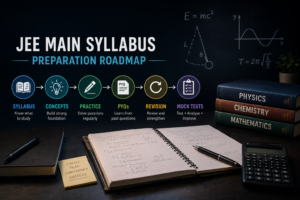
JEE Main preparation
→ understand the concept
→ know formulas and relationships
→ apply concepts quickly
→ solve objective questions
→ practise PYQs
→ work under time pressure
So don’t think:
“I finished the chapter in school, so the JEE chapter is finished.”
Instead ask:
“Can I solve JEE Main-level questions from this chapter?”
How to Turn the JEE Main Syllabus Into a Study Plan
This is where the syllabus becomes genuinely useful.
Don’t just download the PDF.
Create a tracker like this:
| Chapter | Learned | Questions | PYQs | Revised | Test |
| Kinematics | ☐ | ☐ | ☐ | ☐ | ☐ |
| Laws of Motion | ☐ | ☐ | ☐ | ☐ | ☐ |
| Thermodynamics | ☐ | ☐ | ☐ | ☐ | ☐ |
| Chemical Bonding | ☐ | ☐ | ☐ | ☐ | ☐ |
| Quadratic Equations | ☐ | ☐ | ☐ | ☐ | ☐ |
You can create the same checklist for every chapter.
The important part is to define “completed” properly.
A chapter should not be marked complete just because you watched a lecture.
A better definition is:
Concept learned + questions practised + PYQs attempted + revision completed
How Class 11 Students Should Use the JEE Main Syllabus
If you’re in Class 11, don’t try to finish the entire syllabus as quickly as possible.
Your priority should be:
- Understand the concepts
Don’t build your preparation on memorisation alone.
- Keep up with school
Avoid creating a massive backlog.
- Practise consistently
Even a smaller daily practice session is better than irregular bursts.
- Revise Class 11 topics
Your Class 11 chapters will remain important as you move into Class 12.
- Track weak chapters
Don’t wait until Class 12 to discover that several fundamentals are weak.
How Class 12 Students Should Use the JEE Main Syllabus
Class 12 students should divide the syllabus into three categories:
Category A — Strong
You can solve questions comfortably.
Category B — Needs Practice
You understand the concept but make mistakes.
Category C — Weak
You struggle with concepts or cannot solve basic questions.
Then divide your available time accordingly.
Don’t spend 80% of your study time revising chapters you already know simply because they feel comfortable.
Should You Study Every JEE Main Chapter Equally?
Not necessarily.
Your first priority should be complete syllabus coverage.
After that, use:
- Previous-year questions
- Mock-test performance
- Mistake analysis
- Your current strengths and weaknesses
to decide where additional time is needed.
Be careful with online lists claiming:
“These are the only 20 chapters you need for JEE Main.”
Such lists can be useful for prioritisation, but they should not replace the official syllabus.
A topic with historically lower frequency can still appear in your paper.
How to Use Previous-Year Questions With the Syllabus
This is one of the most effective ways to turn the syllabus into an actionable plan.
Take one chapter.
For example:
Chapter → Electrostatics
Then:
- Learn the concepts.
- Solve basic questions.
- Solve JEE Main-level questions.
- Attempt relevant PYQs.
- Record mistakes.
- Revise.
- Test yourself.
Repeat the same process chapter by chapter.
This creates a direct connection between:
Syllabus → Preparation → PYQs → Testing
Our next JEE Main content cluster will go deeper into this preparation process.
JEE Main Syllabus Checklist
Before moving to full-length mock tests, ask yourself:
Physics
- Have I covered the complete syllabus?
- Can I solve numerical questions?
- Have I practised PYQs?
- Have I revised formulas?
- Do I know my weak chapters?
Chemistry
- Have I covered Physical Chemistry?
- Have I revised Inorganic Chemistry regularly?
- Have I understood Organic Chemistry concepts?
- Have I solved PYQs?
- Have I maintained short revision notes?
Mathematics
- Have I covered Algebra?
- Have I covered Calculus?
- Have I covered Coordinate Geometry?
- Have I practised Vector and 3D questions?
- Have I solved mixed-topic tests?
Common Mistakes Students Make With the JEE Main Syllabus
Mistake 1: Downloading the syllabus and never using it
The syllabus should be a working document.
Mistake 2: Following an old syllabus
Always check the latest official version.
Mistake 3: Studying only “high-weightage” topics
Weightage analysis is useful, but it shouldn’t become an excuse to ignore the rest of the syllabus.
Mistake 4: Marking a chapter complete too early
Watching a lecture is not the same as mastering a chapter.
Mistake 5: Ignoring revision
A completed chapter can become a forgotten chapter.
Mistake 6: Not connecting syllabus with PYQs
The syllabus tells you what to study; PYQs show you how it is tested.
Frequently Asked Questions
Is the JEE Main 2027 syllabus released?
No. As of August 21, 2026, NTA has not published a JEE Main 2027 syllabus. The latest official syllabus available is for JEE Main 2026.
Where can I find the official JEE Main syllabus?
The official syllabus is available through the JEE Main website’s Information/Syllabus section.
Check the official JEE Main syllabus page
What subjects are included in JEE Main Paper 1?
Paper 1 for B.E./B.Tech covers Physics, Chemistry and Mathematics.
Is the JEE Main syllabus based on Class 11 and Class 12?
The syllabus has substantial overlap with the concepts studied in Classes 11 and 12, but JEE Main preparation requires objective-question practice and application of those concepts under exam conditions.
Can the JEE Main syllabus change?
Yes. Students should check the official syllabus released for the relevant examination year instead of assuming that previous-year topics will remain unchanged.
Should I start JEE Main 2027 preparation before the official syllabus is released?
Yes, if you’re preparing for the exam. Use the latest official syllabus available as your working reference and check the 2027 syllabus when NTA publishes it.
Should I study every chapter in the syllabus?
You should aim for broad syllabus coverage. After that, use PYQs and mock-test analysis to decide where additional revision and practice are needed.
Is NCERT enough for the JEE Main syllabus?
NCERT is particularly important for building school-level fundamentals, and it is highly useful for Chemistry. However, JEE Main preparation also requires objective-question practice, previous-year questions and timed tests.
Final Takeaway
The JEE Main syllabus is not something you should look at once and forget.
Use it as your preparation map.
Start with:
Official syllabus → Chapter → Concept → Questions → PYQs → Revision → Test
And remember one important point for JEE Main 2027:
Don’t trust a “2027 syllabus” simply because a website has put 2027 in its title.
As of August 21, 2026, the official JEE Main website still lists the 2026 syllabus as the latest available version. Once NTA releases the 2027 syllabus, this page should be updated and any changes should be clearly identified.
If you’re starting your JEE Main preparation now, you don’t need to wait for the 2027 PDF to begin studying.
You need a clear syllabus, a realistic plan and consistent practice.