
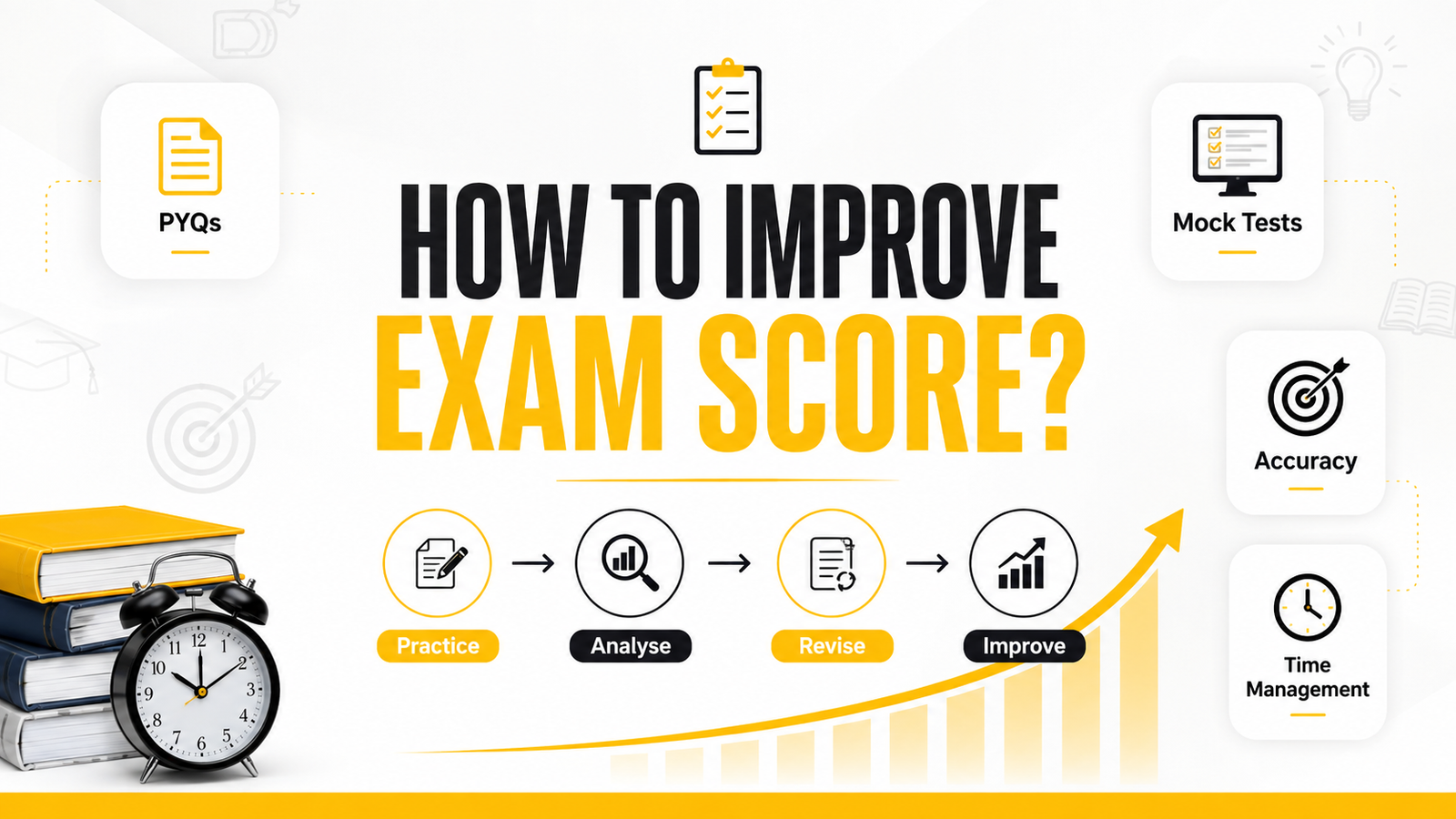
How to Improve Exam Score: Preparing for a competitive exam can sometimes feel like you are putting in a lot of effort but your score is not improving at the same speed.
You study for hours.
You watch lectures.
You make notes.
You solve questions.
And then you take a mock test and see almost the same score again.
This is where many students start thinking:
“Maybe I am not good enough.”
But a stagnant score does not always mean you lack ability. In many cases, it simply means your preparation needs a better strategy.
If you want to know how to improve exam score, the answer is not always “study more.”
You need to study the right things, practise effectively, analyse your mistakes, revise regularly and learn how to perform under exam conditions.
Whether you are preparing for JEE, CUET, SSC, Banking, Railway, Defence or another competitive examination, the basic principles of score improvement remain surprisingly similar.
In this guide, we will discuss practical and realistic ways to improve your score in competitive exams without relying on endless study hours or constantly changing your resources.
Why Is Your Exam Score Not Improving?
Before trying to increase your score, you need to understand why it is stuck.
Two students can score the same marks for completely different reasons.
One student may have weak concepts.
Another may know everything but make careless mistakes.
Someone else may lose marks because of poor time management.
Common reasons for a stagnant score include:
- Incomplete syllabus
- Weak conceptual understanding
- Insufficient question practice
- Ignoring Previous Year Question Papers
- Not revising regularly
- Taking too few mock tests
- Taking too many tests without analysis
- Poor time management
- Careless mistakes
- Guessing without strategy
- Repeating the same mistakes
- Constantly changing study resources
So before asking, “How many hours should I study?”, ask:
“Where exactly am I losing marks?”
That question can completely change your preparation strategy.
1. Analyse Your Current Score Before Changing Your Strategy
Your score is data.
Use it.
Instead of looking at only your total marks, analyse every test you take.
Divide your questions into four categories:
Correct and Confident
These are your strong areas.
Correct but Guesswork
You got the answer right, but your conceptual understanding may not be reliable.
Incorrect
Find out why you made the mistake.
Not Attempted
Was it because you didn’t know the concept, ran out of time or couldn’t decide whether to attempt it?
This simple analysis can tell you much more than your total score.
For example, suppose you scored 110.
You may initially think:
“I need to study more.”
But after analysing the paper, you discover:
- 15 marks lost due to silly mistakes
- 10 marks lost due to time management
- 15 marks from weak topics
- Remaining questions were attempted correctly
Your problem is not necessarily lack of knowledge.
Your biggest opportunity may be accuracy and exam strategy.
2. Focus on High-Impact Topics First
One of the biggest mistakes students make is treating every topic equally.
Your syllabus may be huge, but not every topic deserves exactly the same amount of preparation time.
Analyse:
- Previous year questions
- Official syllabus
- Topic-wise weightage where reliable
- Your strengths
- Your weaknesses
- Frequently tested concepts
This is where PYQ practice becomes extremely valuable.
When you solve Previous Year Question Papers, you start recognising which concepts are repeatedly tested and how questions are framed.
Your goal should not be to skip the syllabus randomly.
Instead, prioritise intelligently.
A practical priority system:
High Priority: Frequently tested + important + weak
Medium Priority: Important but relatively strong
Low Priority: Less frequently tested or low-return areas, depending on the exam
This helps you spend your limited preparation time more effectively.
3. Make PYQs a Regular Part of Your Preparation
If you are preparing for a competitive examination and not solving PYQs, you are missing one of the most useful preparation resources.
PYQs show you what the actual examination has asked in the past.
They help you understand:
- Question patterns
- Difficulty level
- Frequently tested concepts
- Common traps
- Question framing
- Topic importance
Don’t just solve PYQs once and forget them.
Use them strategically.
The Three-Step PYQ Method
Step 1: Understand
Look at the question and understand the concept behind it.
Step 2: Solve
Attempt it independently.
Step 3: Analyse
If you get it wrong, identify why.
The objective isn’t to remember the answer.
The objective is to understand the thinking required to solve the question.
4. Use Mock Tests to Measure Your Preparation
A good Online Mock Test can tell you how well you can perform under exam conditions.
But don’t make the mistake of taking mock tests only to see your score.
A mock test is a diagnostic tool.
It can reveal:
- Speed problems
- Accuracy issues
- Weak subjects
- Weak chapters
- Poor question selection
- Time management problems
- Exam anxiety
- Repeated mistakes
As your exam gets closer, gradually increase your exposure to full-length tests.
However, remember:
Taking a mock test is only half the work. Analysing it is the other half.
5. Learn How to Analyse Your Mock Test
This is one of the most powerful ways to improve exam score.
After every Practice Test, spend time reviewing the paper.
For every incorrect question, ask:
Did I not know the concept?
If yes, revise the concept.
Did I know the concept but make a calculation error?
Practise carefully.
Did I misread the question?
Work on reading accuracy.
Did I spend too much time?
Improve question selection.
Did I guess?
Understand whether guessing was actually worth the risk.
Maintain an error log where you record repeated mistakes.
Over time, you may notice something interesting:
The same mistakes often appear again and again.
Eliminating those repeated mistakes can increase your score without requiring hundreds of additional study hours.
6. Improve Accuracy Before Chasing Speed
Students often say:
“I need to solve questions faster.”
But speed without accuracy can hurt your score.
Suppose you attempt 90 questions but make 20 avoidable mistakes.
Another student attempts 75 questions with excellent accuracy.
Depending on the examination and marking scheme, the second student may score higher.
Therefore, work on:
Accuracy → Consistency → Speed
First learn to solve correctly.
Then practise solving correctly within a reasonable time.
Finally, work on increasing your speed.
7. Create a Realistic Study Timetable
A timetable is useful only if you can actually follow it.
Don’t create a schedule that says:
5:00 AM — Wake up
5:15–7:30 AM — Study
7:30–8:00 AM — Revision
8:00–10:00 AM — Practice
…and continues like this for 14 hours.
If you cannot maintain it after three days, it is not a good timetable.
Instead, create a realistic competitive exam study timetable based on:
- Your school/college schedule
- Available study hours
- Exam date
- Current preparation level
- Subjects
- Energy levels
Your timetable should include four things:
Concept Learning + Practice + Revision + Testing
Don’t allow your entire day to become lecture watching.
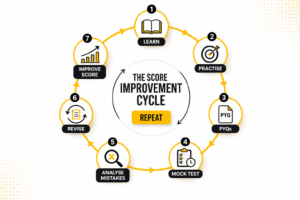
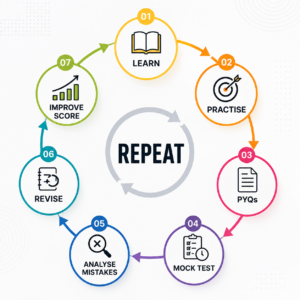
8. Follow the Learn-Practise-Test-Revise Cycle
A simple preparation cycle can make your study much more effective.
Learn
Understand the concept.
↓
Practise
Solve questions based on it.
↓
Test
Take a topic or sectional test.
↓
Analyse
Identify mistakes.
↓
Revise
Revisit the weak concept.
↓
Repeat
Test yourself again.
This is far more effective than repeatedly reading the same chapter without checking whether you can actually solve questions.
9. Stop Studying Only What You Like
This is a very common problem.
Students naturally prefer subjects or topics they are comfortable with.
If you are good at one subject, you may spend three hours practising it because it feels productive.
Meanwhile, the topic you struggle with keeps getting ignored.
That’s not always the best strategy.
If one weak area is consistently costing you marks, you need to address it.
You don’t have to become perfect overnight.
Start with:
Weak Topic → Basic Questions → PYQs → Test → Analysis → Revision
Gradually, the weak topic can become manageable.
10. Use Active Revision Instead of Passive Reading
Reading a chapter again and again can feel productive.
But can you recall the information without looking at the book?
That’s the real test.
Use active revision techniques such as:
- Flashcards
- Formula sheets
- Self-questioning
- Short quizzes
- Practice questions
- Blurting
- Error logs
- Previous year questions
For theory-heavy subjects, close your book and try explaining the concept in your own words.
If you cannot explain it, you probably need another round of revision.
11. Follow a Smart Revision Strategy
Revision should not be something you do only in the final week.
Use multiple revision cycles.
For example:
First Revision
Within a few days of learning the topic.
Second Revision
After a couple of weeks.
Third Revision
Closer to the examination.
The exact interval can vary according to the subject and your retention.
During revision, focus more on:
- Difficult concepts
- Important formulas
- Mistakes
- PYQs
- Short notes
- Frequently tested topics
You don’t need to reread every page with the same intensity.
12. Improve Your Time Management
You can know the answer and still lose marks if you don’t manage your time.
Use Mock Tests to develop an examination strategy.
Practise identifying:
- Easy questions
- Moderate questions
- Time-consuming questions
- Questions worth skipping temporarily
Don’t let one difficult question consume a disproportionate amount of your exam time.
A useful mindset is:
You don’t have to solve every question. You have to maximise your score.
This distinction is extremely important.
13. Learn When to Skip a Question
Competitive exams reward smart decision-making.
If you are stuck on a question and have already spent too much time, moving on can sometimes be the better decision.
You can return later if time permits.
Develop the habit of asking:
Can I solve this quickly?
If yes, solve it.
Will this take too long?
Mark it and move on when appropriate.
Am I guessing without enough information?
Be careful, especially where negative marking exists.
This skill develops through timed Practice Tests and mock exams.
14. Reduce Silly Mistakes
Silly mistakes are frustrating because you often know the concept.
Maybe you:
- Read the question incorrectly
- Marked the wrong option
- Missed a negative sign
- Made a calculation error
- Forgot a unit
- Answered too quickly
If this happens repeatedly, don’t simply call yourself careless.
Find the pattern.
For example:
If you repeatedly make calculation mistakes, slow down slightly during calculation-heavy questions.
If you misread questions, deliberately underline important words.
If you make mistakes because you rush near the end, improve your time allocation.
Small changes can recover marks that you are already capable of earning.
15. Don’t Keep Changing Your Study Resources
Every few weeks, students discover a new teacher, new book, new course or new study app.
They switch.
Then another resource appears.
They switch again.
Eventually, they have five incomplete books and several unfinished courses.
Resource collection is not preparation.
Choose reliable resources and complete them properly.
For most students, a good preparation system needs:
- One primary learning source
- Relevant practice material
- Previous Year Question Papers
- Online Mock Tests
- Revision notes
- Error log
Keep the system simple.
16. Use the 70-20-10 Framework
A practical way to organise preparation is:
70% — Practice
Questions, PYQs, tests and application.
20% — Revision
Concepts, formulas, notes and mistakes.
10% — New Learning
New concepts or topics.
This is not a fixed scientific formula that every aspirant must follow.
Your ratio should change depending on your preparation stage.
If you are starting from zero, you may need more learning time.
If your syllabus is almost complete, practice and testing should take a larger share.
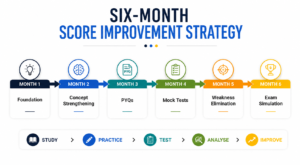
17. Build a Six-Month Score Improvement Strategy
If you have around six months before your exam, divide your preparation into phases.
Month 1 — Foundation
Focus on:
- Syllabus
- Concepts
- Basic practice
- Study routine
Month 2 — Concept Strengthening
Focus on:
- Important chapters
- Topic-wise questions
- PYQs
- Revision
Month 3 — PYQ Focus
Focus on:
- Previous year papers
- Topic patterns
- Timed practice
- Weak areas
Month 4 — Testing
Increase:
- Sectional tests
- Online Mock Tests
- Time management practice
Month 5 — Weakness Elimination
Focus on:
- Error analysis
- Weak topics
- Accuracy
- Full-length tests
Month 6 — Exam Simulation
Focus on:
- Revision
- PYQs
- Mock tests
- Error log
- Exam strategy
This approach gives every stage of preparation a clear purpose.
How to Improve Your Score in Different Exams
The exact strategy will vary depending on your examination.
JEE Main
For JEE Main Preparation, focus heavily on:
- Concept clarity
- Problem solving
- NCERT where relevant
- PYQs
- Numerical practice
- Mock tests
Your score improvement will depend not only on how much you know but also on how accurately and quickly you can apply concepts.
CUET
For CUET Preparation, focus on:
- Official syllabus
- Subject-wise preparation
- Practice questions
- PYQs where available/relevant
- Speed
- Accuracy
- Mock tests
Understanding the examination pattern is important before creating your study plan.
Government Exams
For Government Exam Preparation, the strategy can include:
- Quantitative Aptitude
- Reasoning
- English
- General Awareness
- Current Affairs where applicable
- PYQs
- Sectional tests
- Full-length mock tests
For government examinations, speed and accuracy can play a particularly important role.
You can also use Government Exam Preparation resources and Online Mock Tests to structure your practice.
What If Your Score Is Stuck?
This is one of the most important questions.
Suppose your scores look like this:
Mock 1: 108
Mock 2: 110
Mock 3: 109
Mock 4: 111
Don’t immediately increase your study hours.
First, analyse the pattern.
Ask:
- Are the same chapters causing mistakes?
- Is accuracy poor?
- Am I leaving easy questions?
- Am I spending too long on difficult questions?
- Are my scores low because of one subject?
- Have I revised enough?
- Am I analysing my mocks?
A stagnant score is feedback.
Use it to change your strategy.
Sometimes the breakthrough comes not from studying more, but from identifying the exact reason your marks are being lost.
How Many Mock Tests Should You Take?
There is no magic number.
Your mock-test frequency depends on:
- Exam date
- Preparation level
- Syllabus completion
- Available time
- Test duration
- Ability to analyse the paper
The most important rule is:
Never take more mock tests than you can properly analyse.
One carefully analysed test can teach you more than several tests that you simply complete and forget.
How Aaopadhein Can Help With Your Preparation
A good strategy needs consistent execution.
If you’re looking for Online Mock Tests, Practice Tests, Previous Year Question Papers and Free Study Resources, you can explore the resources available on Aaopadhein.org.
If you are still confused about which examination, course or career direction is right for you, Career Counselling, Student Guidance and Higher Education Guidance can help you make a more informed decision.
The goal isn’t simply to study longer.
It is to understand what you’re preparing for, practise strategically, test yourself regularly and improve based on your performance.
Quick Score Improvement Checklist
Before your next test, ask yourself:
Preparation
- Have I completed the important topics?
- Have I solved relevant PYQs?
- Have I revised regularly?
Practice
- Am I solving questions every day?
- Am I practising under time limits?
- Am I working on weak areas?
Testing
- Am I taking regular mock tests?
- Am I analysing my mistakes?
- Do I maintain an error log?
Exam Strategy
- Do I know which questions to attempt first?
- Am I managing my time properly?
- Is my accuracy improving?
- Am I avoiding unnecessary guessing?
If you can answer “yes” to most of these questions, you’re moving in the right direction.
Final Thoughts: Improve the Strategy, Not Just the Study Hours
Improving your exam score is rarely about one magical trick.
It’s the result of many small improvements working together.
Better concepts.
Better practice.
Better revision.
Better accuracy.
Better time management.
Better mock-test analysis.
And most importantly, consistency.
If your score is not improving today, don’t assume that it never will.
Find out where you’re losing marks.
Fix one problem.
Take another test.
Analyse it again.
Then improve the next weak area.
Remember:
You don’t need to become a completely different student to improve your score. You need to become a more strategic version of the student you already are.
So don’t spend the next six months only counting study hours.
Measure your progress through:
Questions solved.
PYQs analysed.
Mistakes reduced.
Mock scores improved.
Accuracy increased.
Time saved.
That is what real progress looks like.
And when the exam finally arrives, your confidence won’t come from hoping that you prepared enough.
It will come from knowing that you tested yourself, found your weaknesses and worked on them consistently.
Study smart. Practise consistently. Analyse honestly. Improve continuously.
That’s how you turn preparation into a better score.