Completing Class 12 is an important milestone, but for many students, it is also the point where a much bigger question begins:
“What should I do after Class 12?”
There are hundreds of courses, colleges, universities and entrance exams available after school. Students can choose from traditional degree programmes such as BA, BSc and BCom, professional courses such as BTech, MBBS, BBA and BCA, or specialised programmes in areas such as law, design, hotel management, journalism and computer science.
The challenge isn’t simply finding a college.
The real challenge is choosing the right course, understanding the admission process and applying to the right colleges at the right time.
Some programmes offer admission based on Class 12 marks, while others require students to appear for entrance examinations. In some cases, students may have to register for a national-level entrance test as well as complete a separate college or university application.
This guide explains college admission after Class 12, including popular courses, entrance exams, eligibility, application steps, important documents, merit-based admission, entrance-based admission and common mistakes students should avoid.
Important: Admission rules, eligibility criteria, entrance exams, application dates and selection processes can change from one admission cycle to another. Students should always verify the latest requirements on the official website of the college, university or examination authority before applying.
College Admission After Class 12: Quick Overview
| Admission Route | How Admission Usually Works | Common Examples |
|---|---|---|
| Merit-based admission | Selection based mainly on Class 12 marks | BA, BCom, BSc and other programmes |
| Entrance-based admission | Students appear for an entrance exam | Engineering, medicine, law, management and other courses |
| National entrance exam | A common examination is used by multiple institutions | CUET UG, JEE Main, NEET UG, CLAT |
| University entrance exam | Individual university conducts its own test | University-specific programmes |
| Counselling-based admission | Candidates participate in counselling after qualifying | Engineering, medical and other professional courses |
| Direct/institution-level admission | Admission according to the institution’s own rules | Selected colleges and universities |
The exact process depends on the course and institution.
That is why students should decide their course and shortlist colleges before assuming that one admission process will apply to everything.
What Can You Do After Class 12?
The first decision isn’t necessarily about a college.
It is about your career direction.
Depending on your Class 12 stream, interests and eligibility, you can explore many different options.
Popular undergraduate options include:
- BA
- BCom
- BSc
- BBA
- BCA
- BTech/BE
- MBBS
- BDS
- BPharm
- LLB integrated programmes
- BJMC
- Bachelor of Design
- Hotel Management
- Bachelor of Social Work
- Agriculture programmes
- Biotechnology
- Economics
- Psychology
- Nursing
- Architecture
There is no single “best course after Class 12.”
A course that is excellent for one student may be completely unsuitable for another.
Instead of asking:
“Which course is best?”
ask:
“Which course fits my interests, strengths, eligibility and career goals?”
College Admission After Class 12 Based on Your Stream
Your Class 12 stream can influence the courses you are eligible for.
However, it does not always determine your entire career.
If You Studied Science
Students from the Science stream can explore:
- Engineering
- Medicine
- Dentistry
- Pharmacy
- Biotechnology
- Computer Applications
- Computer Science
- Pure Sciences
- Architecture
- Data-related programmes
- Agriculture
- Nursing
- Economics and other interdisciplinary courses
Students should carefully check subject requirements before applying because different programmes can have different eligibility criteria.
If You Studied Commerce
Commerce students can explore:
- BCom
- BCom Honours
- BBA
- Economics
- Finance
- Accounting
- Banking and financial studies
- Business analytics
- Management
- CA-related pathways
- Company Secretary-related pathways
- Law
- Economics and other related programmes
Mathematics can be an eligibility requirement for certain programmes, so students should check the specific college criteria rather than assuming all Commerce students have the same options.
If You Studied Arts/Humanities
Humanities students have a wide range of options, including:
- BA
- Psychology
- Political Science
- History
- Sociology
- Economics
- English
- Journalism and Mass Communication
- Law
- Social Work
- Public Policy
- Languages
- Design
- Hotel Management
- Management
- Liberal Arts
The important thing is not to limit yourself simply because you studied a particular stream.
What Are the Main Types of College Admission After Class 12?
There are three broad admission routes students commonly encounter.
1. Merit-Based Admission
In merit-based admission, the college primarily considers your academic performance in Class 12 or another qualifying examination.
The college may publish:
- Merit lists
- Cut-offs
- Selection lists
- Waiting lists
Students who meet the required criteria can then complete the admission process.
However, the exact system varies between institutions.
2. Entrance Exam-Based Admission
Some programmes require students to qualify for an entrance examination.
The exam may be conducted nationally, by a university, or by an institution.
Examples include entrance examinations associated with:
- Engineering
- Medicine
- Law
- Management
- Architecture
- Design
- University undergraduate admissions
In these cases, your Class 12 marks may still matter because you generally need to satisfy the basic eligibility requirements.
3. Merit + Entrance + Other Selection Criteria
Some colleges combine multiple factors.
For example, the selection process may consider:
Entrance score + Class 12 performance + interview/other criteria
The exact combination depends on the institution.
Therefore, never assume that scoring well in an entrance examination automatically guarantees admission.
Major Entrance Exams After Class 12
The entrance examination you need depends heavily on the course you want to pursue.
Here are some of the major categories students should know about.
CUET UG
The Common University Entrance Test – Undergraduate (CUET UG) is an important route for undergraduate admissions at participating universities.
It is particularly relevant for students considering programmes in areas such as:
- Humanities
- Commerce
- Science
- Management
- Social Sciences
- Languages
- Other undergraduate disciplines
However, participating universities and individual programmes can have their own eligibility requirements and subject combinations.
So students should check the programme-specific requirements before selecting their CUET subjects.
visit official website : https://cuet.nta.nic.in/
A useful approach:
Don’t choose CUET subjects randomly.
First shortlist your desired programmes.
Then check:
What subjects does each programme require?
This can prevent problems later.
JEE Main
Students interested in engineering commonly consider JEE Main.
It is an important entrance examination for undergraduate engineering admissions and can also be relevant to admission processes at participating institutions.
Students planning engineering should understand:
- Eligibility
- Subject requirements
- Examination pattern
- Application dates
- Attempt rules
- Counselling process
- College-specific requirements
Don’t choose engineering simply because you studied PCM.
Think about the branch and career path as well.
Read Blog : JEE Main preparation
NEET UG
Students interested in medical education generally need to understand the NEET UG admission route and the applicable counselling process.
Depending on the programme and institution, medical-related admissions can involve:
- Entrance examination
- Rank
- Eligibility
- Counselling
- Choice filling
- Seat allocation
- Document verification
Students should follow official authorities for the latest rules because medical admission procedures can change.
CLAT
Students interested in law can explore the Common Law Admission Test (CLAT) for participating National Law Universities and relevant programmes.
CLAT is particularly important for students targeting undergraduate law programmes through the participating institutions.
Students should research:
- Eligibility
- Exam pattern
- Participating universities
- Registration process
- Counselling
- Seat allocation
If law is your goal, don’t wait until after Class 12 results to start researching the admission process.
Other Entrance Exams
Depending on your preferred course, you may also encounter entrance exams for:
- Design
- Architecture
- Hotel management
- Fine arts
- Journalism
- Management
- Agriculture
- Pharmacy
- Computer applications
- University-specific programmes
The safest strategy is to start with the course, not the exam.
How to Apply for College After Class 12
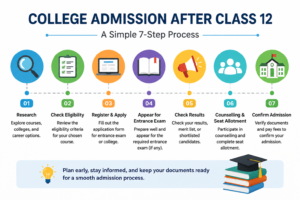
The admission process can seem complicated, but you can break it into simple steps.
Step 1: Decide Your Preferred Course
Before filling out forms, identify what you want to study.
For example:
BCom → Finance/Accounting career
or
BTech → Technology/Engineering career
or
BA Psychology → Psychology-related higher education/career
You don’t need to have your entire career planned at 17 or 18.
But you should have enough clarity to shortlist suitable courses.
Step 2: Make a College Shortlist
Don’t apply blindly.
Create three groups:
Dream Colleges
Highly competitive colleges where admission may be difficult.
Target Colleges
Institutions where your profile and entrance performance give you a realistic chance.
Backup Colleges
Good alternatives that provide another route if your first choices don’t work out.
This is much better than applying to 30 random colleges.
Step 3: Check Eligibility
Before paying an application fee, check:
- Required Class 12 subjects
- Minimum marks
- Age requirements, if applicable
- Entrance examination requirement
- Category-specific criteria
- Final-year/result requirements
- Programme-specific conditions
A common mistake is checking only the overall percentage.
A programme may also require a particular subject combination.
Step 4: Check Whether an Entrance Exam Is Required
Ask:
Does this college admit students through Class 12 marks, an entrance exam, or both?
For example, one university may use a common entrance examination while another may have its own test.
This distinction is extremely important.
Step 5: Register for the Entrance Exam
If an entrance examination is required, register through its official website.
Keep:
- Application number
- Login credentials
- Payment receipt
- Confirmation page
- Important dates
in a safe place.
Don’t depend on memory.
Step 6: Complete the College Application
This is one of the most important things students often misunderstand.
Entrance exam registration and college application may be separate processes.
Just because you have registered for an entrance examination does not necessarily mean that you have applied to every college accepting that examination.
Always check the admission instructions of the individual institution.
Step 7: Upload Documents
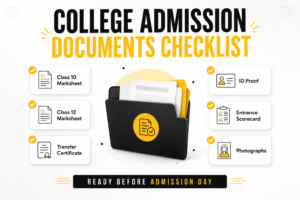
You may need documents such as:
- Class 10 certificate/marksheet
- Class 12 marksheet or result
- Passport-size photograph
- Signature
- Identity document, where required
- Category certificate, if applicable
- PwD certificate, if applicable
- Migration/transfer certificate, where applicable
- Other programme-specific documents
Requirements vary.
Check the exact document list before submission.
Step 8: Pay the Application Fee
Review the application carefully before making payment.
Check:
- Name spelling
- Date of birth
- Category
- Subject selection
- Course
- College preferences
- Photograph
- Contact details
After payment, save the receipt.
Step 9: Track the Admission Process
After submitting your application, don’t forget about it.
Track:
- Admit card
- Entrance exam
- Answer key
- Result
- Merit list
- Counselling
- Choice filling
- Seat allocation
- Admission deadline
Missing one deadline can affect your admission opportunity.
Documents Required for College Admission After Class 12
Although requirements vary, students should keep a digital folder containing commonly requested documents.
Academic documents
- Class 10 marksheet
- Class 12 marksheet
- Passing certificate
- Transfer certificate, if required
- Migration certificate, if required
Identification documents
- Government-issued identity document
- Passport-size photographs
- Signature
Category-related documents
Where applicable:
- Caste/category certificate
- EWS certificate
- PwD certificate
- Other applicable certificates
Other documents
Some colleges may request:
- Domicile certificate
- Gap-year affidavit
- Medical certificate
- Anti-ragging undertaking
- Income certificate
- Character certificate
Don’t create documents unnecessarily.
Check the official admission instructions first.
How to Choose the Right College After Class 12
Choosing a college only because it is famous can be a mistake.
Consider at least these factors.
1. Course Curriculum
Look at what you will actually study.
A college name matters, but the programme itself matters too.
2. Faculty
Check the faculty profile, teaching approach and academic environment.
3. Fees
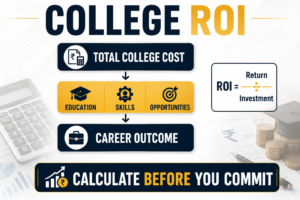
Calculate the total cost, not just tuition.
Consider:
- Tuition
- Hostel
- Food
- Transportation
- Books
- Other institutional charges
4. Placements
If the programme offers campus placements, research:
- Median salary
- Average salary
- Placement percentage
- Recruiters
- Batch size
- Internship opportunities
Don’t make your decision based only on the highest package advertised.
5. Location
Think about:
- Cost of living
- Distance from home
- Safety
- Transportation
- Internship opportunities
- Industry exposure
6. Student Life
College is not only about examinations.
Consider:
- Clubs
- Societies
- Sports
- Competitions
- Events
- Student communities
- Research opportunities
These can contribute significantly to your overall development.
College Admission After Class 12: What If Your Marks Are Low?
A lower Class 12 percentage does not mean your education journey is over.
You may still have multiple options depending on your eligibility and preferred course.
You can explore:
- Colleges with different cut-offs
- Entrance-based programmes
- Universities with alternative admission routes
- Skill-oriented degree programmes
- Professional certifications alongside graduation
- Different specialisations
But don’t choose a college simply because admission is easy.
A low admission barrier should never be the only reason you choose an institution.
What If You Don’t Get Your First-Choice College?
Don’t panic.
Admission doesn’t end with the first merit list.
Depending on the institution, you may encounter:
- Second merit list
- Third merit list
- Waiting list
- Spot admission
- Counselling rounds
- Upgradation
- Vacant-seat rounds
Keep monitoring official admission notices.
At the same time, keep your backup options active.
Common Mistakes Students Make After Class 12
Mistake 1: Choosing a Course Because Friends Are Choosing It
Your friend’s interests and strengths may be completely different from yours.
Choose based on your own goals.
Mistake 2: Looking Only at College Rankings
Rankings can provide context, but they shouldn’t be your only criterion.
Compare:
course + fees + placements + faculty + location + career outcomes.
Mistake 3: Missing Application Deadlines
This is completely avoidable.
Create a simple admission calendar.
| Task | Deadline | Status |
|---|---|---|
| Entrance exam registration | — | ☐ |
| College application | — | ☐ |
| Admit card | — | ☐ |
| Entrance exam | — | ☐ |
| Result | — | ☐ |
| Counselling | — | ☐ |
| Admission fee | — | ☐ |
Mistake 4: Filling Forms Without Checking Eligibility
Always read the official eligibility criteria first.
Mistake 5: Applying Only to One College
Even excellent students should have a sensible backup plan.
Mistake 6: Trusting Unofficial Information
You may find outdated admission dates and eligibility information on social media, random websites or old videos.
For important admission decisions, verify information through the official examination authority or college website.
College Admission After Class 12: A Smart Strategy
Here’s a simple approach students can follow.
Phase 1: Self-Assessment
Ask yourself:
- What subjects do I enjoy?
- What am I good at?
- Do I prefer theory or practical learning?
- Do I want a professional course?
- Do I want to pursue higher studies?
- What careers interest me?
Phase 2: Course Research
Shortlist 3–5 courses.
Don’t limit yourself to one option too early.
Phase 3: College Research
For every course, identify 5–10 colleges.
Compare:
- Eligibility
- Admission route
- Fees
- Location
- Placements
- Curriculum
Phase 4: Entrance Exam Planning
Identify which exams are necessary.
Then create a preparation schedule.
Phase 5: Application Tracking
Maintain a spreadsheet or notebook containing:
Exam → College → Course → Deadline → Fee → Status
This simple system can prevent many mistakes.
Should You Choose College First or Course First?
Ideally:
Career interest → Course → College → Entrance exam → Application
not:
Popular college → Random course → Admission
The college you attend matters, but the degree and skills you build there will also influence your future.
For example, if you want a career in technology, choosing a college simply because it is famous but selecting a programme unrelated to your interests may not be the best decision.
College Admission After Class 12: Frequently Asked Questions
Can I get admission to college after Class 12 without an entrance exam?
Yes, some programmes and institutions offer merit-based admission based on Class 12 performance. However, many professional and competitive programmes require entrance examinations.
Which entrance exam should I take after Class 12?
There is no single entrance exam for all courses. Your exam depends on your target programme and college. Examples include CUET UG, JEE Main, NEET UG and CLAT for different admission pathways.
Can I apply to multiple colleges after Class 12?
Yes, students can generally apply to multiple colleges, subject to each institution’s application rules and fees.
Can I change my course after Class 12?
Yes, depending on the admission rules and eligibility requirements of the new programme. However, changing courses after admission may have academic and financial implications.
What documents should I keep ready for college admission?
Common documents include Class 10 and Class 12 records, photographs, identification documents and applicable category or other certificates. The exact list varies by institution.
What if I am waiting for my Class 12 result?
Some institutions allow students appearing in or awaiting their qualifying examination results to apply, subject to their rules. Always check the programme’s eligibility criteria.
Is Class 12 percentage important for college admission?
It depends on the course and institution. Some programmes use Class 12 marks directly for merit-based selection, while others primarily use entrance examination scores after checking minimum eligibility.
Should I take an entrance exam even if my Class 12 marks are good?
If your target college or programme requires an entrance examination, then yes. Good Class 12 marks do not replace a mandatory entrance test.
How many colleges should I apply to?
There is no fixed number. A balanced shortlist can include ambitious, realistic and backup options rather than applying randomly to a very large number of colleges.
Final Checklist for College Admission After Class 12
Before submitting any application, check:
- ☐ Course selected
- ☐ College shortlisted
- ☐ Eligibility checked
- ☐ Required subjects checked
- ☐ Entrance exam requirement confirmed
- ☐ Application deadline noted
- ☐ Documents prepared
- ☐ Photograph and signature prepared
- ☐ Application details reviewed
- ☐ Application fee paid
- ☐ Confirmation page saved
- ☐ Admit card date noted
- ☐ Result date tracked
- ☐ Counselling dates tracked
- ☐ Backup colleges shortlisted
Final Thoughts
College admission after Class 12 is not about finding the college with the biggest name. It is about finding the right combination of course, institution, affordability and future opportunities.
You may have several choices, and that’s a good thing.
Take time to understand what you actually want to study. Then research the eligibility requirements, entrance examinations, admission dates and colleges offering that programme.
Most importantly, don’t compare your journey with your classmates.
One student may choose engineering. Another may choose law. Someone else may pursue commerce, psychology, design or a completely different field.
There is no single correct path after Class 12.
What matters is making an informed decision instead of a rushed one.
A good admission strategy is simple:
Know yourself → choose the course → research colleges → check eligibility → understand entrance exams → apply on time → compare your options → make the final decision carefully.
Your Class 12 result is an important milestone, but it is not the final definition of your career.
The choices you make after Class 12 are the beginning of your next chapter—so make them with research, patience and a clear understanding of your goals.